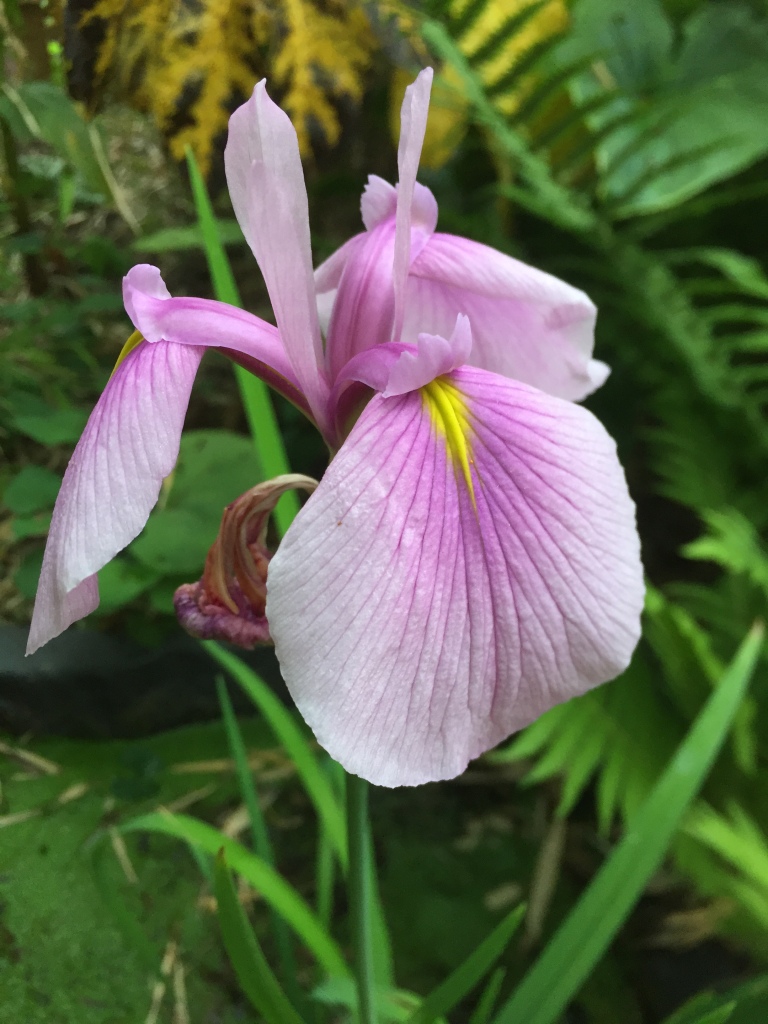
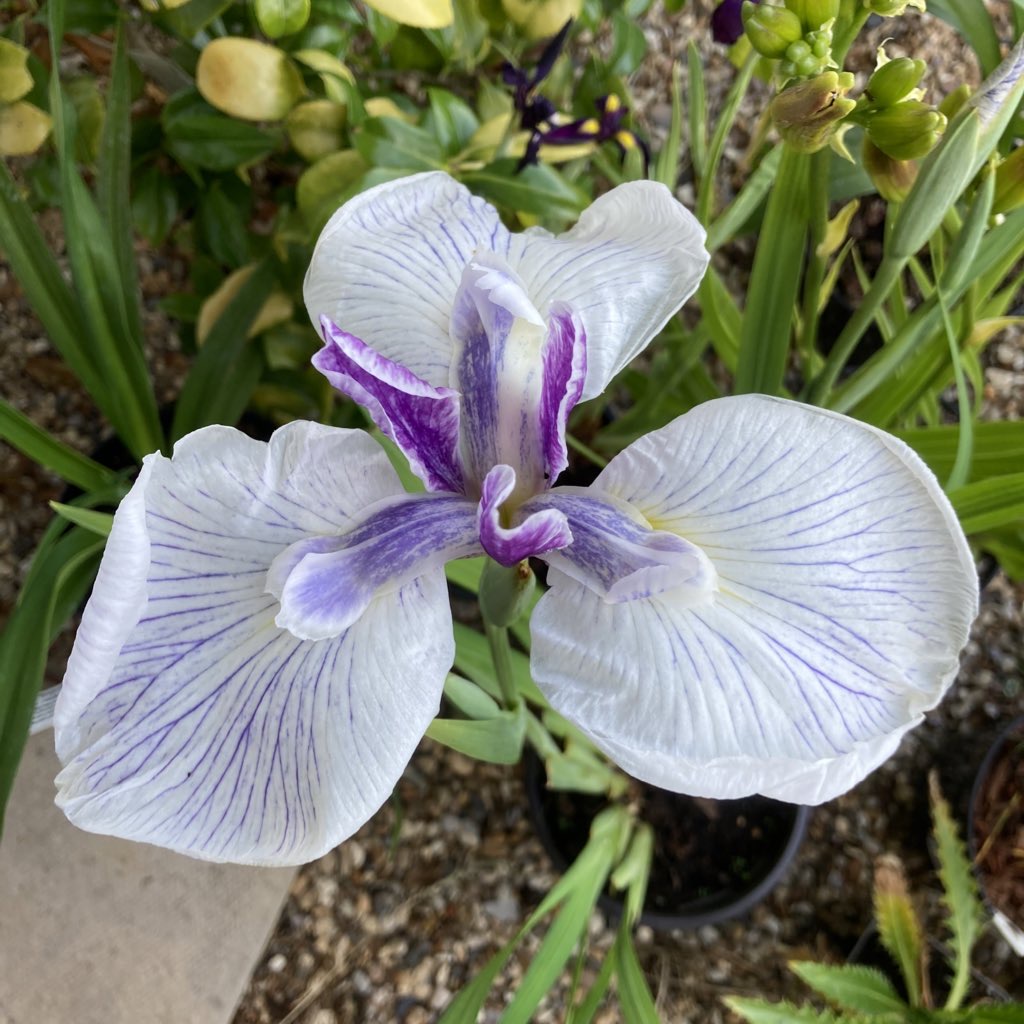
Iris ensata (syn. Iris kaempferi) is one of the archetypal plants of the Japanese garden. They are rhizomatous, beardless irises, native to East Asia. They have fans of strap shaped leaves and flowering stems 2-4ft tall. They flower in early summer, with two or three large, exotic-looking flowers on a stem, in shades of purple, blue, white, and pink.
They are extremely hardy, down to -20ºC, zone 4 in the US. They will grow in full sun to partial shade, as long as they get at least 6 hours of sun, and like a loose, slightly acidic damp soil with plenty of organic matter. It is especially important in the spring, in the run up to their early summer flowering, that they have plentiful moisture.
Iris ensata ‘Moonlight Waves’
They are sometimes sold as marginal plants, and are happy to be grown in shallow water, as long as the crown of the plant is not covered, during spring and summer. However, they need to be lifted out of the water over winter or they are likely to rot. The old foliage should be cut back to the ground in the winter, after it has been knocked back by the first frost.
Iris ensata ‘Rose Queen’
Iris ensata are heavy feeders and will benefit from a generous feed of a balanced fertiliser for acid-loving plants in the early spring and again after flowering, and a good mulch to help retain moisture. It’s good to add plenty of organic matter to the soil when they are planted or divided, but don’t add fertiliser at this point. Bone meal should be avoided as it is actively harmful to Japanese irises.
Iris ensata ‘Grayswood Catrina’
It’s very important to divide and transplant Japanese Irises every three to four years to maintain vigour. New roots form above the old each year, so over time the crown of the plant rises above the soil, potentially causing it to fail. To divide, dig up the plant and divide it into individual sections or fans, or slightly larger sections of 2-4 fans each. The oldest roots and rhizomes – the lowest – should be removed, and the foliage cut back to about 1/3 of its length. The divisions should be planted 2-3 inches deep. in fresh soil where Iris ensata has not been grown for the previous three years, and kept well watered. It is best to divide Japanese Irises in spring or autumn, avoiding the heat of mid-summer, though in cooler areas they can be divided immediately after flowering.
Iris ensata ‘Oku Banri’
Iris ensata have been cultivated in Japan for at least five hundred years, and possibly much longer. Extensive Iris breeding began in the late Edo period, around the 1800s. Japanese Irises were introduced to the West by Carl Thunberg in 1794, and again by von Siebold in the 1850s (as Iris kaempferi). Many varieties have been bred in the United States as well. Some 2000 varieties are now available.
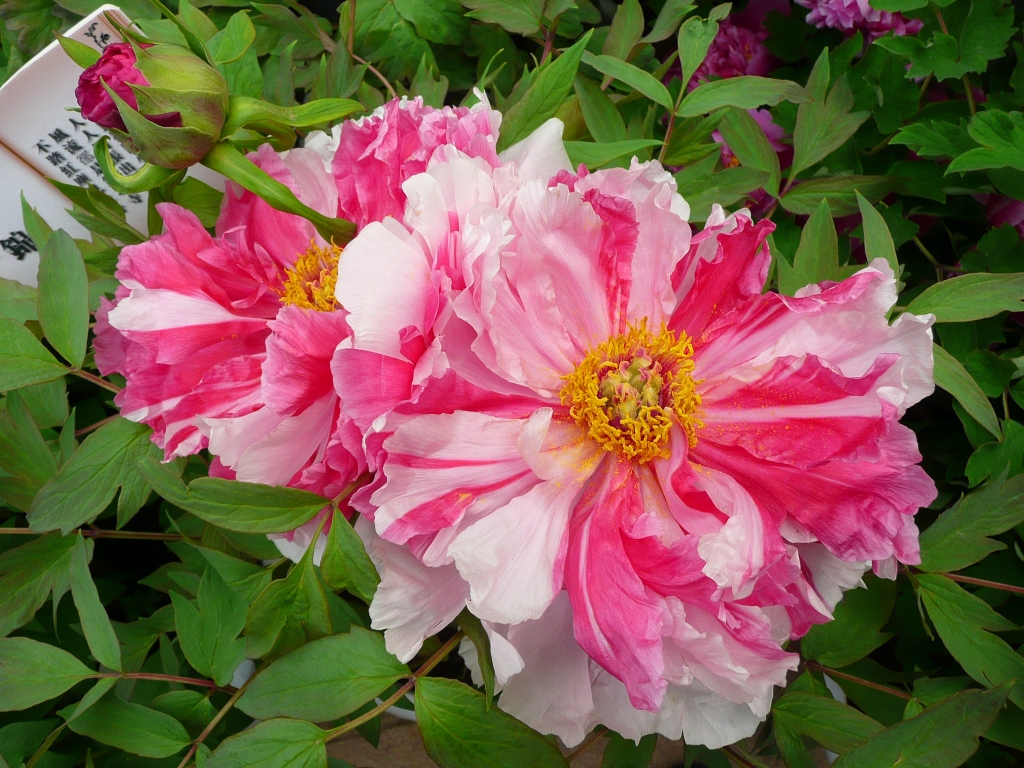
A symbol of wealth and honour, peonies are known as the King of Flowers and have been cultivated in China for millennia. Like many traditional plants of the Chinese garden, they were originally cultivated for medicinal purposes and are mentioned in the Shennong Bencao Jing, an ancient materia medica written circa 200-250 AD, recording oral traditions dating back much further. Some records indicate they were cultivated as far back as the Xia (the possibly mythical first dynasty, 2000-1766 BC).
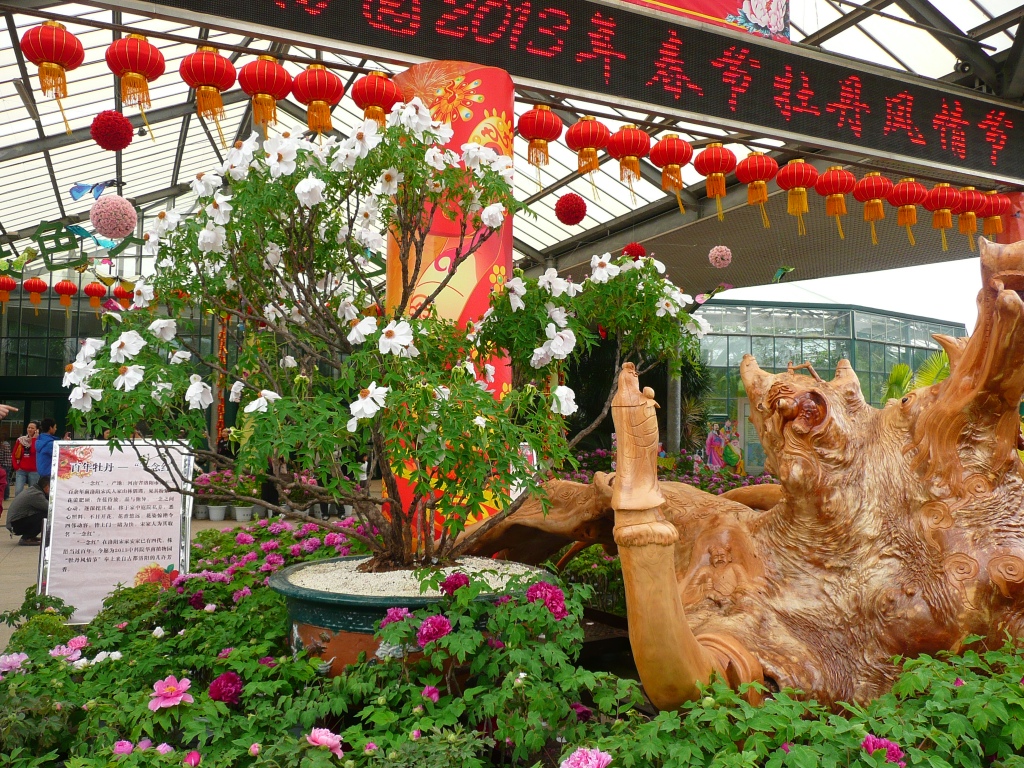
New Year peony festival at the South China Botanical Garden, Guangzhou
Before the Qin dynasty (221-206 BC) not much distinction was made between herbaceous peonies, shaoyao, and tree peonies, mudan, which were simply called tree shaoyao. Paintings from around 400 AD depict peonies in the background, showing that they have been cultivated as ornamentals for at least 1600 years. By the Sui dynasty, 581-618 AD, individual varieties were being recorded, and twenty boxes of peonies were sent as tribute to the Emperor from Hubei. In the early Tang dynasty, peonies were an imperial flower, only permitted to be grown in imperial gardens. They soon spread, however, and were planted in temple and monastery gardens. In the 8th century they were introduced to Japan by a Buddhist monk.
Peonies, by Yun Shouping, 17th century
There is a legend that the Tang Empress Wu Zetian visited a garden in the winter. Nothing was in flower, so she ordered all the plants to bloom. The next day, despite the snow, all the plants had obeyed the Empress and flowered, except the peony. Enraged, she banished it from the capital to Luoyang, where it bloomed profusely. Subject to the vicissitudes of war and changing dynasties, Luoyang has been the capital of China’s peony industry ever since.
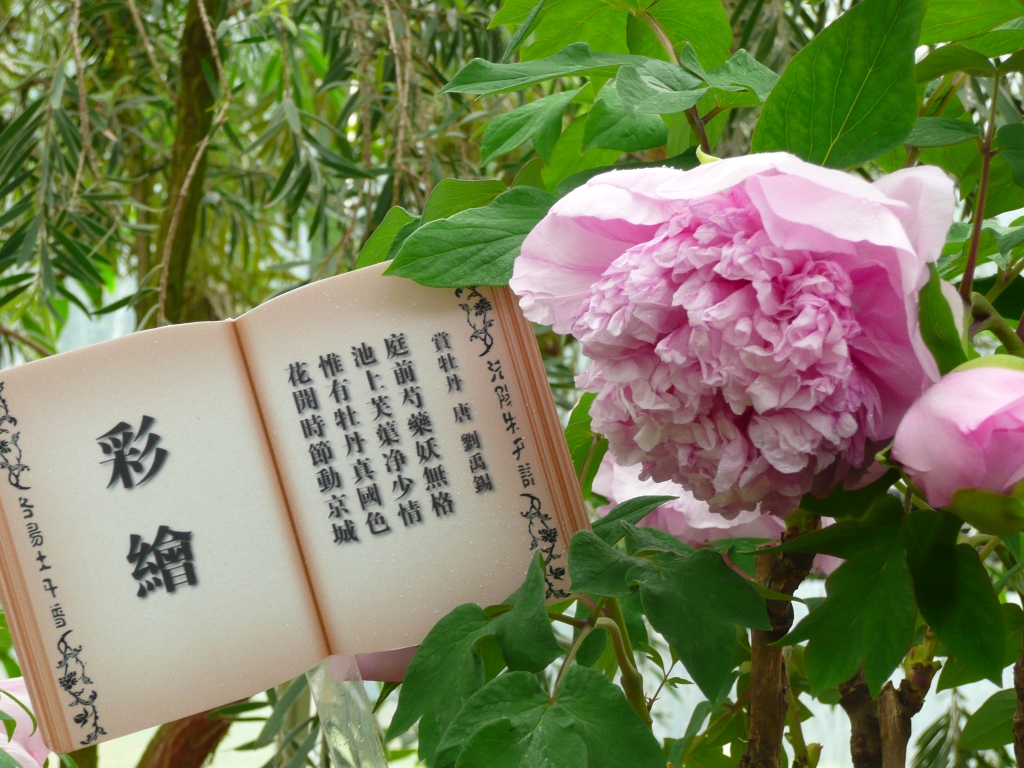
Paeonia x suffructicosa ‘Cai Hui’, Brightly Coloured Painting
The first monograph on peonies, written in 1034 AD, described 24 double and semi-double varieties. The large double ‘Thousand-Petalled’ varieties were the most popular, new varieties costing as much as a hundred bushels of rice. At least two of the varieties, Yao’s Yellow and Wei Purple, are still in cultivation. By the 1800s, a single plant could cost 1000 coins.
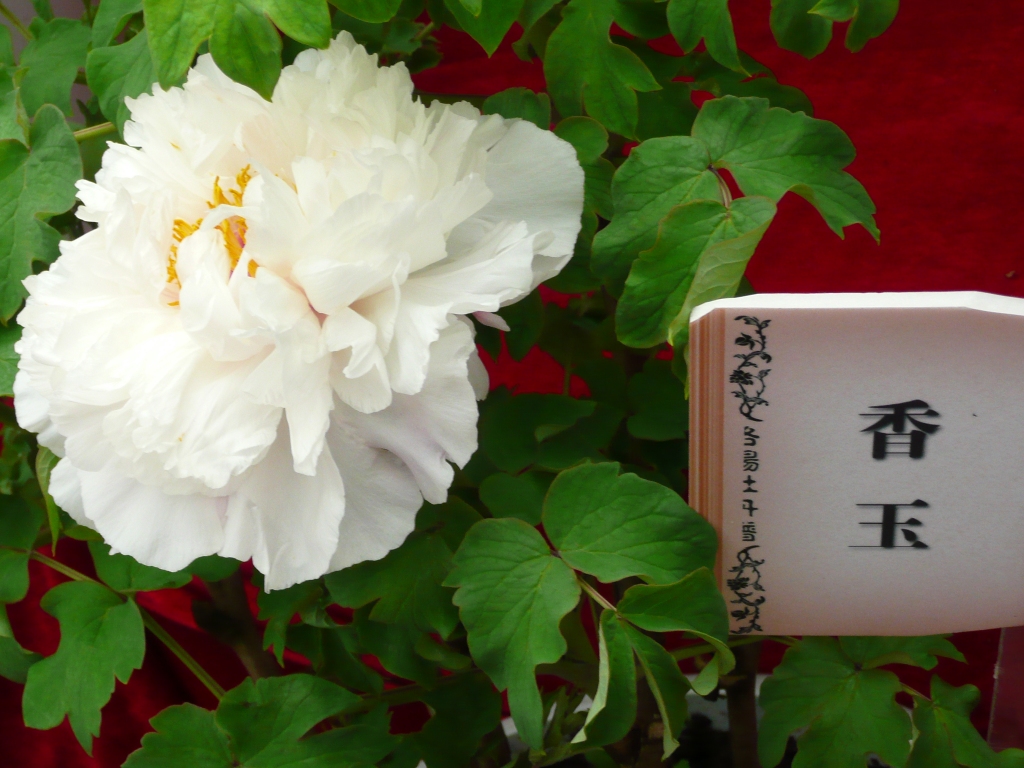
Paeonia x suffructicosa ‘Xiang Yu’, Fragrant Jade
In 1655, English visitors from the East India Company saw peonies in Beijing and sent accounts home. More than a hundred years later, in 1787, Joseph Banks asked the Company’s representative in China, Alexander Duncan, to send plants to Kew. The Kew plants have not survived but a plant from that first introduction was moved from Duncan’s own garden to the Edinburgh Botanical Gardens and can still be seen there.
Further introductions through the late 18th and early 19th century culminated in Robert Fortune’s third expedition, 1848-1851, when he obtained 30 of the best tree peonies available in Shanghai, as well as herbaceous peonies for grafting. The latter half of the 19th century saw hundreds of peony varieties offered for sale by nurseries across Europe. Kelways nursery in the U.K., famous for peonies, dates from this period.
The peony was the national flower of China until 1928, when the government of the Republic of China replaced it with the plum blossom instead, which was a symbol of resilience in hard times, and not as closely associated with China’s imperial past. The People’s Republic of China has no official national flower, though the peony consistently tops polls held to choose one, by a huge margin.
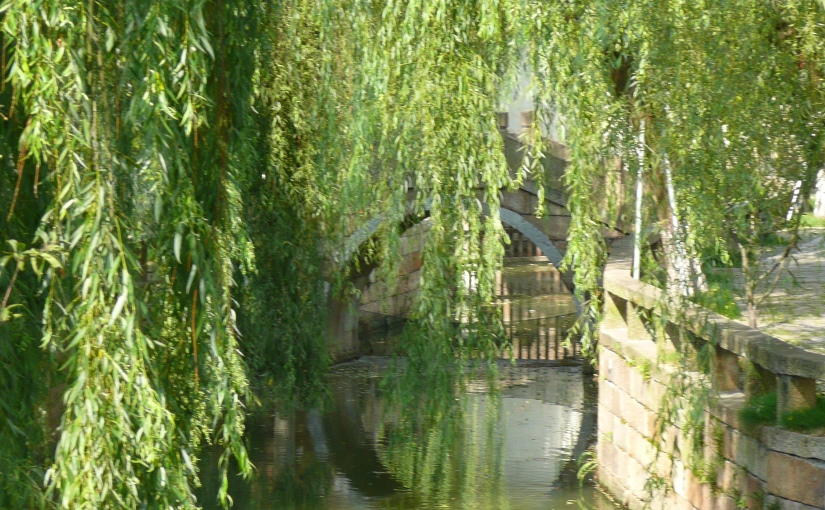
Willows are one of the plants most closely associated with Chinese gardens. In the West, they are inextricably linked with China through ‘Willow Pattern’ plates – though in fact the pattern originated in England, part of the 18th century craze for Chinoiserie.
Though the ‘Willow Pattern’ itself is inauthentic, willows are truly an essential plant in the Chinese garden.
The weeping willow, Salix babylonica, is native to northern China and probably made its way to Europe along the Silk Road. It was named by Linnaeus, and the specific epithet is due to the fact that, through a mistranslation, it was incorrectly believed to be the tree mentioned in the Bible as growing ‘by the rivers of Babylon’. Many of the weeping willows seen in the U.K. nowadays are hybrids between Salix babylonica and forms of our native willow, Salix alba, which are better suited to our climate.
Willows in Tongli water town, Jiangsu
In Chinese culture, willow has a number of symbolic meanings. It is associated with spring and rebirth. Its pliability suggests meekness and humility. It is associated with friendship, because of its intertwining branches, and also with parting from friends. Traditionally a willow branch was given as a parting gift, because its name in Chinese – 柳 liǔ – sounds like a word for ‘stay’. It was believed to have the power to repel evil spirits, and was used to sweep tombs on the Qingming festival. A branch might be fixed to the front door of a house to ward off harm.
Leifeng pagoda, West Lake, Hangzhou
Willow was also a symbol of female beauty, sometimes compared to the waist of a beautiful woman in poems. Its pliability also suggested frailty, however, and its combined associations with spring, the season of sexual desire, and femininity, meant it was also used as a symbol for prostitution. So the innocent sounding chengyu (Chinese idiom) 花街柳巷 Flower Street and Willow Lane actually means a red light district.
Willows by the pond in the Lingering garden, Suzhou
In the Chinese garden, willows are planted beside water. They are one of the few plants mentioned by name in Ji Chang’s The Craft of Gardens, where he always mentions planting them by water. The rectangular lattice work windows were known as willow leaf pattern.
It is sometimes said that a Chinese garden is built rather than planted. The essential physical elements are rocks, water, plants, and buildings. Ji Cheng, in the Ming classic The Craft of Gardens (1631) recommended starting a garden with water. In the Chinese garden, as in the landscape, water is yin, the opposite of mountains which are yang. The two opposites in balance embody the harmony of nature.
“For every ten parts of land, three should be made into a pond, of irregular shape so that it is interesting, and preferably made by dredging out an existing stream. Of the remaining seven-tenths, four should be built up with earth – how high or low is of no importance – and be planted with bamboo in a harmonious way.”
(Ji Cheng, The Craft of Gardens)
Artificial mountain with grotto beneath overlooking a pond. Pearl Pagoda Garden, Tongli
Rocks in the garden are often piled up to make an artificial mountain, with a path leading to a pavilion on top. The views from the top are carefully planned. There may be a grotto beneath. Both mountain and grotto echo the abodes of the Daoist Immortals.
‘Bamboo Shoot’ rocks in the Couple’s Retreat Garden, Suzhou
Individual rocks are admired for their aesthetic qualities, and have been for centuries. The most famous of these ‘Scholars’ Rocks’ are called Taihu rocks, limestone features formed by erosion deep in Lake Tai. From the Tang dynasty onwards it became fashionable to use these in gardens. The ‘Cloud Capped Peak’ in the first photo is a famous Taihu rock, said to be a relic from the collection of rocks ordered by Emperor Huizong (reigned 1100-1126 AD) of the Song dynasty.
Rocks may also represent imaginary landscapes, as in this penjing in the Lion Grove Garden, Suzhou:
Buildings are a vital part of the Chinese garden. A large part of The Craft of Gardens enumerates the many types of different structures that can be constructed, as well as discussing in detail elements such as walls, doorways, lattice windows, paving, and bridges.
Doorway in the Couple’s Retreat Garden, Suzhou. This is a visual pun – ‘ping’, the word for vase, sounds like the word for peace.
Many traditional Chinese houses are built around one or more courtyards. With the addition of various pavilions, halls, and of course a library (no scholar’s garden could be without one) the division between inside and outside is often not clearly marked, especially in the warm sub-tropical south of the country. Buildings in the garden are released from the formal Confucian regularity of the main house, and indeed symmetry is to be avoided.
“…buildings in gardens are different from ordinary dwelling-houses, for they must have order in variety and yet their orderliness should not be too rigid: even this orderliness should have a pleasing unpredictability, and yet at their most diverse there should be an underlying consistency.”
(Ji Cheng, The Craft of Gardens)
Building in the Lion Grove Garden, Suzhou
The last element in the Chinese garden is the plants. Although China – described by E.H. Wilson as ‘The Mother of Gardens’ – has huge botanical diversity, Chinese gardens use a fairly restrained palette of plants.
Lotus pond in the Humble Administrator’s Garden, Suzhou
They are mostly chosen for their symbolic value, with meanings acquired over many centuries. Many of these will be dealt with in more detail in later posts. Key Chinese garden plants include bamboo; pines; willows; chrysanthemums; orchids; peonies; plum (Prunus mume, more commonly known in the West as Japanese Apricot); lotus; wisteria; and peach.
Bamboo and rock, framed through a window and against a white wall to create a living painting in the Lingering Garden, Suzhou
A Westerner reading The Craft of Gardens may be surprised by how little mention is made of plants, with very few mentioned by name, and only one snippet of what we might consider gardening advice (on training roses).
Subtropical planting in the Qinghui Garden, Shunde, Guangdong. This southern garden in the Lingnan style boasts over 100 species of plants.
Ji Cheng considered the placing of garden buildings and features, perhaps especially rocks, as more difficult and requiring of a refined taste and a sensitivity to the nature of the site.
“The hidden significance of mountains and forests needs deep study, whereas the temperament of flowers and trees is easy to grasp.”
(Ji Cheng, The Craft of Gardens)
Indeed it is the atmosphere of a Chinese garden, its indefinable essence, that is the most important element of all. A Chinese garden is a microcosm of the world, and a retreat from it. Inspired by nature, it is a work of careful artifice. It is a search for immortality which at the same time reminds us of the passing of the seasons and the transience of life.
It is hard to appreciate all the beauty of the Chinese garden without some understanding of its history and place in an ancient horticultural tradition, its religious and philosophical roots, its inspiration in the Chinese landscape and its links to Chinese artistic culture, especially painting and poetry. These elements will be addressed in later posts.
One of the greatest plant-hunters of the early twentieth century, Ernest Henry ‘Chinese’ Wilson was born in 1876 and began his horticultural career as an apprentice at a local nursery before going on to study at Birmingham Botanical Gardens. In 1899 he was working at Kew when he was chosen to go on a plant-hunting expedition to China for Veitch’s nursery.
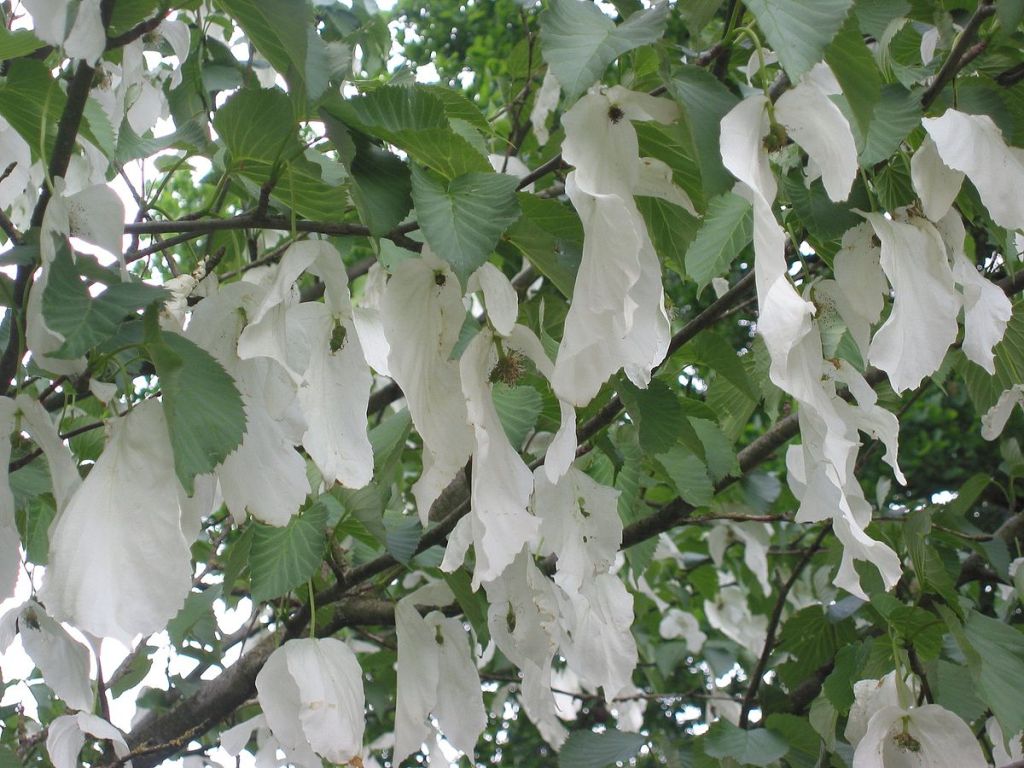
The aim of this first expedition was to find specimens of Davidia involucrata, the handkerchief tree, an almost legendary rarity discovered in 1866 by Pere David Armand. A lone tree in a single location had been seen twelve years previously by Augustine Henry. Harry Veitch, employing a number of plant-hunters at the time, advised Wilson to stick to the one thing he was searching for and not waste time and money wandering about as probably every worthwhile plant in China had already been introduced. Wilson was to prove him spectacularly wrong.
Davidia involucrata
Wilson’s first objective was to reach Henry, then stationed in a remote town in Yunnan. The journey, by river and mule, was arduous and dangerous, complicated by the unstable political situation, plague epidemics, and recent anti-foreign riots. Having met and consulted with Henry, Wilson set out armed with a sketch map marked with a cross representing the single tree Henry had found in the course of a six month trip. Wilson eventually reached the location of the previous sighting after a journey he described euphemistically as “exciting”, only to find that the tree had recently been felled to make way for a new house. Undaunted, he eventually managed to locate a grove of flowering trees in Hubei. In the same month, he made a discovery less celebrated but now probably better known – ‘Wilson’s Chinese Gooseberry’, now known as the kiwi fruit. Making his base at the town of Yichang on the Yangtze river, he spent the next two years exploring and collecting seeds. Despite the danger of plague and outbreaks of rebellion, he collected seed of 305 different species and 35 Wardian cases full of plant material, as well as dried herbarium specimens, representing over 900 species in total.
Wilson’s second trip to China in 1903 was in search of the yellow poppy Meconopsis integrifolia. He was able to hire many of the of the men who had worked with him on his previous expedition. In contrast to some other Western plant-hunters of the time, Wilson respected and got on well with the Chinese people he met and employed. Travelling from Sichuan into Tibet, he secured seed of both Meconopsis integrifolia and the red Meconopsis punicea. He suffered from altitude sickness and other illnesses, cured with “large doses of opium” and had lost almost three stone by the time he reached Songpan in Sichuan. He returned to England in 1905, with the seed of over 500 species and 2400 herbarium specimens, including Lilium regale, the species he was most proud of introducing in his remarkable career.
Wilson’s third expedition to China was undertaken on behalf of the Arnold Arboretum of Harvard University. Their interest was primarily in woody plants, but the expedition was partially funded by subscribers, for whom Wilson was to look for orchids and lilies amongst other things. The Arnold Arboretum also asked Wilson to photograph as much as he could. His photographs, taken on a plate camera, were quite remarkable for the time and are now in the Arboretum’s archive. Some can be seen here:
Surviving famine and a bad bout of malaria, Wilson shipped huge amounts of plant material to the United States in 1908, including thousands of lily bulbs. Unfortunately, almost all of the bulbs rotted in transit.
Lilium regale
It was to collect more lily bulbs in particular that Wilson was reluctantly persuaded to make one last expedition to China, with serious consequences. He always travelled with a sedan chair, though he rarely used it, as it was a kind of badge of respectability that allowed the traveller to pass freely. Wilson considered it better than a passport. For once he was being carried in the chair, on a narrow mountain road, when the expedition was hit by an avalanche. Wilson managed to get out of the chair just before it was carried over the edge, but was hit by falling rock and broke his leg in two places. Fortunately only one of the porters was injured and no one was killed. While the leg was being immobilised with splints improvised from the camera tripod, a mule train came up. Wilson could not be moved and the mule train could neither pass on the narrow track, nor wait in case of further rockfalls, so he lay across the road and the mules stepped over him. After that it was a three days’ forced march back to the nearest medical attention in Chengdu. Infection set in and he came close to losing his leg. After three months he was well enough for the journey back to the States, but the leg never healed properly and he walked with what he called his ‘lily limp’ for the rest of his life.
This was the end of his travels in China. Between 1911 and 1915, he collected specimens in Japan for the Arboretum, including 63 named flowering Cherry forms, and in 1917 he made an expedition to Korea and Taiwan. His wife and daughter joined him on these trips. Wilson named Rosa helenae and the bamboo Fargesia murielae after them.
Ironically, given the dangers and privations he had survived on his collecting trips, Wilson died in a car accident in the States in 1930, three years after becoming Keeper of the Arnold Arboretum.
In total, Wilson introduced about 2000 Asian plant species to the West. Sixty species of Chinese plants are named after him.
Some plants named after Wilson:
Chrysanthemum ‘E H Wilson’, Corydalis wilsonii, Cymbidium wilsonii, Ensete wilsonii, Exochorda giraldii var. wilsonii, Gentiana wilsonii, Hypericum wilsonii, Magnolia wilsonii, Meconopsis wilsonii, Phalaenopsis wilsonii,Picea wilsonii, Primula wilsonii, Styrax wilsonii, Trachelospermum jasminoides ‘Wilsonii’. Sinowilsonia is a monotypic genus which commemorates the nickname ‘Chinese’ Wilson.
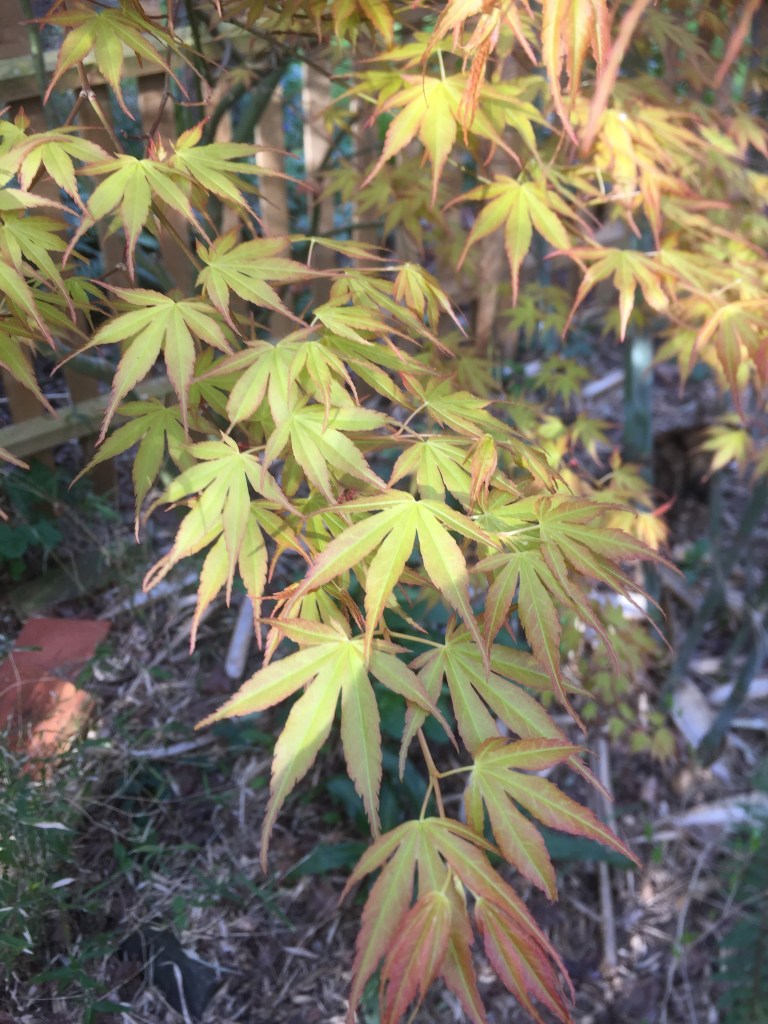
One of the classic plants of the Japanese garden is the maple, Acer palmatum. The common Japanese names for maples are ‘momiji’ derived from ‘leaves turning red’ or ‘kaede’ derived originally from ‘frogs’ hands’. Autumn trips to the mountains to see the beauties of the changing leaf colours are called ‘momiji-gari’, maple leaf hunting.
Spring foliage of Acer palmatum ‘Katsura’ (meaning ‘wig’)
There are thousands of cultivars, many with poetic and beautiful names. Here are some Japanese words used in the names of Japanese maple varieties.
Ao – blue-green
Ba – leaves
Beni – deep red
Fu – variegated
Gasa – umbrella
Hime – princess or little
Ito – fine thread
Kin – gold
Koto – a stringed instrument
Acer palmatum ‘Koto-no-ito’
Maiko – dancing girl
Murasaki – purple
Nishiki – brocade, by extension variegated or textured
In China, Japan, and parts of India, the rare phenomenon of bamboo flowering is considered a bad omen. In China, a proverb warning of ‘pestilence or famine’ presaged by bamboo flowers was reported in a letter to Kew from a British Medical Officer who noted that bamboo flowering in Hong Kong in 1894, 1896, and 1898 coincided with outbreaks of bubonic plague. It was during this epidemic that Alexandre Yersin discovered both the bacillus responsible for the plague and the fact that it was present in rats. Given that we now know that the abundance of food provided by bamboo seeds from mass flowerings creates booms in the rodent population, and that fleas on rats transmit plague, the proverb seems well-founded.
In 1958 the authorities in Mizoram in north eastern India were warned that the bamboo was flowering and famine would follow. They dismissed the reports as local superstition. The bamboo flowered, the rat population exploded and a ‘rat flood’ consumed every scrap of every crop in the area. The resultant famine was so bad it led to an armed uprising.
Wild bamboo flowering in Guangdong, 2013
In India this phenomenon is known as ‘Mautam’, bamboo famine. 90% of all the bamboo in the area is the same species, a tropical clump former with a relatively stable flowering cycle of about 48 years. It all flowers at once (gregarious flowering) and then dies. Not all species of bamboo are so predictable or, fortunately, so devastating in the effects of their reproduction.
In fact, there is a great deal we don’t understand about bamboo flowering, despite records of the phenomenon going back some 2000 years in China. What triggers it? How do plants of the same clone, growing in different locations, know to flower at the same time? Why are the flowering cycles so varied (between 1 and 120+ years)? Why do many bamboos die after flowering?
Sporadic flowering of Phyllostachys praecox ‘Viridisulcata’, 2020
Many factors have been proposed as possible triggers over the years, from external environmental factors to an internal clock. It is generally believed now that the flowering does follow an internal time table, modulated slightly by environment and cultivation. The exact mechanism is not yet understood. In the 1970s, the ecologist Daniel Janzen theorised that bamboos flowered in synchrony as a method of overwhelming seed-eating predators. So many seeds would be produced that they could not all be eaten and some would germinate and grow. Plants that fell out of sync would not have this protection, their seeds would be eaten, and their genes would not continue.
Complete flowering of Phyllostachys nigra ‘Megurochiku’, 2019
A group of biologists at Harvard extended this theory to explain how the long flowering cycles evolved. Supposing in a forest of bamboos which flowered every year, a few mutated to flower every two years. They would have longer to prepare and more stored energy to produce seed. Their seeds would have an advantage and their offspring would increase. More and more bamboos would flower every two years, and eventually those flowering every year would not produce enough seeds to survive predation. They would die out. Then suppose a few bamboos mutated to flower every three years. They also would not have the protection of flowering and producing seed in synchrony and would die out. What about mutations that flowered every four years? Again, they would have the advantage of more time to store energy but still flower in synchrony with plants on the two years cycle. So bamboos which flowered in multiples of the cycle would gradually predominate, and the cycle would get longer and longer over time.
Phyllostachys nigra ‘Megurochiku’ showing signs of recovery, 2020
What does all this mean for bamboos in the garden? First of all, bamboos flower at very long intervals, so the plants in your garden may never be affected. However, given the likelihood of them dying if they do flower, it is a good idea to plant a mix of different species if you are planting a bamboo hedge, to protect against expensive losses if you are unlucky.
Secondly, there’s nothing you can do to stop a bamboo flowering. The only thing to do is wait and see. It may only be sporadic flowering, which shouldn’t harm the plant. If it is complete flowering (anecdotally more common in clump-forming bamboos than runners) the plant is both more likely to die and more likely to set seed. You can water and feed it if you wish, and it may recover, but it will take a long time to do so if it does and will look awful in the meantime, so most people dig them out or at least cut them down. I have found seeds more likely to germinate in situ, if they escape the notice of hungry birds.
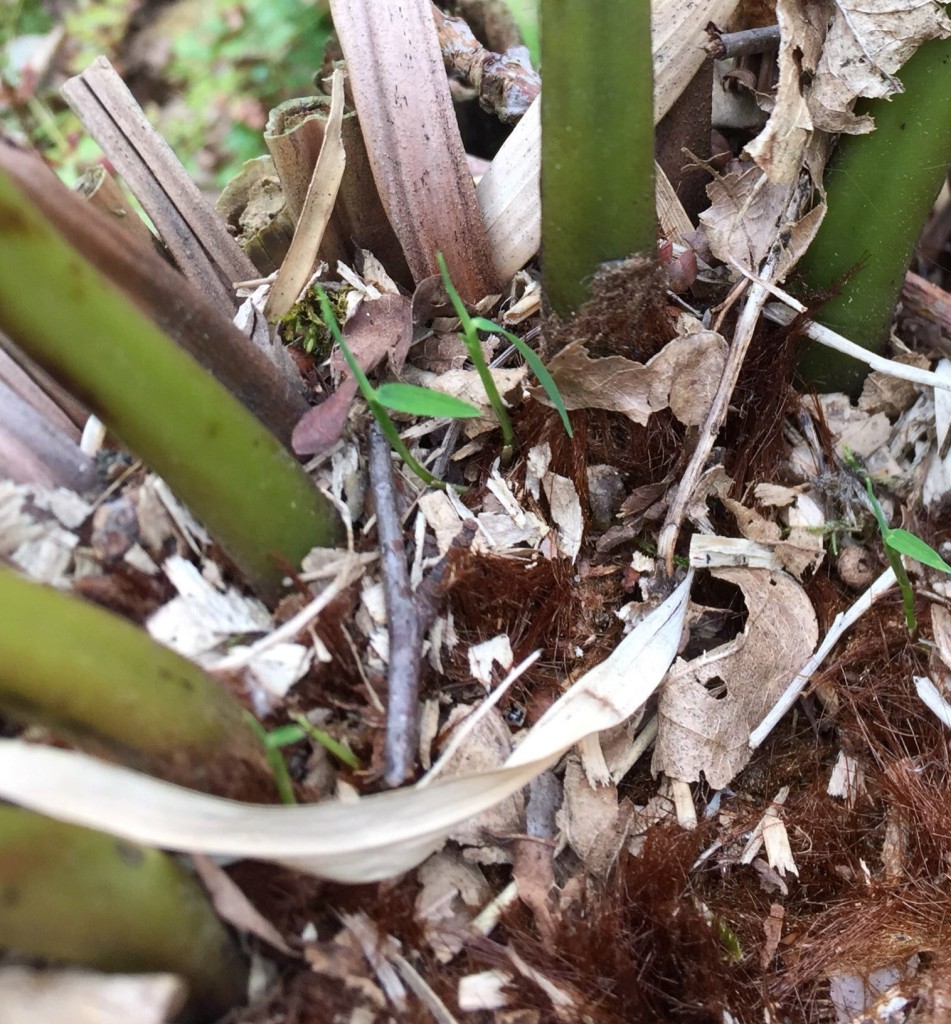
Fargesia nitida seedlings germinating in the crown of a tree fern, 2018
In 20 years of collecting bamboo, I have had three species flower completely out of a collection of more than a hundred: Fargesia nitida, Chusquea gigantea, and Phyllostachys nigra ‘Megurochiku’. The Fargesia, a clump former, produced viable seed and died. The Chusquea and the Phyllostachys, a giant clumper and a runner, next to one another in my garden, flowered at the same time last year. A forest of seedlings has appeared, but I have no way of knowing their parentage. The Phyllostachys is recovering. The Chusquea has as yet shown no signs of doing so, but I have not cut it down yet as I will not be opening my garden this year and can live with the eyesore if there’s any chance of regrowth. It is a favourite plant and I will be very sad to lose it. Fingers crossed, but as I have learnt over the years, you might be able to predict famine and plagues, but bamboos rarely do what you expect them to do.











 Japonica Plants Nursery