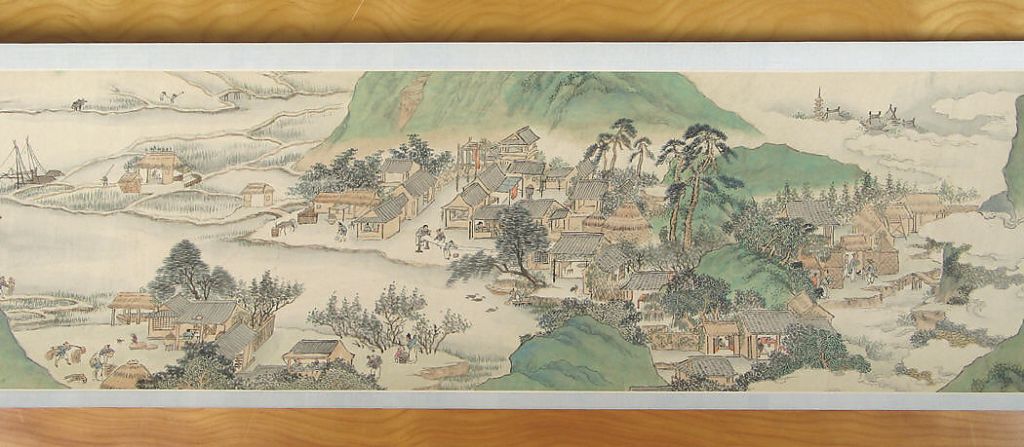
Genyue, the Garden that Brought Down a Dynasty

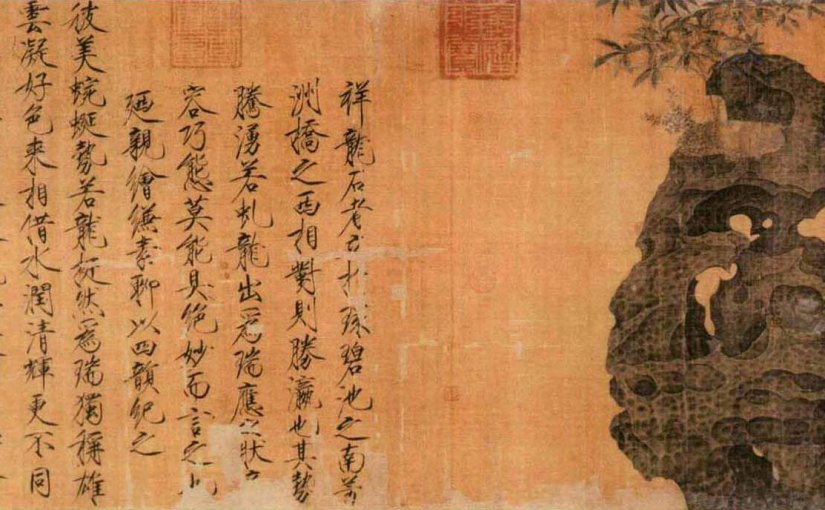
Auspicious Dragon Rock, painting and poem by Zhao Ji (the personal name of Emperor Huizong)

The Song dynasty was founded in 960AD following 60 years of turmoil after the fall of the Tang, China’s golden age. Like the Tang, it was a great era of garden building. It was a time of commercial prosperity, scientific and technological advancement, agricultural development and, as a consequence, population expansion. However, with powerful rivals to the north and west, contested borders, factionalism at court and the long shadow of the An Lushan Rebellion (which broke the power of the Tang) behind it, Song prosperity was tinged with hedonism and excess.

Portrait of Emperor Huizong, artist unknown

The eighth Emperor of the Northern Song was Huizong (1082-1135AD). He was a great painter – arguably one of China’s greatest – a calligrapher, a musician and poet. He wrote treatises on medicine and on tea. He was a patron of the arts, a fervent Daoist, an avid collector of paintings and antiques, and passionate about gardens. In particular, he loved rocks.

Five-coloured Parakeet on Blossoming Apricot Tree, attributed to Zhao Ji (the personal name of Emperor Huizong)

There were five Imperial parks in the Song capital Bianjing (now Kaifeng), four of which were situated at the gates on the four sides of the city. These parks were opened to courtiers and officials on set occasions, and one was opened to the general public for a short while each year. The fifth park, Genyue, the Northeast Marchmount, was for the private use of the Emperor and his guests. It was built beside the imperial residence on a site selected by a geomancer in the northeast of the city. He recommended that the earth be heaped up and artificial mountains constructed, to ensure the Emperor plenty of heirs. (The character ‘Gen’ 艮 of Genyue is from the I Ching and represents mountains, the northeast, and sons).

The construction of Genyue was, after long preparation, begun in 1118, but Huizong had been collecting plants, rocks, animals, and birds from much earlier in his reign. In 1105 a ‘Provision Bureau’ was set up in Suzhou. This was the base of the merchant Zhu Mian, who was especially talented at finding scarce and valuable Lake Tai stones, often in other people’s gardens. Some of these ended up in Zhu Mian’s own garden. To find materials for Genyue a ‘Flower and Rock Network’ was set up to transport huge quantities of rarities from all corners of the empire. The scale of this undertaking is hard to comprehend. Collectors sourced rare plants from as far as 900 miles to the south of the capital. The military were drafted in to help with transportation, and commoners were sent out to search in swamps and mountains for rare plants. A dedicated fleet of boats transported huge rocks along the Grand Canal to the capital, day and night, interrupting the normal transport of food and raw materials. In some places bridges were knocked down and irrigation systems destroyed to allow their passage. As well as the physical damage and disruption, the Flower and Rock Network spawned largescale corruption and waste, drained the imperial treasury, and was greatly resented by the common people.

The Cloud-Capped Peak, Lingering Garden, Suzhou, said to be one of a handful of ‘relic stones’ from those collected by Huizong. 6.5 metres tall, it weighs about 5 tons.

Completed in 1122, Genyue was a representation of the empire in miniature, a tradition dating back to earlier Emperors, most notably Qin Shi Huangdi himself. Depleting an empire to build a garden seems supremely frivolous now, but at the time such gardens had a ritual and religious aspect, giving the project a deeper meaning. As well as ensuring more sons, Huizong hoped to gain the favour of the Immortals for himself, his dynasty, and for Song China. Zhang Hao, an official writing soon after the events, during the Southern Song, recounted the story of the site’s geomantic significance:

…as predicted, there was a response [in the form] of numerous sons. From this time forward, there was regular security within the seas and lack of incident at the imperial court, and His Highness devoted quite a bit of attention to parks and preserves.

Record of the Northern Marchmount, Zhang Hao, translated by James M. Hargett p. 185 in The Dunbarton Oaks Anthology Of Chinese Garden Literature, A. Hardie and D.M. Campbell (Eds,)

The garden was not particularly large, when compared to other imperial parks. What was most remarkable about it was the size of the artificial mountain landscape,

…an artificial pile more than ten li in circumference, of ‘ten thousand layered peaks’, with ranges, cliffs, deep gullies, escarpments and chasms. In some places the structure rose two hundred and twenty-five feet above the surrounding countryside, and in others it fell away, through foothills of excavated earth and rubble, to ponds and streams and thickly planted orchards of plum and apricot.

The Chinese Garden, Maggie Keswick, p.53. ‘Li‘ is a historical measurement which has varied over time. In the Song dynasty, ten li was about 2.5 miles.

There were dozens of buildings dotted about this landscape, enumerated and named by the Emperor in his own account of the garden. There was an artificial cascade, operated by workers who rushed to open the sluice gate when the Emperor arrived. More prosaically, there was a farm with fields, orchards, and a herb garden. Besides entire transplanted forests of bamboo there were plants of all kinds. Huizong himself records some of the plants that were sent from around the empire.

…loquat (Eriobotrya japonica), orange (Citrus sinensis),
pomelo (Citrus grandis), sourpeel tangerine (Citrus deliciosa),
sweetpeel tangerine (Citrus reticulata), betel-nut palm (Areca catechu),
Chinese juniper (Juniperus chinensis), and lichee (Litchi chinensis)
trees, as well as gold moth (unidentified), jade bashfulness
(unidentified), tiger ear (Saxifraga stolonifera), phoenix tail
(Pteris multifida), jasmine (Jasminum grandiflorum), oleander
(Nerium oleander), Indian jasmine (Jasminum sambac), and magnolia
(Michelia figo) plants. Ignoring variations in geography and differences
in climate, all the trees and plants generated and grew…

Record of the Northern Marchmount, Emperor Huizong, translated by James M. Hargett ibid p.186

Above all, of course, there were rocks. Scholars’ rocks had become popular in gardens in the Tang dynasty, but Huizong took petromania to new extremes. Fantastically shaped rocks were arranged all over the garden. Names were bestowed upon them, and engraved, with the most important inscribed in gold.

Rock landscape in the Lion Grove Garden, Suzhou. Dating from the following Yuan dynasty, these contorted rocks are said to resemble lions and to this day are immensely popular.

Unfortunately, the use of the vast amounts of money and manpower expended on the garden weakened an empire surrounded by warlike rivals. Focusing on his garden and the arts, Huizong neglected economic policy and, most crucially, the military. In 1126 – just four years after Genyue was completed – the Jurchen, of the Jin empire to the north, laid siege to Bianjing. The garden was destroyed, its precious rocks flung from catapults, its trees cut for firewood, its rare animals killed and eaten by the army. Huizong was persuaded to abdicate in favour of his son. A temporary peace was cobbled together, but within a year, the Jurchen returned in greater force. They took Bianjing, sacked the city, destroyed or looted its treasures, and massacred many of the inhabitants. Huizong was taken north as a captive, given the mocking title Duke Hunde ‘Besotted Duke’. One of his sons, who avoided capture, withdrew south of the Yangtze and founded the Southern Song. Huizong died in Heilongjiang in 1135, a prisoner of the Jin dynasty to whom he had lost the heartlands of his country.
Poetry and the Chinese Garden

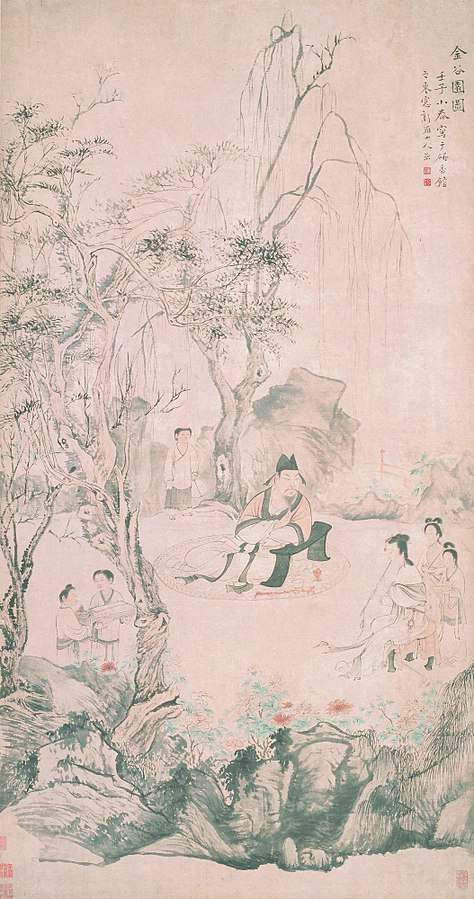
During the turbulent Six Dynasties period (220-589AD) after the fall of the Han, ministers and officials came and went as power at court changed hands. Having lost their positions, disappointed scholars retired to the country to live in seclusion and build gardens. This became a recurring theme in Chinese garden history. One of these, a wealthy aristocrat and former provincial governor called Shi Chong, built a garden northeast of the capital Luoyang in 296AD, called Jingu Yuan, the Garden of the Golden Valley. This was no simple rural retreat, however, but an extravagant and elaborate garden which inspired emulation through the centuries.

Hua Yan (1682–1756) Golden Valley Garden
金谷園圖

He invited thirty poets to a banquet at which they were required to compose a poem each – those who failed were ‘punished’ by being required to drink an immoderate quantity of wine. The resulting collection Poems from the Golden Valley began a long association between poems and gardens in Chinese culture, in which gardens became both a location for composing poetry and the subject thereof. In turn, gardens were inspired by poems and literary works.

Wen Zhengming (1470–1559) A Graceful Gathering at the Orchid Pavilion
兰亭修禊图

Another famous early example of this association was the Liubei Tang, the Garden of the Floating Cup. In 353AD, the poet, calligrapher, and general Wang Xizhi held a gathering of poets at a garden called the Orchid Pavilion, where King Guojian of Yue is supposed to have planted an orchid in the 5th century BC. Seating them beside a winding stream, he floated cups of wine. If a poem came to rest beside a guest, he had to drink the wine and compose a poem on the spot. This was much imitated and became a feature of many later gardens. The poems themselves are much less well regarded than Wang’s Preface to them. The pavilion and garden still exist, as well as a stele bearing what is said to be Wang Xizhi’s calligraphy.

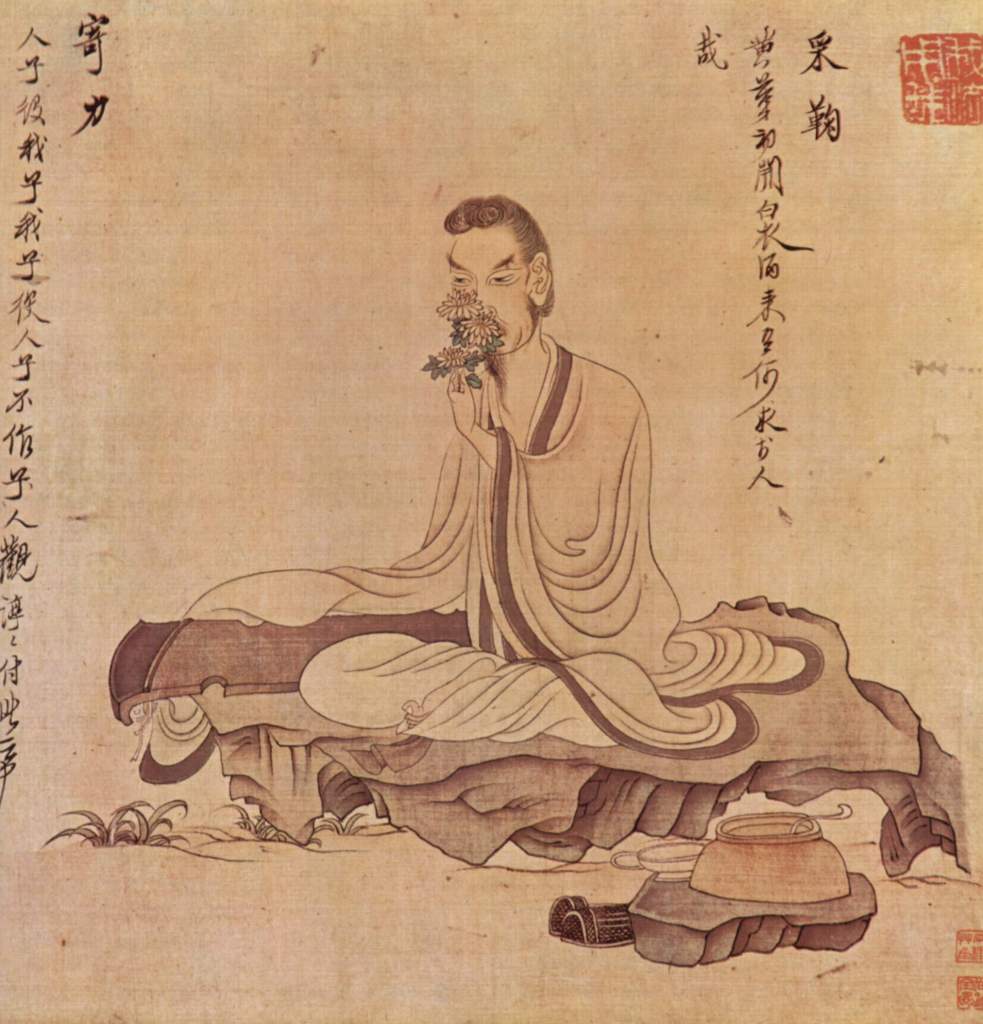
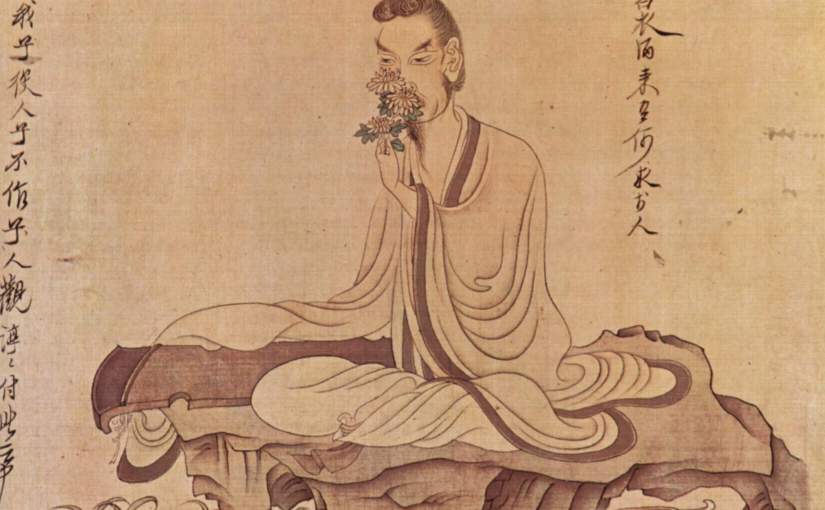
Chen Hongshou (1598-1652) Painting of Tao Yuanming

Tao Yuanming (365-427AD), author of The Peach Blossom Spring, was another scholar who withdrew from the world. Always reluctant to participate in public life, he endured poverty to live in seclusion and cultivate himself in the Daoist tradition. He wrote poetry and gardened, as well as farming to feed himself and his family.

Drinking Wine (#5)
I’ve built my house where others dwell
And yet there is no clamour of carriages and horses
You ask me how this is possible– (And so I say):
When the heart is far, one is transported
I pluck chrysanthemums under the eastern fence
And serenely I gaze at the southern mountains
At dusk, the mountain air is good
Flocks of flying birds are returning home
In this, there is a great truth
But wanting to explain it, I forget the words

Tao Yuanming

To this day he is the archetype of the refined gentleman hermit, and chrysanthemums have been closely associated with him throughout history. He was one of the originators of the ‘Field and Garden’ genre of poetry.

Wang Wei, Wangchuan Villa

The Tang dynasty, which followed the turbulent Six Dynasties period, was a golden age of Chinese culture, including gardens. One famous Tang garden was the Wangchuan garden of the poet, painter, and administrator Wang Wei (701-761AD). The garden included 20 landscape scenes to be viewed from set viewpoints. Wang wrote poems to go with each scene and also painted them. The gardens, poems, and paintings were hugely influential in later years.

The Garden of the Golden Valley

Scattered pomp has turned to scented dust
Streaming waters know no care, grass spreads and claims spring as its own
At sunset, an East Wind carries the sound of crying birds
Petals on the ground are her likeness still, beneath the tower where she fell

Du Mu (803–852)

In the late Tang the poet Du Mu wrote this poem (translation from here) about Shi Chong’s Garden of the Golden Valley, built 500 years earlier. Shi Chong ultimately came to a sad end. A rival, jealous of Shi Chong’s beautiful concubine Lüzhu, framed him for treachery. Shi Chong was executed and Lüzhu threw herself to her death from a tower in the garden.

How to grow Japanese Maples

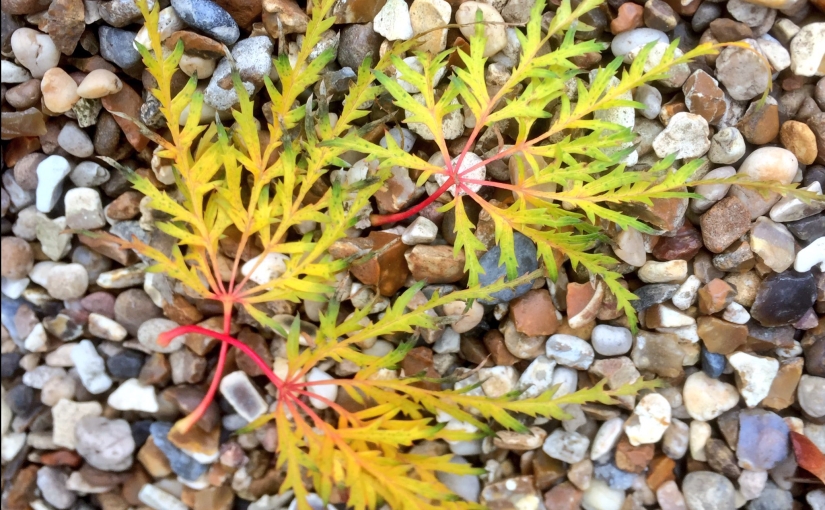
One of the most evocative of Japanese plants, Acer palmatum cultivars are easy to grow as long as they are sited correctly. Whether in the ground or in containers they need shelter from cold or drying winds. Cool dappled shade is the ideal position. Green cultivars, and some purples, tolerate sun best. Red leaved cultivars need some sun, or the colour will not develop properly, but don’t like full sun all day. Variegated or more delicate dissectum and linearilobum cultivars will need shade at least during the hottest part of the day to prevent scorching and some, like ‘Ukigumo’, can only be grown successfully in shade.

Acer palmatum ‘Katsura’

They do best in a moist but well-drained soil with plenty of organic matter, ideally slightly acidic. In a container, the standard advice is to use John Innes 2 or 3, mixed with an ericaceous compost, but it is better for the environment to use a good quality peat free ericaceous, such as those available from Sylvagrow or Dalefoot. Top pots with gravel to suppress weeds, or mulch well with compost or leafmould in the ground, but make sure the mulch doesn’t touch the trunk. Feed with a balanced fertiliser in spring before the leaves emerge.

Acer palmatum ‘Omureyama’ starting to colour in autumn

Correct watering is important. They need a good supply of moisture, and won’t tolerate either drought or water-logging well. They are quite shallow rooted, so make sure they are not crowded by other plants competing with them. Besides, they are best given space to show off their beautiful form.

Emerging foliage of Acer palmatum ‘Katsura’

Acers are perfectly hardy, but in pots their roots are more vulnerable to frost, so in colder area the pots should be wrapped in fleece or moved to a protected spot in winter. Acers come into leaf very early in the year and the new foliage can be caught by late frosts. This won’t kill them but will set them back, so protect with fleece when frosts are expected.

Acers don’t need much pruning – simply removed dead, damaged or diseased branches, and any that are crossing and rubbing. Prune when the tree is dormant, between November and February, and be sure to cut back to just above a bud. A long stub left above a cut can be an entry point for disease or dieback.

Love, Immortality and Utopia – The Symbolism of Peaches

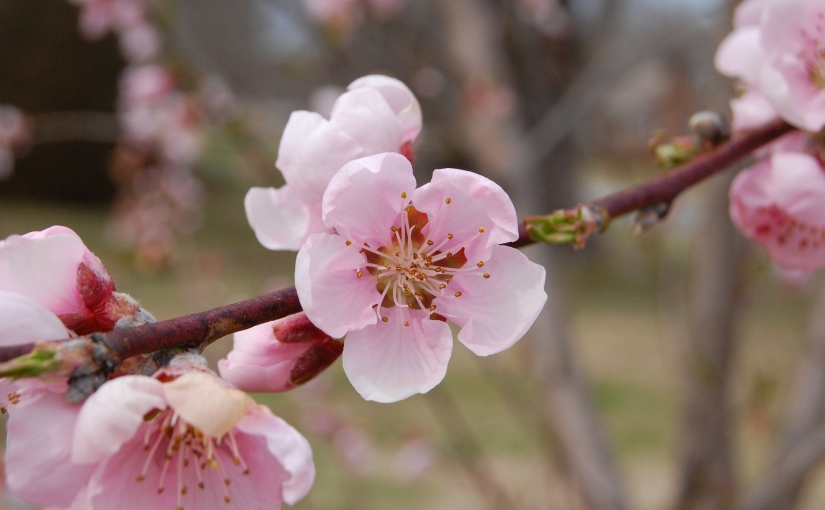
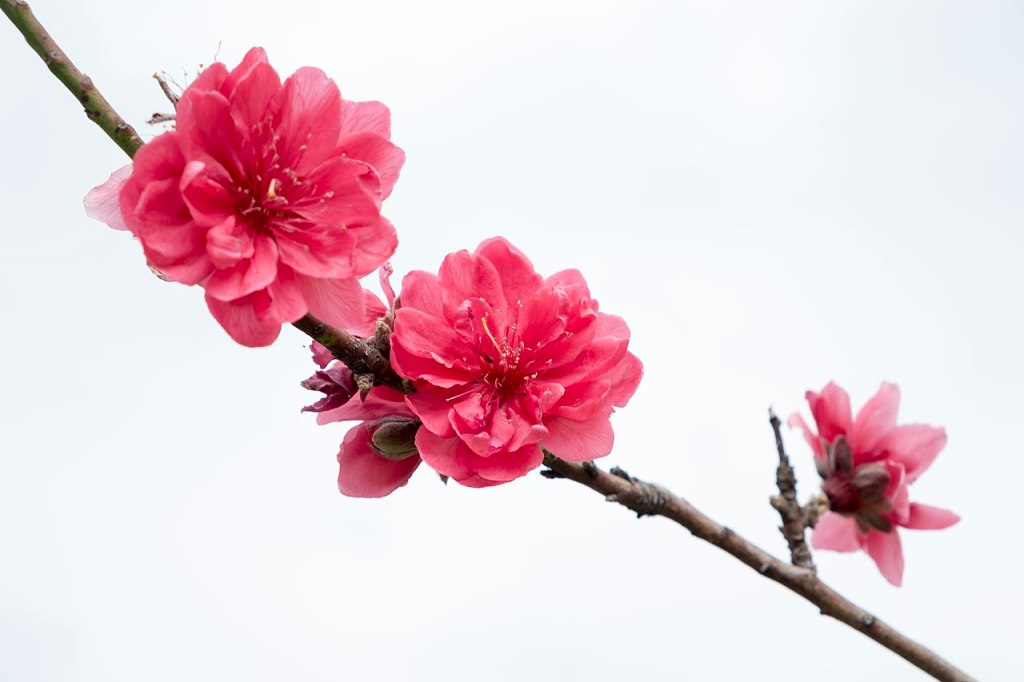
Peaches have been cultivated in China for about 3000 years, originally for food and medicinal purposes, and poems about the beauty of peach blossom date to 600BC, showing their early use as an ornamental. By the Song dynasty (960-1279AD), several varieties had been bred with double flowers in reds and whites as well as pinks.

Each part of the tree has its own symbolism. Peach blossom opens in spring, the season of romance, and is strongly associated with love, and with feminine beauty.

Within this gate on this same day last year,  
Cheeks and peach flowers out bloomed each other here.  
Her very cheeks can now be found no more.  
The peach flowers smile in spring wind as before 

Cui Hu (translated by Ma Hongjun).

This very well known poem from the Tang dynasty has formed the basis for many romantic stories and operas and given rise to a chengyu (Chinese idiom) 人面桃花 rén miàn táo huā, her face is like a peach blossom, to describe a woman’s beauty.

Today, peach blossom is one of the flowers used to decorate at Chinese New Year, and is especially popular with single people hoping for ‘peach blossom luck’ – luck in love.

The peach itself has long been a Taoist symbol of immortality. Xiwangmu, the Queen Mother of the West, lives on the mythical Mount Kunlun and grows peaches in her orchard. They produce fruit every three thousand years and confer immortality on anyone who eats them.

The wood of the peach tree is said to ward off demons. Swords carved from peach wood were used in Taoist exorcisms, and feature as magical weapons in martial arts legends.

Peach Blossom Spring by Zhang Hong, Ming dynasty

One further literary association which was highly influential in the development of the Chinese garden was the story of ‘The Peach Blossom Spring’. Written in 421 AD by Tao Yuanming, it told of a fisherman who followed a stream through a forest of blossoming peach trees to a cave at its source. Squeezing through this cave he found a hidden village, surrounded by beautiful scenery and fertile fields, where people lived happy and tranquil lives, cut off from the world for many generations. He met with a warm welcome and stayed for a while, but then wanted to return home. He was warned that it was pointless to tell anyone else or to try to find his way back to the village later, and so it proved. The story inspired many paintings and poems, as well as influencing gardens, and gave rise to a chengyu – 世外桃源 shìwaì taóyuán, the Peach Spring beyond this world, which means a utopia.