There are well over 200 species and varieties of temperate bamboo, and more being introduced all the time, but if I could only have one, this would be it.
Borinda papyrifera CS1046
Borinda papyrifera CS1046 is a clump-forming bamboo collected from Yunnan in southwest China by Chris Stapleton (hence ‘CS’). The specific epithet ‘papyrifera’ refers to the large, papery sheaths which protect the emerging culms.
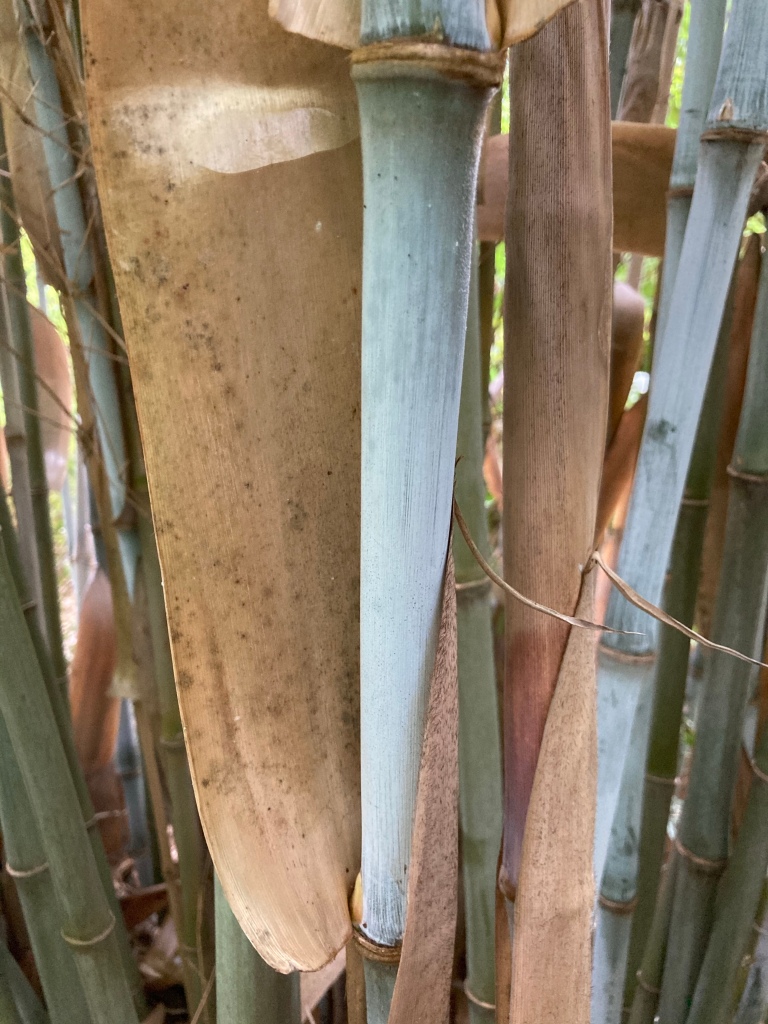
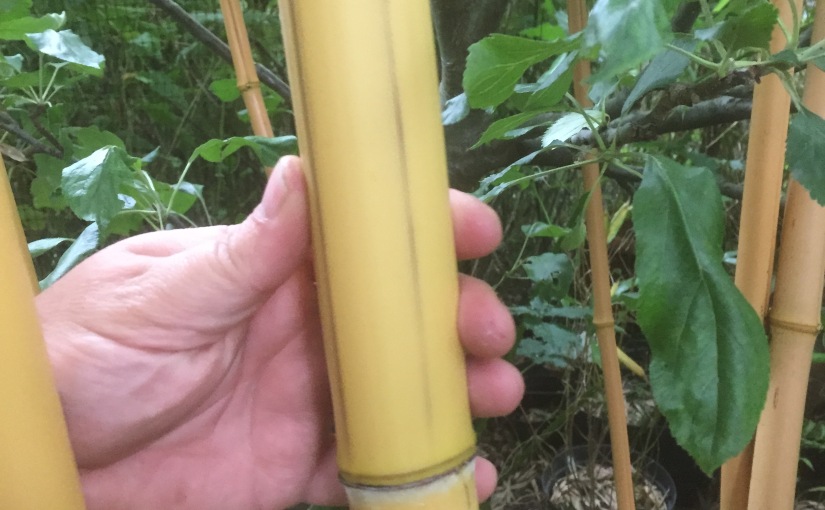
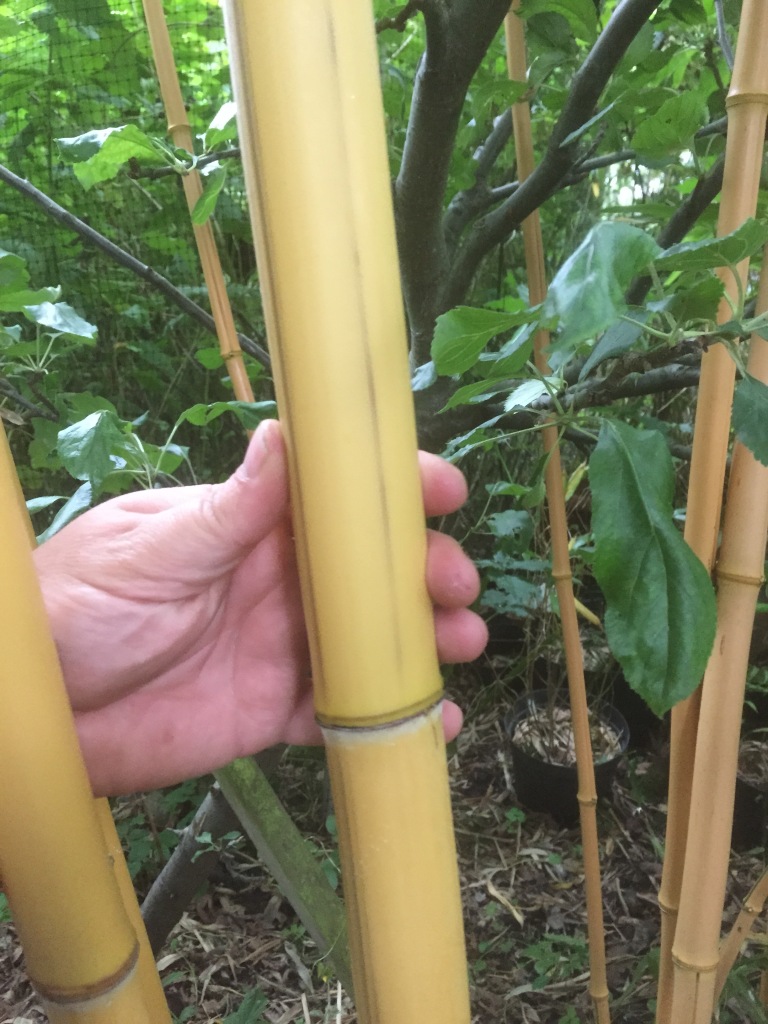
This year’s culm showing the pale colouration and the papery sheath that gives the plant its name.
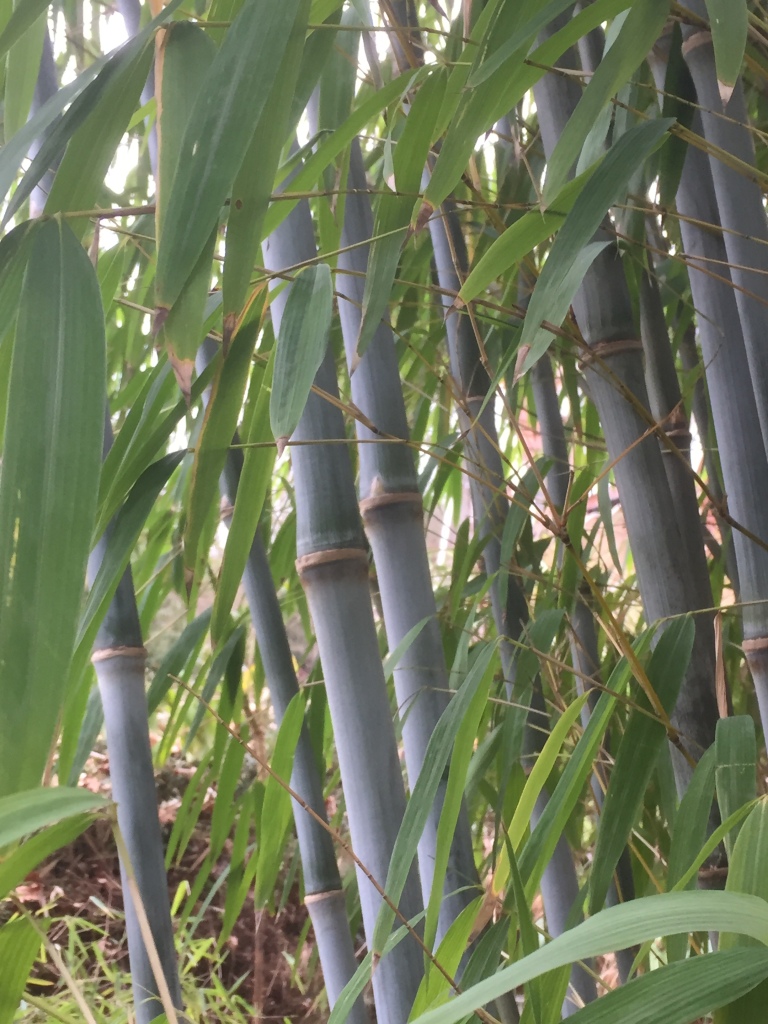
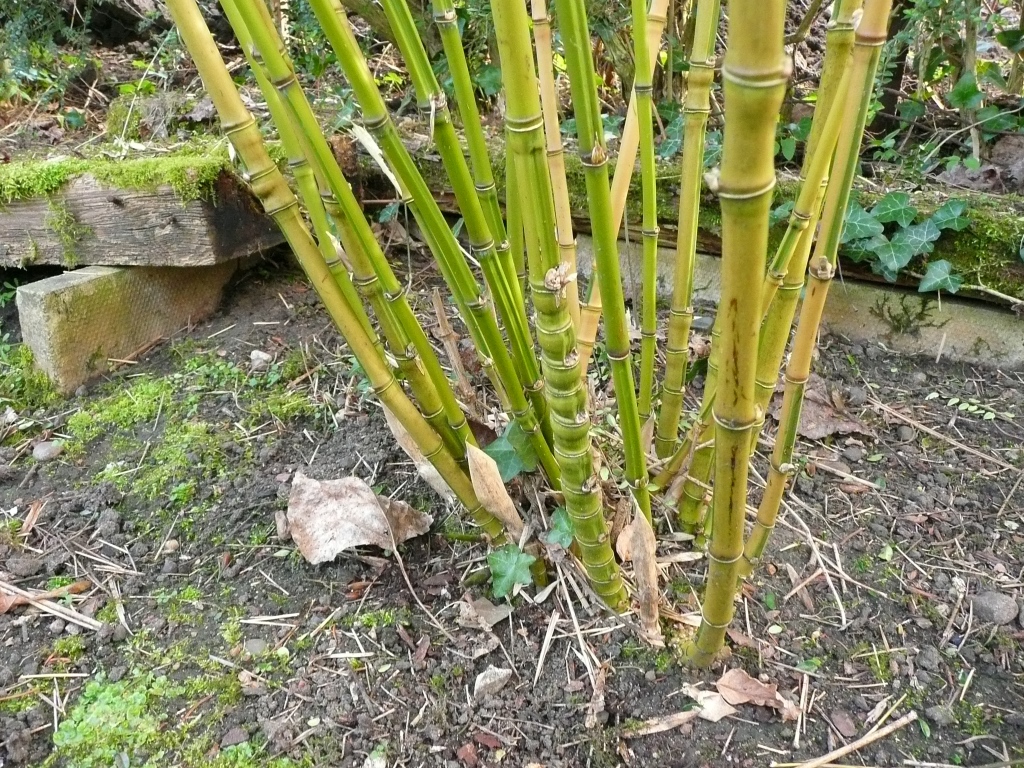
Its most striking and ornamental feature is the icy blue colour of its new culms. This colour is quite persistent, lasting a couple of years before fading to a more greenish shade. The culms are thick – about 2 inches in diameter on my 10 year old plant – and the leaves are quite large.
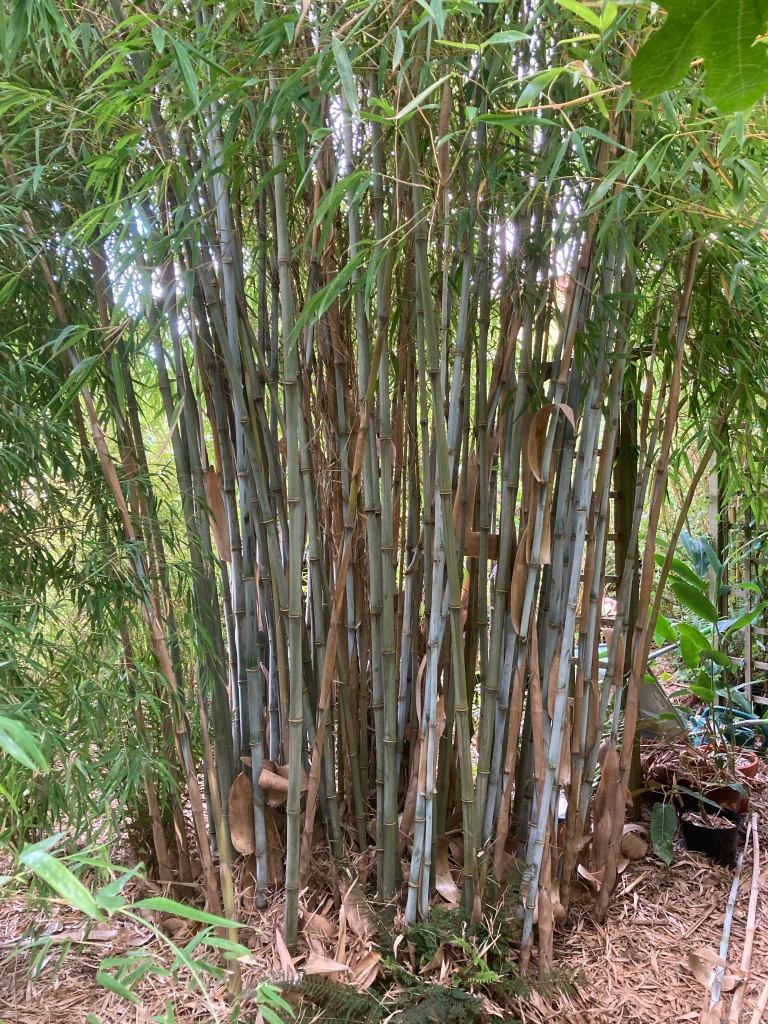
The 10 year old plant in my garden is now some 2.5m (8ft) across.
Though clump-forming it is by no means small. At 6m (20ft) plus with culms more widely spaced than many clumpers it is perhaps best described as statuesque. It would make an ideal specimen plant.
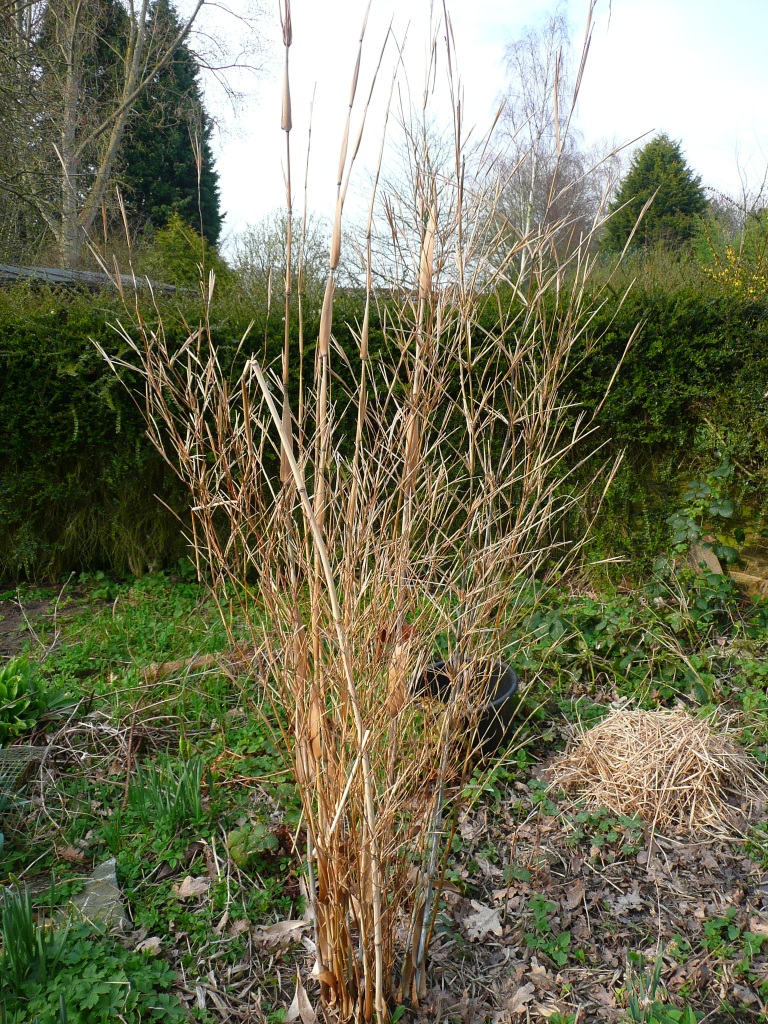
Borinda papyrifera CS1046 is not tremendously hardy as a young plant, but once established is much tougher. Mine was cut almost to the ground as a youngster in the hard winter of 2010, though it came back quite strongly, but didn’t lose a leaf in the ‘Beast from the East’ in 2018. Other clones of Borinda papyrifera are available, some of which were collected at higher altitudes and may prove hardier.
The same plant as above, after the winter of 2010.
It is reasonably tolerant of drought once established, but will tend to abort some culms in dry summers. My plant has attained its current size without extra watering until this year when I gave in to the realities of the changing climate and bought a hose. I also haven’t fed it, but always leave the shed leaves and sheaths in the base of the clump, which break down slowly and return their nutrients to the plant.
Unfortunately this very desirable bamboo is tricky to propagate, partly because it is quick to mature, which makes it hard to find and somewhat expensive. A variety called Fargesia ‘Blue Panda’ is being sold, which is apparently a micro-propagated form of Borinda papyrifera CS1046. If anything it seems to be more expensive than the original and, given what poor plants micro-propped Phyllostachys make, it would be wise to wait until more is known about its performance before buying it. Personally I would only buy a hand-propagated Borinda.
Most bamboos are suitable for growing in containers, and in a small garden it may be the best way to include these lovely plants.
The first thing is to choose your bamboo. All Fargesia species do well in containers. Many Phyllostachys species are also happy in containers, and as they are running bamboos, it is a good way to grow them without having to worry about them spreading. These two genera make up the majority of widely available bamboo species, so there’s plenty of choice. Less commonly encountered, Chusquea species hate being grown in pots and very invasive species of Sasa and Chimonobambusa will also not do well.
The next thing is to choose your container. It’s important to choose one which either has straight sides or slopes outwards, so that the bamboo can be removed for repotting when necessary. Containers which belly outwards or narrow towards the top are not suitable. People often buy tall and narrow pots for bamboo, but actually the best shape is shorter and wide. Bamboos are comparatively shallow rooted, and a wider base both gives them room to grow and helps with stability in windy conditions.
You can either pot a bamboo up every couple of years into progressively larger containers or pop it straight into the largest one. Bamboos are not generally bothered about being over potted. Once it has filled the pot, it should be taken out every two or three years, the rootball sawn in half, and each half repotted. It’s best not to cut it into more than two pieces. Bamboos aren’t keen on being divided and if you try to make too many you risk losing them.
The logical choice of growing medium would be half multipurpose compost and half John Innes no 3. I have only used peatfree compost for many years and my bamboos are perfectly happy in it, even in the old New Horizon which wasn’t a patch on the Sylvagrow I use now.
As far as feeding and watering go, remember bamboos are woody grasses, so essentially you have a 7ft lawn in a pot. A high nitrogen feed is ideal, but not too late in the year when it encourages vulnerable soft growth. Always keep the bamboo’s shed leaves in the top of the pot. As they break down they return essential nutrients, including the silica that makes bamboos flexible, to the plant.
Watering is really important. Bamboos in the ground are pretty drought resistant when established, but a bamboo in a pot will go brown and crispy like your lawn if it dries out, and it may well die. If you do have one that dries out (and it’s happened to me more than once) plunge it in a big bucket of water as soon as you notice. Lift it out when thoroughly soaked, and keep it well watered. If you’re lucky it will sprout new leaves, though it will take a while. It’s almost impossible to overwater a bamboo, so you won’t ever go wrong by being generous with water. I stand most of my potted bamboos in shallow trays of water all summer.
Bamboo is an extremely effective and decorative screen in the garden. Being evergreen, it blocks unsightly views all year round. The gentle sound of the foliage and its thickness means it is quite effective at filtering unwanted noise as well. Bamboo can also be used as a windbreak, although in exposed positions only the tougher species such as Pseudosasa japonica should be used. Pseudosasa japonica is also the best choice for screening salt winds, though measures must be taken to manage its spread. As always with bamboo, the most important thing is to choose the right variety in the first place.
Borinda papyrifera CS1046
The first thing to consider is height. If you want a really tall screen, over about 4m (16ft), you will need to go for a running bamboo. Clumpers don’t generally get above this height, and some are quite a bit shorter. Most Borinda species (clumpers) are exceptions to this, but are both expensive and hard to find. So if you wanted a tall but narrowish screen, where one plant would do, a Borinda would be a very attractive possibility. If you are looking at screening a longer length, a Phyllostachys species would be more economical. Phyllostachys aurea is widely available, tough, very hardy, and grows 5-8m (16-26ft) depending on conditions. It is a running bamboo, but generally quite well-behaved. (For more on clumping and running bamboos see here). For a taller screen still, Phyllostachys vivax or one of its forms would be a good choice. It can get over 8m (26ft) in the right conditions. It’s also quick to mature, with lovely thick culms, and several of the forms are very decorative, such as P. vivax f. aureocaulis which is a beautiful sunshine yellow with occasional fine green stripes. On the downside it doesn’t have much foliage low down on the culms, and is more vigorously spreading than P. aurea.
Phyllostachys vivax f. aureocaulis
The next thing to consider is the width of the planting. Generalising somewhat, running bamboos tend to be more upright, while clumpers tend to have a wide mushroom cloud of foliage over a narrower clump of culms. You should also consider the width of the planting area available. The taller you want your bamboo to be, the more growing space for the rhizomes you will need. So, for example, if you had a bed 30cm (1ft) wide, you couldn’t grow a bamboo to 8m (26ft) tall in that space. In fact only the smallest bamboos, such as Pleioblastus auricomus at 1-2m (3-6.5ft), could be grown in such a narrow space, and as it is quite invasive would need work to control it. The best option for such a small space would be to grow bamboos in containers.
Phyllostachys aurea ‘Koi’, with three sided concrete paver barrier visible behind it. This was one of the first bamboos I planted in my current garden about 12 years ago and it is still nowhere near needing that barrier though technically a runner!
The third factor to consider is how you will control the spread of your bamboo screen. If you are planting along a boundary I would always recommend using a barrier of some kind, even if you are planting clumpers. Though they will never send out runners, the clumps do expand in width every year and will eventually come up just the other side of the fence. There are a number of options you can use. I use a line of recycled concrete pavers on edge in the ground, overlapping an inch or so and also sticking up an inch or so above soil level. They are angled very slightly away from the bamboo, so that a runner meeting them is encouraged upwards. When it pokes over the barrier it is easy to see and trim. Bamboo rhizome barrier is available, but not cheap, and I know of one grower who swears by damp proof membrane! For a running bamboo you can encircle the entire planting area with a barrier, giving it the most space allowable, but after many years it will effectively become ‘potbound’ and will try to break through. I put a barrier along no more than three sides of a plant, so it can only spread out of bounds in one direction and I can cut and dig out rhizomes should it eventually become necessary.
Fourthly, and related to all the above factors, is whether to plant your screen of bamboos in the ground or grow them in pots. The advantage of growing in containers is that the spread is controlled and you can grow almost any species you like regardless of how invasive it would be in the ground. The disadvantages are that the plants will stay shorter than they would in the ground, and that you will have to water them. Bamboos established in the ground are pretty drought tolerant, but in pots will die if allowed to dry out completely. If you need height, P. vivax will still get to a decent height in pots, and the larger the container you can give it the taller it will get.
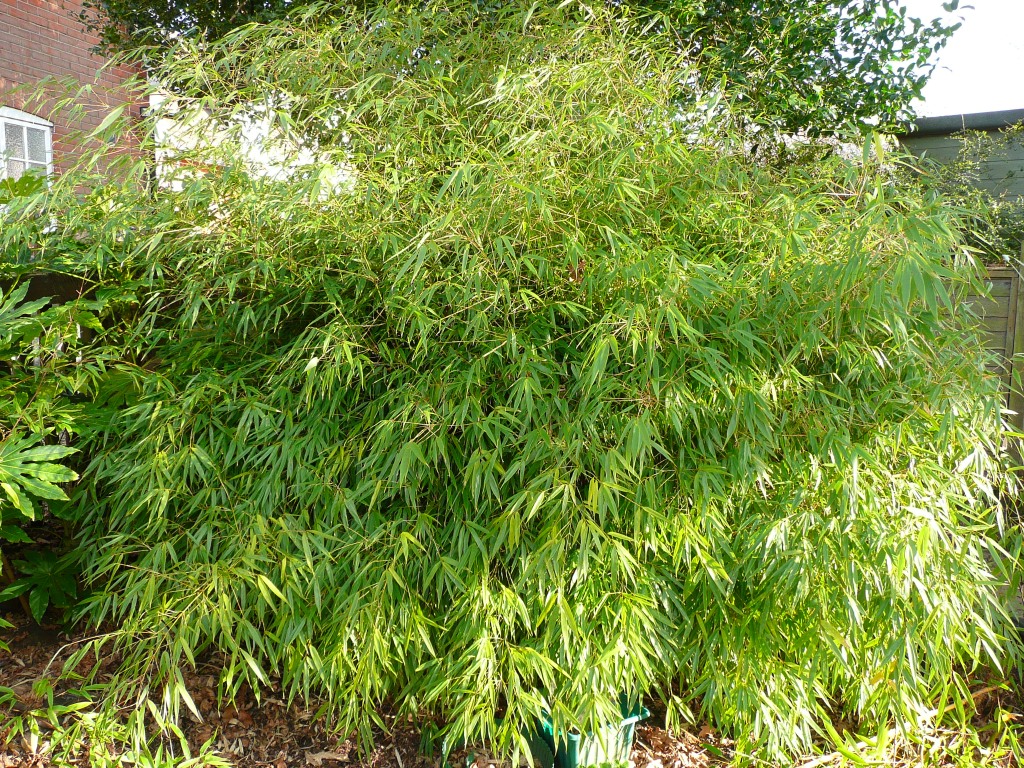
Fargesia rufa, a clumping bamboo which forms a mushroom of foliage.
The final thing to consider is the likelihood of flowering. Bamboos flower very infrequently, with gaps for many species upwards of thirty years. However, there is always a small chance, and clumpers in particular are likely to die if they flower completely (more on bamboo flowering here). If planting a long row of clumping bamboos it is a very good idea to choose a mix of species and varieties, so that if you are unlucky you only lose one or two plants and not the whole row. Fargesia nitida and its numerous forms have flowered since the 2000s so are unlikely to flower again soon. A number of hybrids between F. nitida and F. murielae have recently become available, show promising vigour (F. murielae itself is very slow to get going) and also should not flower for many years. F. robusta and its forms are among the taller clump formers at 4-5m (14-16ft). F. rufa is one of the shortest, topping out at 3m (10ft), but has a particularly wide cloud of foliage, is quick growing, and tough as old boots.

 Japonica Plants Nursery