In 1899, the plant hunter Ernest Wilson set out on his first plant hunting expedition to China for James Veitch and Sons nursery. He was looking for Davidia involucrata, the fabled Dove Tree, discovered by Père Armand David in 1869. “Stick to the one thing you are after and don’t spend time and money wandering about. Probably every worthwhile plant in China has now been introduced to Europe,” he was advised by his employers. They could hardly have been more wrong. In his 1929 book “China, Mother of Gardens”, Wilson wrote about collecting some 3500 species in China alone, of which about 1800 were new introductions to the West.
China is second only to Brazil in the number of native plant species and its botanical diversity is unparalleled amongst temperate countries. With a similar land area to the USA, China has about twice as many plant species – 31000. About half of these are endemic. Where does this biodiversity come from? One important factor was the relative lack of glaciation in China during the last major ice age. Some species which would once have been found across the northern hemisphere were wiped out elsewhere, surviving only in China. This accounts for the ‘living fossils’ such as Metasequioa glyptostroboides, the Dawn Redwood, described as a species from fossils of the Mesozoic Era in 1941 and discovered as a living plant in China in the same year (although the connection was not made until 1946).

Similarly, Ginkgo biloba, the Maidenhair tree, is the last remaining species of a genus found in the fossil record around the world. By the end of the Pliocene, Ginkgo species were restricted to central China. Introduced to the West from Japan in the 17th century, having made its way there from China in the 14th century, Ginkgo biloba was long believed to be extinct in the wild. Some specimens planted by temples are said to be 1500 years old or more, with one perhaps 4000 years old. Such a long history of cultivation in China makes it hard to determine whether plant populations are wild or cultivated – small existing populations of Ginkgo in Zhejiang province have very little genetic diversity, suggesting they may have been planted, probably by monks, about 1000 years ago. Small populations recently studied in the Dalou mountains show much greater genetic diversity, suggesting they may be of wild origin.
This long history of cultivation may be another, though lesser, factor in China’s remarkable diversity of plant species. Many ornamental species were first cultivated in China for food and/or medicinal purposes, and a number of trees were grown for symbolic and religious reasons as far back as 5000 years ago. This may have preserved species now extinct in the wild. For example Trachycarpus fortunei, the Chusan or Windmill palm, though widely grown, may have no truly wild specimens in existence.

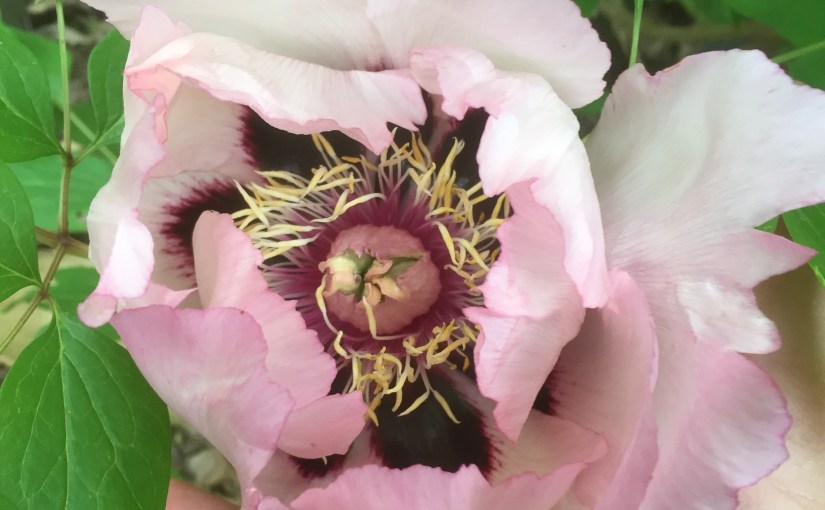
China is the centre of distribution for roses (93 out of 150 species); camellias (the number of species varies depending on the authority – the Flora of China counts about 120 species, 97 native to China with 76 endemic); maples (half of the 110 species are found in China); peonies (about 30 species, half native to China, 10 endemic), and many other plants, without which our gardens would be very much the poorer.
 Japonica Plants Nursery