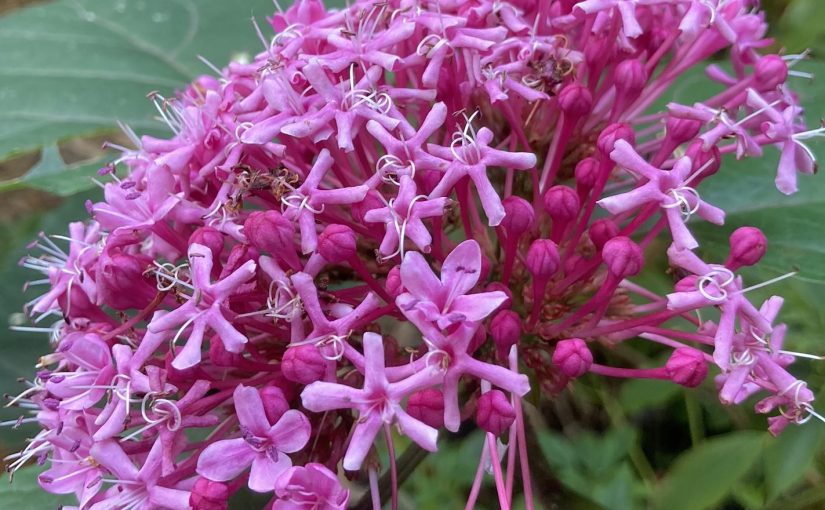

This exotic looking shrub, native to China and northern India, has a number of common names: Rose Glory Bower, Glory Flower, Kashmir Bouquet and Mexican Hydrangea. Rather more prosaically, it is known in China as Chou Mudan, stinky peony, and stinky safflower in Japan. Indeed it was originally introduced to the West under the name Clerodendrum foetidum. These names refer to the leaves, which smell quite unpleasant to some people, although to others the scent is reminiscent of peanut butter. Ironically, it is used medicinally in China to ‘dispel wind’, amongst other things. The large, showy, pink flowers, produced from late summer into autumn, are sweetly and strongly fragrant. The large ovate leaves, flushed dark red when young, are very attractive and give a distinctively exotic effect.
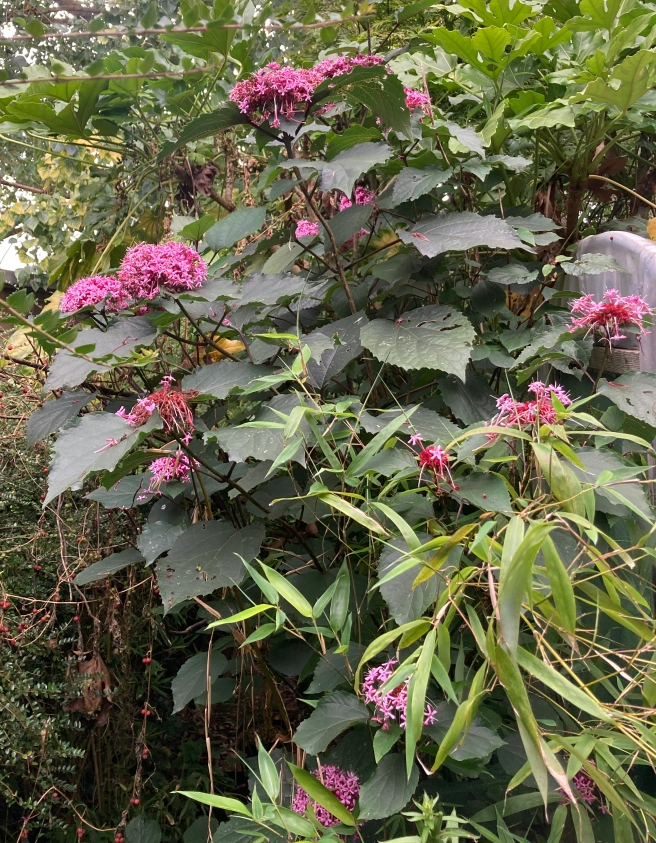
Clerodendrum bungei is hardy to zone 7, dying back to the ground in some parts of the U.K., although in my dry, shady, East Anglian garden it has yet to do so, even in the last winter (22/23). It gets to a good 6ft, 2m, in height, and once established in conditions it likes, can become invasive. It can spread quite a distance – up to 6 metres! – by suckers, and also self-seeds, though not prolifically. I find growing it in drier conditions keeps it reasonably well in check. It has become naturalised in several parts of the world and is an invasive weed in parts of the southern U.S. In its native China, it is a plant of mixed woodland slopes and waste ground, preferring shady, moist conditions and a humus rich soil.
There is also a variegated form, Clerodendum bungei ‘Pink Diamond’, which has attractive grey-green leaves with cream-variegated margins, and is slightly more compact than the straight species.


 Japonica Plants Nursery