
Hemiboea is a genus of attractive semi-evergreen woodland perennials originating from China, with a few also found in Vietnam, Taiwan, and the southernmost islands of Japan. There are more than forty species, but only three are currently in cultivation in the U.K., and these are rarely encountered. They are hardy and surprisingly tough members of the Gesneriad family, having come through the deep freeze, droughts, and torrential rain of the last year in the UK with surprising aplomb. They spread by stolons, have glossy green leaves which are very attractive in their own right, and flower in autumn. Their natural habitats are montane forests and the shaded banks of streams; in cultivation they like at least partial shade and a moist, humus rich soil. That said, they show a surprising tolerance for dry conditions, especially H. subcapitata.

Hemiboea strigosa is probably the most widely available species in the U.K. With leaves slightly smaller and lighter in texture than H. subcapitata, it makes a spreading clump about 1′ to 18″ (30-50cm). The tubular pink flowers appear in September, and it flowers readily for me.

Hemiboea subcapitata has larger, broader, and darker green leaves than the other species. The white flowers, spotted pink and washed with yellow inside, appear very late, well into October. Apparently, the balloon-like flower buds shoot out a jet of water when squeezed. Unfortunately, I only heard this recently, so will have to wait till next year to try it!
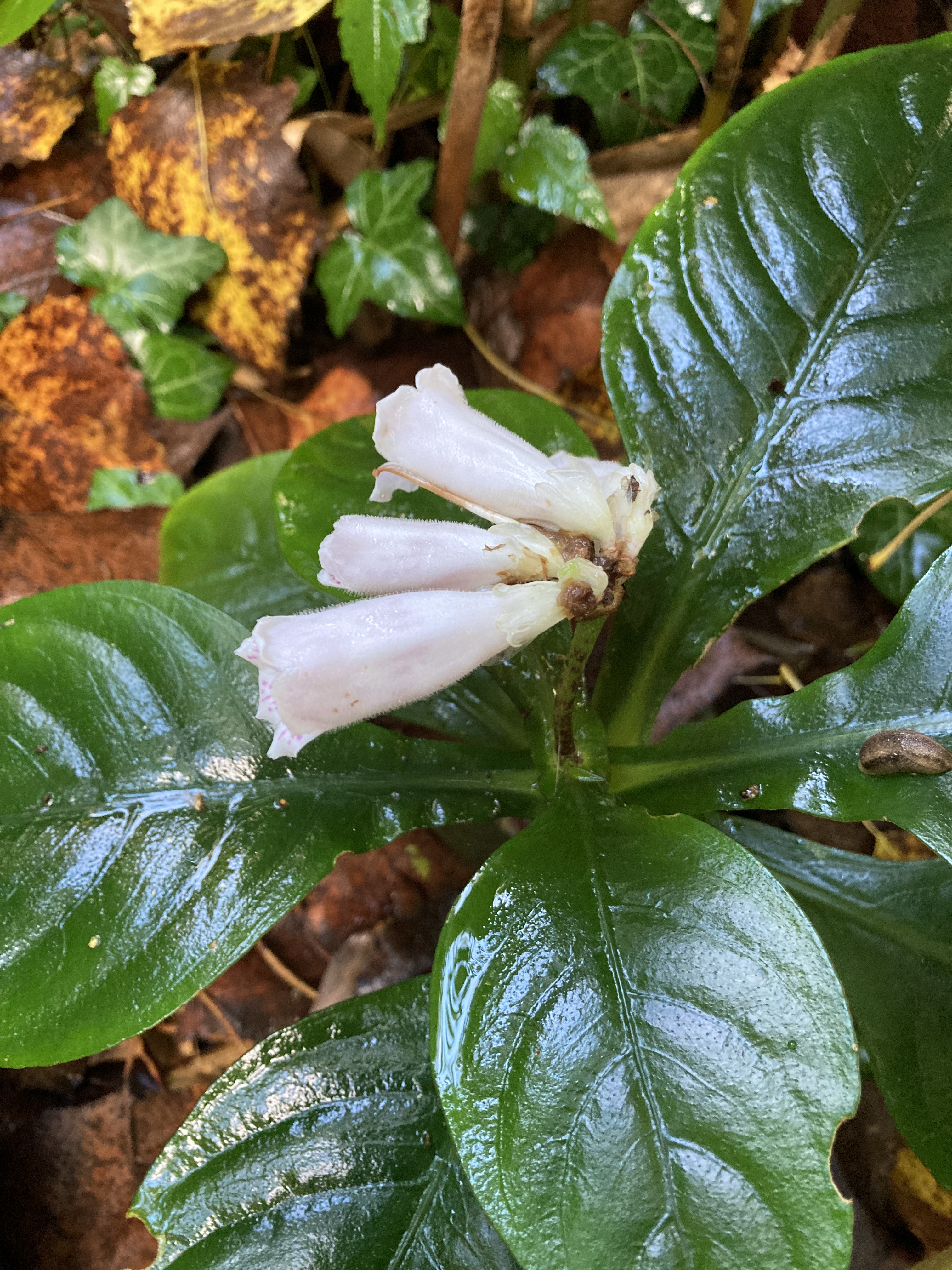
The third species, Hemiboea bicornuta, is a Taiwanese species and very rare in the U.K. The leaves are somewhat thinner and less glossy. The white or pale pink flowers, spotted purple within, are very similar to the other species and also appear in September to October. It should prove to be the tallest of the three, reaching up to a metre in the wild. I have found it a rather shy flowerer.
 Japonica Plants Nursery