

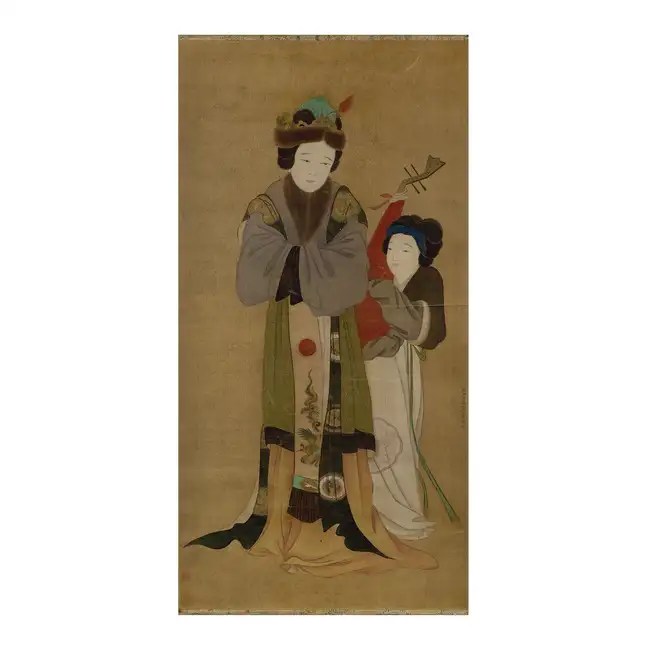
Wang Zhaojun was one of the ‘four great beauties’ of ancient China. A lady-in-waiting in the palace of the Han emperor, Han Yuandi, she seemed destined to pass her life in obscurity due to a tactical error. It was the custom for ladies entering the palace to have their portrait painted. It was also the custom to bribe the court painter generously, to encourage him to put forth his best efforts. Confident in her legendary beauty, charm, and intelligence, Wang Zhaojun did not do so, and the artist expressed his feelings by adding a large, unsightly mole to her portrait.
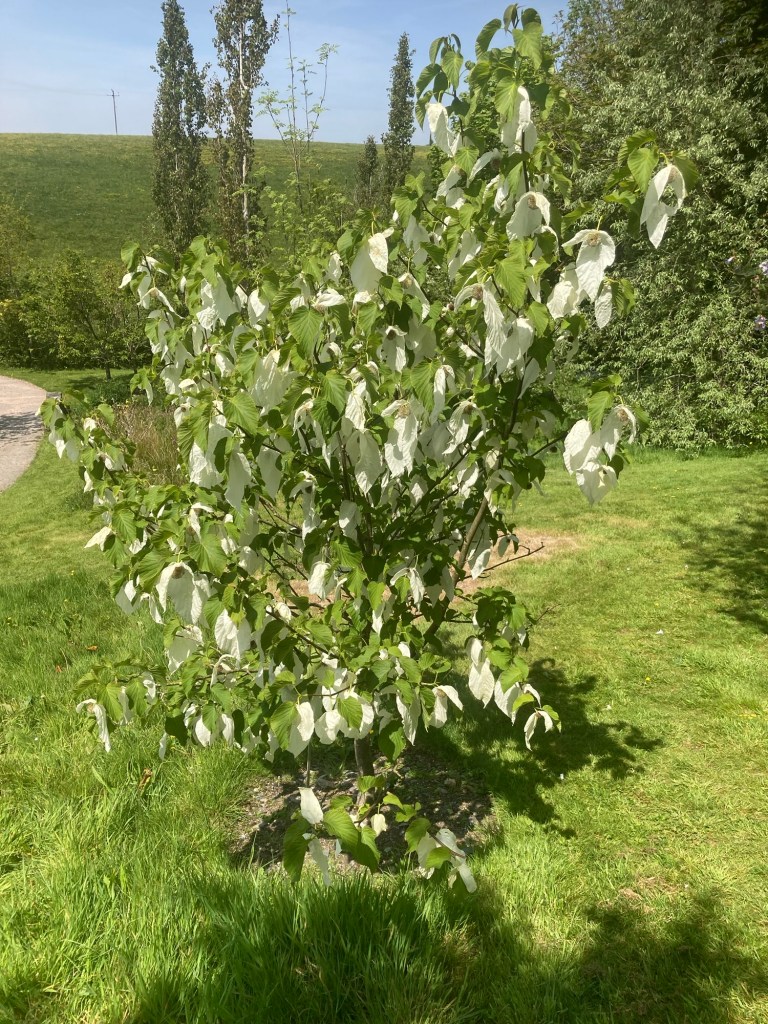
Some time later, as part of negotiations between the Han and the Xiongnu, a Xiongnu prince asked for the hand of a Han princess. Unwilling to marry his daughter to a barbarian, Han Yuandi ordered that the plainest girl in the palace should by presented as the royal bride. When, based on her portrait, Wang Zhaojun was brought forward, the Emperor rather regretted his decision (and had the court painter executed) but the Xiongnu prince was delighted. Wang Zhaojun self-sacrificingly agreed to the marriage and went to live among the barbarians. Lonely and homesick on her journey, she wrote a letter home every day and sent it attached to a dove. The doves flew back and settled on a tree outside Wang’s family home. The name dove tree was given to Davidia involucrata as its large, drooping white bracts resembled the flock of white doves.
In 1869, Père Armand David, Catholic missionary, botanist, and zoologist, became the first westerner to see this tree near Moupin (now Baoxing) in Sichuan province. He sent specimens and seeds to the Jardin des Plantes in Paris, but the seeds were preserved along with herbarium specimens rather than sown. Previously unknown to western science, a new genus was created for it and named in honour of Père David. (The first description of it, based solely on the herbarium specimens, had the long white bracts pointing up instead of drooping down).
Nearly twenty years later, Augustine Henry, an Irish doctor who had developed an interest in natural history to alleviate the tedium of working for the British customs service in China, found another dove tree near Yichang in Hubei. Like Père David, he found only a single specimen on his expedition, and again, like David, the fruits he sent back to Kew in 1889 were preserved and not planted.
In 1899, Harry Veitch of Veitch’s nursery employed Ernest Wilson as a plant hunter, tasked with finding the dove tree. His first objective was to find Augustine Henry, then stationed in Yunnan, before Henry left the country to return home. Arriving in Hong Kong, Wilson found that an outbreak of bubonic plague meant he could not hire an interpreter. This made the journey, through what was then French Indochina and up into Yunnan, rather more difficult, as Wilson spoke neither French nor Chinese. There was also considerable anti-European feeling in the area, and Wilson was held up at the border for some weeks by outbreaks of serious violence. Fortunately, just as Wilson was considering writing to Veitch to call off the expedition, word came that it was safe to proceed. His onward journey further enlivened by the wreck of his riverboat in rapids, Wilson finally reached Henry in September 1899.

The help that Henry was able to offer in finding the dove tree was rather limited, consisting of a sketch map, drawn on half a page torn from a notebook and covering an area of some 20,000 square miles, with a pencilled X marking the location of the tree. Undeterred, Wilson organised an expedition and set out for Yichang, an important town on the Yangtze which was to be his base for the next two years, arriving in February 1900. Again, there was a considerable risk of anti-European violence – the Boxer Rebellion in North China reached its peak in June of that year – but Wilson felt that in these more remote regions it should be safer. In April, he set out in search of the Davidia and, on reaching the house where Henry had stayed 12 years before, was delighted to find that the locals remembered both Henry and the tree in question. However, guided to the correct spot, Wilson was horrified to discover only a stump, with a house, recently built of the wood, standing beside it.
Wilson returned to his base in Yichang, intending to collect in the area for the rest of the year and then, the following year, travel a thousand miles west to search the area where Père David had originally found the tree. He collected a number of interesting plants around Yichang, including what is now known as the Kiwi fruit. Then, just a few weeks after his crushing disappointment, he found a Davidia in full flower. Luck now appearing to be on his side, he went on to find ten more trees in the region, which fruited heavily – by no means a given for this species. Wilson was able to collect and send back a considerable quantity of seeds. In later expeditions he also collected Davidia seeds but never again in such quantity.
The seeds arrived in Britain in 1901, and were planted in varying conditions at Veitch’s nursery. By the time Wilson returned early in 1902, despite the best efforts of Veitch’s propagators, not a single one had germinated. Fortunately, those seeds planted outside, exposed to the elements, began to germinate shortly after, and soon Veitch’s had 13,000 young seedlings. Harry Veitch, however, decided to destroy some of the stock in order to be able to charge a higher price. Several thousand were burnt before wiser counsels prevailed. Wilson was appalled.
Further disappointment was in store for Wilson. In 1893, the botanist Adrien Franchet of the Muséum d’Histoire Naturelle in Paris had asked the missionary Père Paul Farges, stationed in north western Sichuan, to collect seed of Davidia involucrata. Despite his best efforts, Farges was unable to collect any seed until October 1896, which he sent to Franchet and to the French nurseryman Maurice de Vilmorin. Only one germinated successfully, two years after planting, in 1899. Harry Veitch had become aware of this shortly after Wilson had left, but didn’t tell him so as not to lessen his enthusiasm. Wilson only found out that his introduction had been pre-empted when pictures of Farges’ plant were published in the Revue Horticole in 1902.
Two cuttings were taken from the French plant and a layer successfully rooted. One of the cuttings was sent to the Jardin des Plantes and one to Kew. The layer was sent to the Arnold Arboretum in Boston, where it is still growing.
 Japonica Plants Nursery