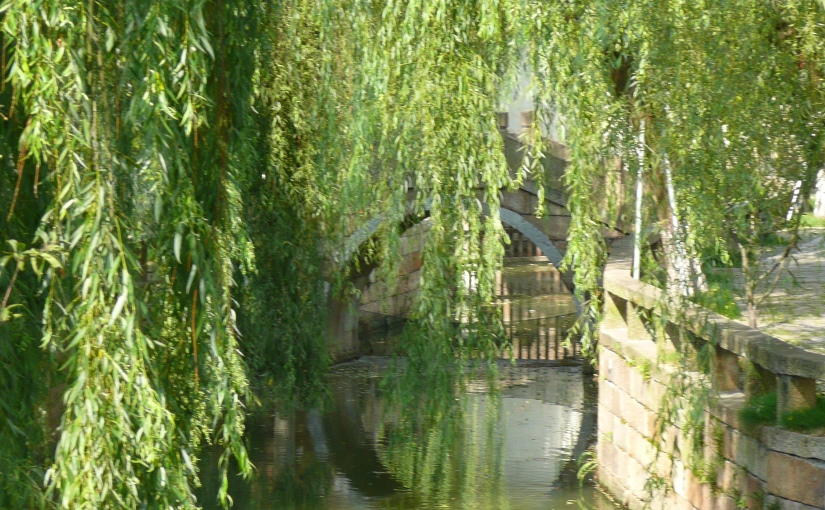
Tinkling jade and pine waves – the sounds of the Chinese garden

In the classical Chinese garden, sound was an essential element. The garden is a representation of nature in miniature, and that includes the evocative sounds of the Chinese landscape. Borrowed scenery is an important concept in the Chinese garden and in The Craft of Gardens, Ji Cheng discusses it at length. Borrowed scenery refers not just to views of landscapes outside the garden, but to other elements which can be brought in, such as sounds, fragrances, and wildlife.

Planting flowers serves to invite butterflies, piling up rocks serves to invite clouds, planting pine trees serves to invite the wind… planting banana trees serves to invite the rain, and planting willow trees serves to invite cicadas.

Zhang Chao (1650-1707)

Plants, chosen for their symbolic meanings as well as aesthetic effect, were often used to create sounds. Bamboo is one of the essential plants of the Chinese garden, representing spring, and symbolising the virtues of the Confucian gentleman – such as humility, resilience, and uprightness. The sound of the wind blowing through bamboo leaves was known as ‘the sound of heaven’, and pavilions would be sited to take advantage of this effect. It was also compared to tinkling pieces of jade. There is a story that one of the Sui empresses could not sleep without the sound of bamboo, so the emperor order courtiers to hang jade pendants from the eaves to mimic the sound.

The Bamboo Garden, West Lake, Hangzhou

The effect of wind in the pines was called songtao 松涛, often translated as ‘pine wind’ but ‘pine waves’ or ‘pine surf’ might be better. Large areas of pines were planted where space allowed, at the Summer Palace in Chengde, for example. In smaller gardens a single pine could evoke this.
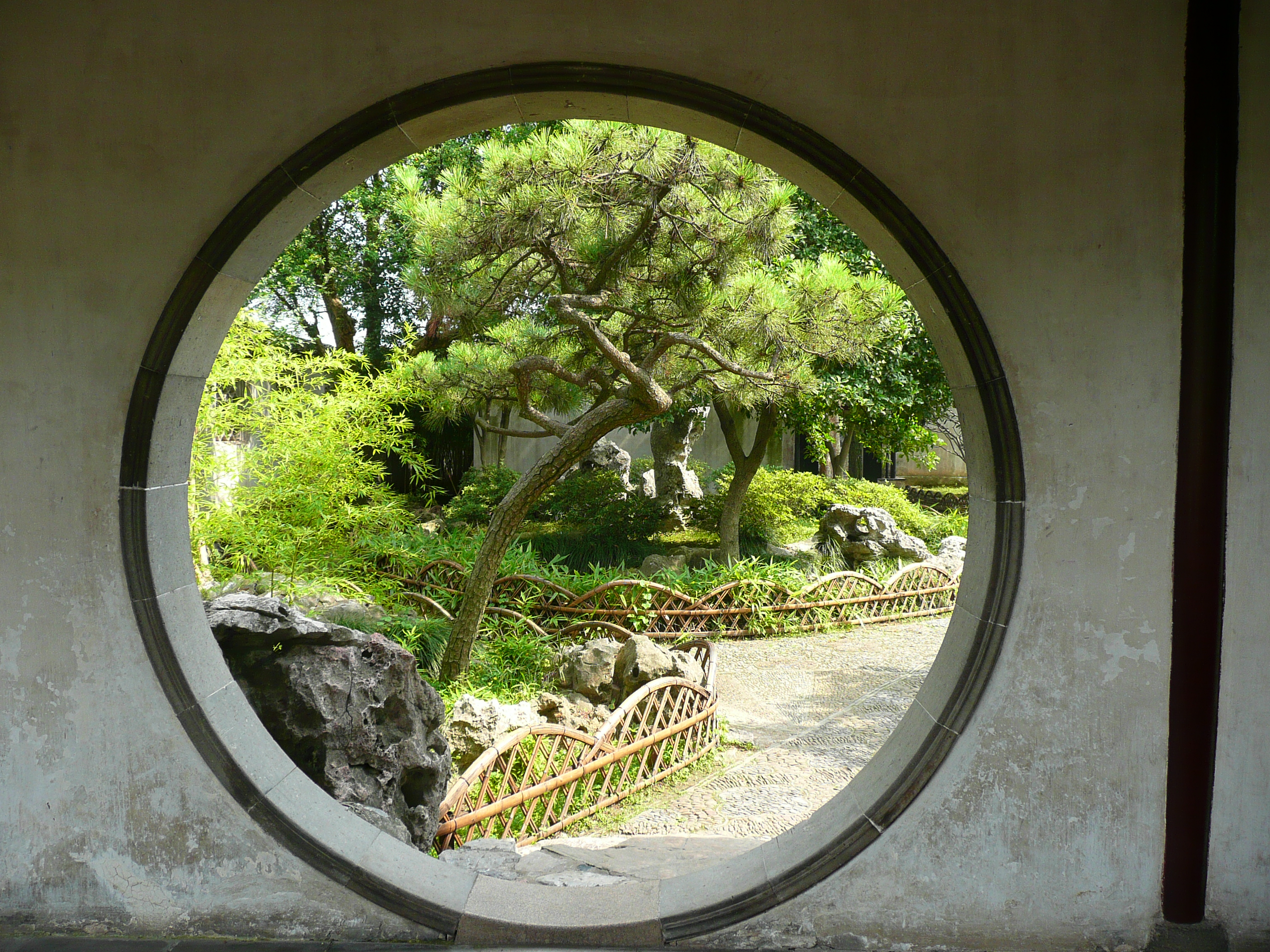
Pine in The Couple’s Retreat Garden, Suzhou

‘Wind through the pines’ is a phrase found in a number of poems and songs, and is also represented in paintings. Pine is another highly symbolic plant, associated with strength, resilience, and long life.

‘Listening to the wind in the pines’, Ma Lin

Large leaved plants such as banana and lotus were valued for the sound of rain falling on their leaves. Bamboo leaves are prone to being shredded by the wind, so to protect them they were often planted in clumps against a sheltering wall, against which their shadows moved. A pavilion would be built nearby with windows looking out onto the bananas to enjoy the aesthetic effect, both visual and auditory.

Bananas in the Humble Administrator’s Garden, Suzhou

The pattering of rain on withered lotus leaves was a theme often used in poetry to create a feeling of melancholy, and was particularly associated with autumn. The Listening-to-the-rain Pavilion in the Humble Administrator’s Garden, Suzhou, was placed to highlight the different sounds of rain on various types of leaves.

Lotuses, West Lake, Hangzhou

Other natural sounds were produced by birds, animals, and insects. The song of Orioles was particularly admired, and willows in particular were planted to attract them. This association was also used in paintings and poems, perhaps most notably this by the great Tang poet Du Fu.

Two golden orioles sing in the green willows,
A row of white egrets against the blue sky.
The window frames the western hills’ snow of a thousand autumns,
At the door is moored, from eastern Wu, a boat of ten thousand li.

Jueju (Two Golden orioles Sing in the Green Willows) by Du Fu, translation from chinese-poems.com

Willows were also associated with cicadas, one of the sounds of summer, and a symbol of rebirth and the cycle of life and death. As they were believed to live solely upon dew, cicadas also represented a pure and refined life.

Finally, sounds in the garden could be artificial – music, singing, nearby temple bells or prayers. Occasionally, elements of the garden would be built to produce sounds, although this is not as common as it is in Japanese gardens. One example of this is Winter Hill in Geyuan garden in Yangzhou, which has a wall with 24 round holes in it, through which the wind blows. This makes noises reminiscent of winter storms. (This section of the garden also faces north so it gets no direct sunlight and has white quartzite rocks to evoke the effect of snowy mountains).

Photo from: Wang, Wanlin. (2021). The Application of Soundscape in Environmental Art. 10.2991/assehr.k.210106.098.

As with everything else in the Chinese garden, sounds existed in balance and harmony with their opposite, silence.

The forest is more peaceful while cicadas are chirping. The mountain is more secluded while the birds are singing”

Wang Ji

Pines in the Chinese Garden

As with most plants used in the Chinese garden, pines are a hugely important symbol in Chinese culture, and have been grown for thousands of years. Originally associated with religion and funerary practices thousands of years BCE, they have long been essential plants in the Chinese garden.

Pine, bamboo and plum (Prunus mume) make up the Three Friends of Winter. Pine symbolises strength and endurance. Many Chinese sayings relate to this- for example, Confucius said that only in winter do we see that the pine and cypress are evergreen, meaning that only in adversity do we see a person’s true strength. Growing in isolated places and clinging to life on inhospitable rocky cliffs, they represent longevity, resilience, and the noble hermit of Chinese literary tradition.

Ma Lin, 1180-1256 靜聽松風圖 Listening Quietly to Soughing Pines

There are a number of ancient pine trees in China, often planted beside temples. Possibly the most famous is the Guest Greeting Pine on the sacred mountain of Huangshan. A specimen of Pinus hwangshanensis believed to be between 800 and 1000 years old, it has become a symbol of China and Chinese hospitality, and is so precious that it is guarded 24 hours a day, carefully protected from adverse weather, lightning, disease, animal damage, and over-enthusiastic tourists. It was represented in firework form in the opening ceremony of the Beijing Olympics, and is currently being digitised in a 5 year long 3D modelling project.

迎客松, Guest Greeting Pine, Huangshan

Like bamboo, pines are valued for the sound of the wind blowing through them. In ancient times, this was known as songtao, which translates roughly as pine waves or pine surf. The wind in the pines is a recurring motif in both Chinese poetry and landscape painting, and the music of the traditional instrument, the qin, has been likened to the sound of pines and vice versa.

Pine in the Couple’s Retreat Garden, Suzhou

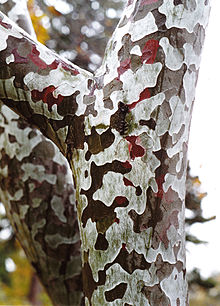
Pines planted in the Chinese garden, like almost all the plants used, are local species intended to evoke the natural landscape of China. Pinus bungeana, the lacebark pine, is often used for its attractive scaly bark. Pinus tabuliformis, the Chinese red pine, is the most commonly used, along with Pinus massoniana and Pinus armandii, the Chinese white pine. Gnarled and misshapen specimens are particularly prized, suggesting trees growing on windswept mountains, or bringing to mind dragons with their scaly bark and twisted limbs.

Bark of Pinus bungeana

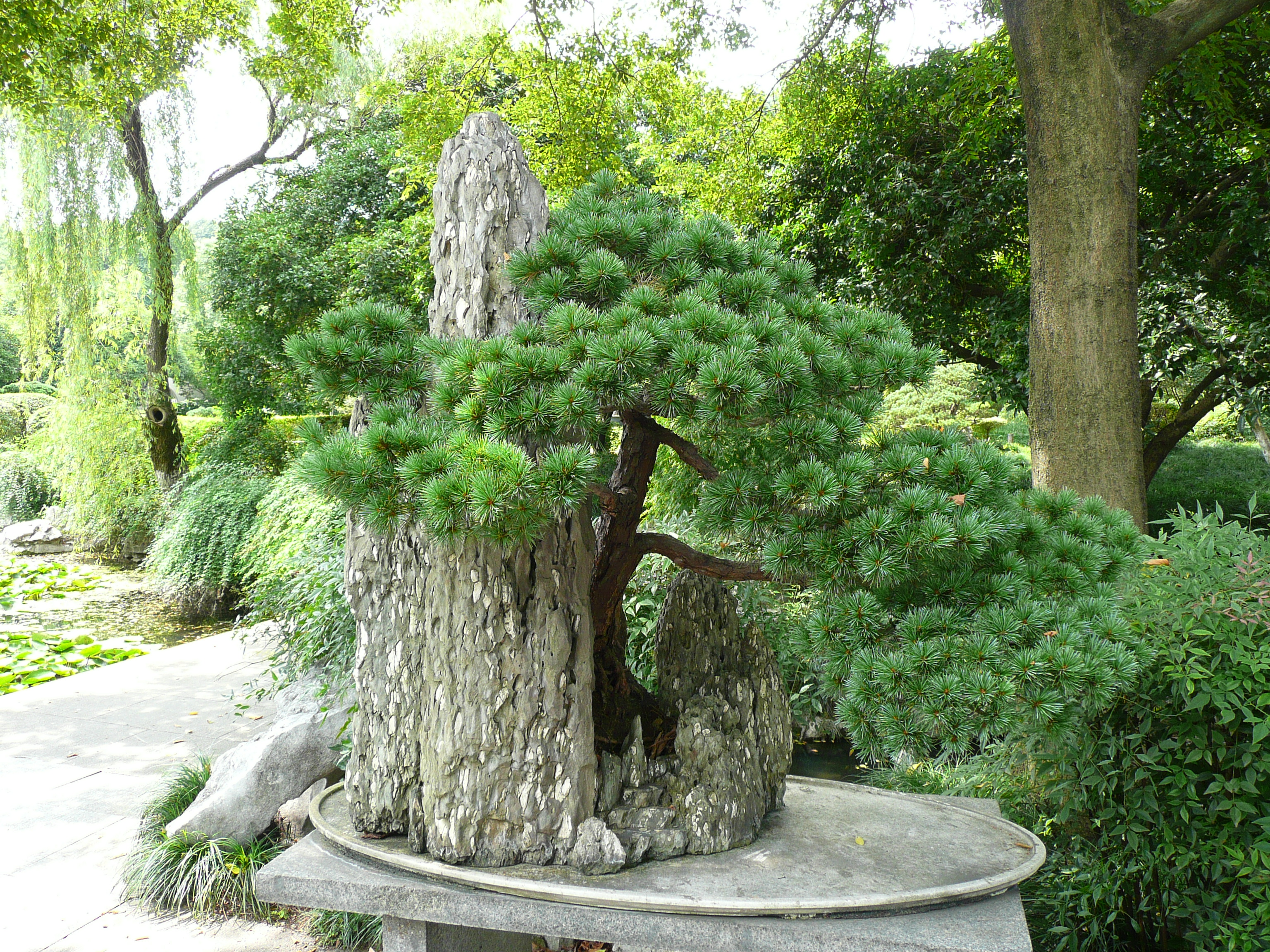
Pines are also very popular subjects for penjing, the miniature landscapes that were the ancestors of bonsai.

Pine penjing in the Bamboo Garden, West Lake, Hangzhou

The Mother Of Gardens

In 1899, the plant hunter Ernest Wilson set out on his first plant hunting expedition to China for James Veitch and Sons nursery. He was looking for Davidia involucrata, the fabled Dove Tree, discovered by Père Armand David in 1869. “Stick to the one thing you are after and don’t spend time and money wandering about. Probably every worthwhile plant in China has now been introduced to Europe,” he was advised by his employers. They could hardly have been more wrong. In his 1929 book “China, Mother of Gardens”, Wilson wrote about collecting some 3500 species in China alone, of which about 1800 were new introductions to the West.

China is second only to Brazil in the number of native plant species and its botanical diversity is unparalleled amongst temperate countries. With a similar land area to the USA, China has about twice as many plant species – 31000. About half of these are endemic. Where does this biodiversity come from? One important factor was the relative lack of glaciation in China during the last major ice age. Some species which would once have been found across the northern hemisphere were wiped out elsewhere, surviving only in China. This accounts for the ‘living fossils’ such as Metasequioa glyptostroboides, the Dawn Redwood, described as a species from fossils of the Mesozoic Era in 1941 and discovered as a living plant in China in the same year (although the connection was not made until 1946).

Metasequioa glyptostroboides

Similarly, Ginkgo biloba, the Maidenhair tree, is the last remaining species of a genus found in the fossil record around the world. By the end of the Pliocene, Ginkgo species were restricted to central China. Introduced to the West from Japan in the 17th century, having made its way there from China in the 14th century, Ginkgo biloba was long believed to be extinct in the wild. Some specimens planted by temples are said to be 1500 years old or more, with one perhaps 4000 years old. Such a long history of cultivation in China makes it hard to determine whether plant populations are wild or cultivated – small existing populations of Ginkgo in Zhejiang province have very little genetic diversity, suggesting they may have been planted, probably by monks, about 1000 years ago. Small populations recently studied in the Dalou mountains show much greater genetic diversity, suggesting they may be of wild origin.

This long history of cultivation may be another, though lesser, factor in China’s remarkable diversity of plant species. Many ornamental species were first cultivated in China for food and/or medicinal purposes, and a number of trees were grown for symbolic and religious reasons as far back as 5000 years ago. This may have preserved species now extinct in the wild. For example Trachycarpus fortunei, the Chusan or Windmill palm, though widely grown, may have no truly wild specimens in existence.

Trachycarpus fortunei

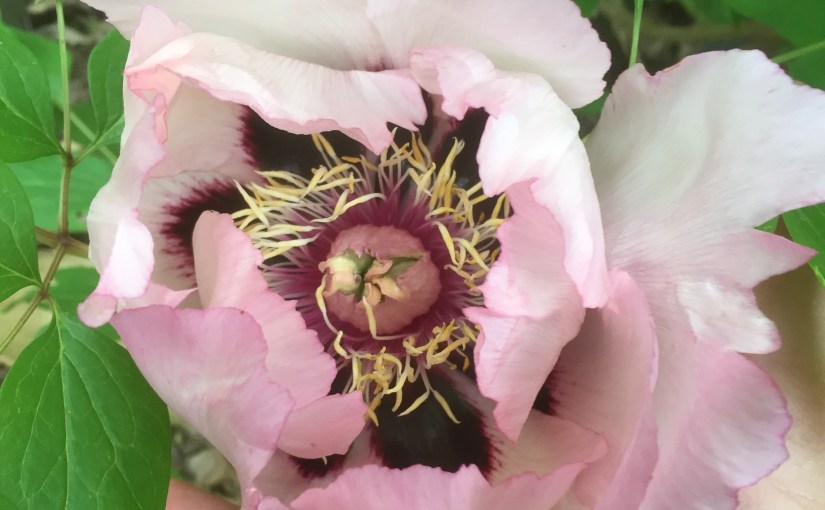
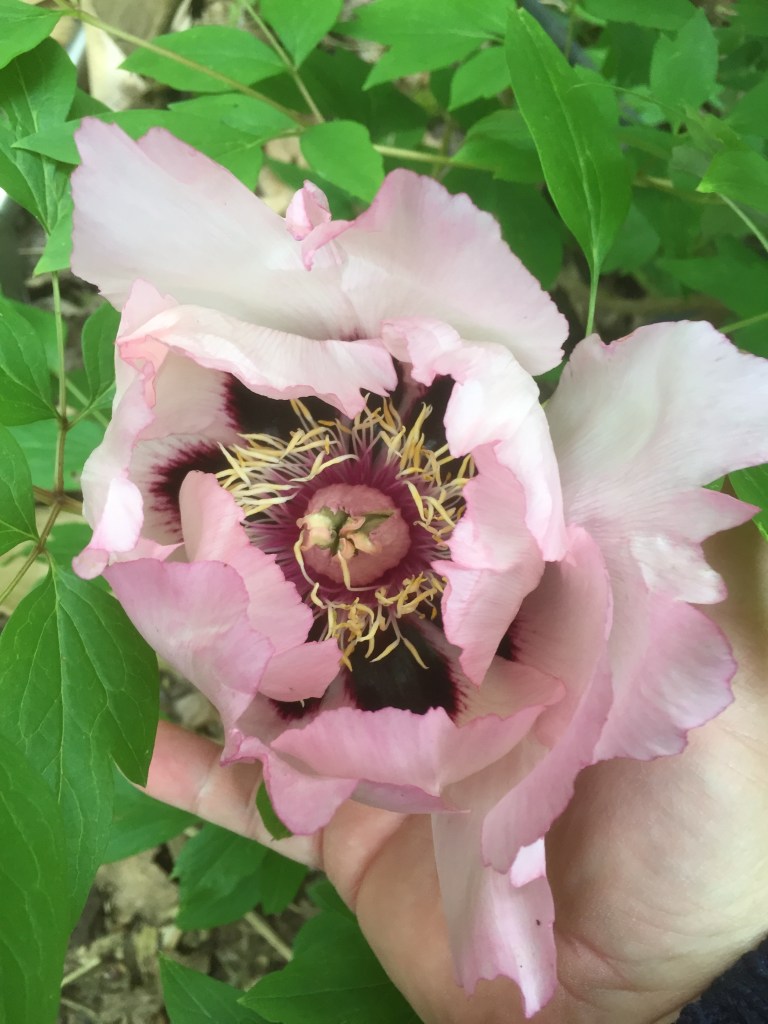
China is the centre of distribution for roses (93 out of 150 species); camellias (the number of species varies depending on the authority – the Flora of China counts about 120 species, 97 native to China with 76 endemic); maples (half of the 110 species are found in China); peonies (about 30 species, half native to China, 10 endemic), and many other plants, without which our gardens would be very much the poorer.

Paeonia rockii

Chinese Sayings about Plants

‘Orchid and Rock’, 1572, attributed to Ma Shouzhen. The central poem, by Xue Mingyi, refers to secluded orchids in an empty valley.

Four character sayings, called chengyu, are an interesting feature of the Chinese language, if rather a challenge for the learner. Some of them are quite easy to understand – like 好久不見 hao jiu bu jian, long time no see. Others require knowledge of the often ancient story they refer to. 塞翁失馬 Sai Weng shi ma, the old man from the border lost his horse, can mean either a blessing in disguise or bad luck disguised as good, and refers to a Daoist story from the second century BC.

Many chengyu refer to plants, particularly those with strong symbolic meanings in Chinese culture, such as orchids, willows, pines, and bamboo. Here are a selection.

柳暗花明 liǔ àn huā míng, willows make shade, flowers give light – hope at the darkest hour

柳烟花雾 liǔ yān huā wù, willow scent and flower mist – a scene full of the delights of spring

残花败柳 cán huā bài liǔ, broken flower, withered willow – a fallen woman (willow is often used to symbolise female frailty)

华而不实 huá ér bù shí, flower but no fruit – all show and no substance

红杏出墙 hóng xìng chū qiáng, the red apricot blossom leans over the garden wall – a wife having an affair

破竹之势 pò zhú zhī shì, a force to smash bamboo – an irresistible force

雨后春笋 yǔ hòu chūn sǔn, after rain, the spring bamboo – rapid new growth, or many new things in rapid succession

胸有成竹 xiōng yǒu chéng zhú, to have a finished bamboo in mind – to plan and prepare in advance

势如破竹 shì rú pò zhú, like splitting bamboo – when things are going your way, don’t stop.

出水芙蓉 chū shuǐ fú róng, a lotus flower breaking the surface – surpassingly beautiful (apparently this can refer to a young woman’s face or an old man’s calligraphy – offered without comment)

秋菊傲霜 qiū jú ào shuāng, the autumn chrysanthemum braves the frost – resilience in adversity

明日黄花 míng rì huáng huā, chrysanthemums after the Double Ninth festival – an out-dated or antiquated thing

春兰秋菊chūn lán qiū jú, spring orchids and autumn chrysanthemums – everyone/ thing has their own unique charm

采兰赠芍 cǎi lán zèng sháo, pick orchids and present peonies – presents between lovers

芝兰之室 zhī lán zhī shì, a room with irises and orchids – in wealthy and pleasant company

芝兰玉树 zhī lán yù shù, irises, orchids and jade trees – a child with splendid future prospects (irises and orchids symbolise a noble character and the jade tree is also called the scholar tree, a term which might be used to describe a fine son who would do well in the Imperial examinations)

兰艾同焚 lán ài tóng fén, burn orchids and stinking weeds together – to destroy noble and common indiscriminately, or the rain falls on the just and unjust alike

空谷幽兰 kōng gǔ yōu lán, secluded orchids in an empty valley – a noble character (Confucius often used the orchid as a symbol of virtue. Orchids still give out their perfume when there is no one to appreciate it, just as people of good character maintain their standards in poverty)

松柏后凋 sōng bǎi hòu diāo, the pine and the cypress are the last to wither – honesty and virtue will stand the test of time (again, this refers to the Analects of Confucius)

苍松翠柏 cāng sōng cuì bǎi, evergreen pine and cypress – steadfast nobility, similar to the previous phrase

瓜田李下 guā tián lǐ xià, in a melon patch or under a plum tree – suspicious circumstances (this is an abbreviated form of the saying “Don’t put on your shoes in a melon patch, don’t adjust your hat in a plum field,” as reaching up or down in those circumstances could be misconstrued as stealing fruit.)

Genyue, the Garden that Brought Down a Dynasty

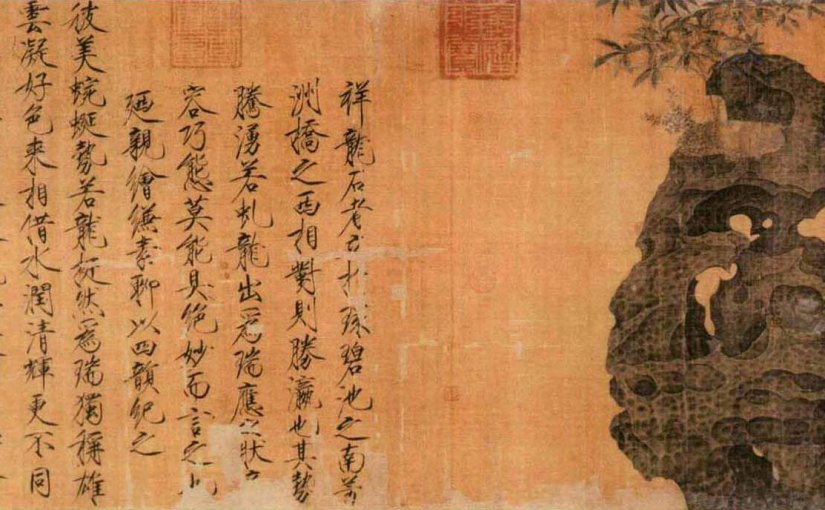
Auspicious Dragon Rock, painting and poem by Zhao Ji (the personal name of Emperor Huizong)

The Song dynasty was founded in 960AD following 60 years of turmoil after the fall of the Tang, China’s golden age. Like the Tang, it was a great era of garden building. It was a time of commercial prosperity, scientific and technological advancement, agricultural development and, as a consequence, population expansion. However, with powerful rivals to the north and west, contested borders, factionalism at court and the long shadow of the An Lushan Rebellion (which broke the power of the Tang) behind it, Song prosperity was tinged with hedonism and excess.

Portrait of Emperor Huizong, artist unknown

The eighth Emperor of the Northern Song was Huizong (1082-1135AD). He was a great painter – arguably one of China’s greatest – a calligrapher, a musician and poet. He wrote treatises on medicine and on tea. He was a patron of the arts, a fervent Daoist, an avid collector of paintings and antiques, and passionate about gardens. In particular, he loved rocks.

Five-coloured Parakeet on Blossoming Apricot Tree, attributed to Zhao Ji (the personal name of Emperor Huizong)

There were five Imperial parks in the Song capital Bianjing (now Kaifeng), four of which were situated at the gates on the four sides of the city. These parks were opened to courtiers and officials on set occasions, and one was opened to the general public for a short while each year. The fifth park, Genyue, the Northeast Marchmount, was for the private use of the Emperor and his guests. It was built beside the imperial residence on a site selected by a geomancer in the northeast of the city. He recommended that the earth be heaped up and artificial mountains constructed, to ensure the Emperor plenty of heirs. (The character ‘Gen’ 艮 of Genyue is from the I Ching and represents mountains, the northeast, and sons).

The construction of Genyue was, after long preparation, begun in 1118, but Huizong had been collecting plants, rocks, animals, and birds from much earlier in his reign. In 1105 a ‘Provision Bureau’ was set up in Suzhou. This was the base of the merchant Zhu Mian, who was especially talented at finding scarce and valuable Lake Tai stones, often in other people’s gardens. Some of these ended up in Zhu Mian’s own garden. To find materials for Genyue a ‘Flower and Rock Network’ was set up to transport huge quantities of rarities from all corners of the empire. The scale of this undertaking is hard to comprehend. Collectors sourced rare plants from as far as 900 miles to the south of the capital. The military were drafted in to help with transportation, and commoners were sent out to search in swamps and mountains for rare plants. A dedicated fleet of boats transported huge rocks along the Grand Canal to the capital, day and night, interrupting the normal transport of food and raw materials. In some places bridges were knocked down and irrigation systems destroyed to allow their passage. As well as the physical damage and disruption, the Flower and Rock Network spawned largescale corruption and waste, drained the imperial treasury, and was greatly resented by the common people.

The Cloud-Capped Peak, Lingering Garden, Suzhou, said to be one of a handful of ‘relic stones’ from those collected by Huizong. 6.5 metres tall, it weighs about 5 tons.

Completed in 1122, Genyue was a representation of the empire in miniature, a tradition dating back to earlier Emperors, most notably Qin Shi Huangdi himself. Depleting an empire to build a garden seems supremely frivolous now, but at the time such gardens had a ritual and religious aspect, giving the project a deeper meaning. As well as ensuring more sons, Huizong hoped to gain the favour of the Immortals for himself, his dynasty, and for Song China. Zhang Hao, an official writing soon after the events, during the Southern Song, recounted the story of the site’s geomantic significance:

…as predicted, there was a response [in the form] of numerous sons. From this time forward, there was regular security within the seas and lack of incident at the imperial court, and His Highness devoted quite a bit of attention to parks and preserves.

Record of the Northern Marchmount, Zhang Hao, translated by James M. Hargett p. 185 in The Dunbarton Oaks Anthology Of Chinese Garden Literature, A. Hardie and D.M. Campbell (Eds,)

The garden was not particularly large, when compared to other imperial parks. What was most remarkable about it was the size of the artificial mountain landscape,

…an artificial pile more than ten li in circumference, of ‘ten thousand layered peaks’, with ranges, cliffs, deep gullies, escarpments and chasms. In some places the structure rose two hundred and twenty-five feet above the surrounding countryside, and in others it fell away, through foothills of excavated earth and rubble, to ponds and streams and thickly planted orchards of plum and apricot.

The Chinese Garden, Maggie Keswick, p.53. ‘Li‘ is a historical measurement which has varied over time. In the Song dynasty, ten li was about 2.5 miles.

There were dozens of buildings dotted about this landscape, enumerated and named by the Emperor in his own account of the garden. There was an artificial cascade, operated by workers who rushed to open the sluice gate when the Emperor arrived. More prosaically, there was a farm with fields, orchards, and a herb garden. Besides entire transplanted forests of bamboo there were plants of all kinds. Huizong himself records some of the plants that were sent from around the empire.

…loquat (Eriobotrya japonica), orange (Citrus sinensis),
pomelo (Citrus grandis), sourpeel tangerine (Citrus deliciosa),
sweetpeel tangerine (Citrus reticulata), betel-nut palm (Areca catechu),
Chinese juniper (Juniperus chinensis), and lichee (Litchi chinensis)
trees, as well as gold moth (unidentified), jade bashfulness
(unidentified), tiger ear (Saxifraga stolonifera), phoenix tail
(Pteris multifida), jasmine (Jasminum grandiflorum), oleander
(Nerium oleander), Indian jasmine (Jasminum sambac), and magnolia
(Michelia figo) plants. Ignoring variations in geography and differences
in climate, all the trees and plants generated and grew…

Record of the Northern Marchmount, Emperor Huizong, translated by James M. Hargett ibid p.186

Above all, of course, there were rocks. Scholars’ rocks had become popular in gardens in the Tang dynasty, but Huizong took petromania to new extremes. Fantastically shaped rocks were arranged all over the garden. Names were bestowed upon them, and engraved, with the most important inscribed in gold.

Rock landscape in the Lion Grove Garden, Suzhou. Dating from the following Yuan dynasty, these contorted rocks are said to resemble lions and to this day are immensely popular.

Unfortunately, the use of the vast amounts of money and manpower expended on the garden weakened an empire surrounded by warlike rivals. Focusing on his garden and the arts, Huizong neglected economic policy and, most crucially, the military. In 1126 – just four years after Genyue was completed – the Jurchen, of the Jin empire to the north, laid siege to Bianjing. The garden was destroyed, its precious rocks flung from catapults, its trees cut for firewood, its rare animals killed and eaten by the army. Huizong was persuaded to abdicate in favour of his son. A temporary peace was cobbled together, but within a year, the Jurchen returned in greater force. They took Bianjing, sacked the city, destroyed or looted its treasures, and massacred many of the inhabitants. Huizong was taken north as a captive, given the mocking title Duke Hunde ‘Besotted Duke’. One of his sons, who avoided capture, withdrew south of the Yangtze and founded the Southern Song. Huizong died in Heilongjiang in 1135, a prisoner of the Jin dynasty to whom he had lost the heartlands of his country.

Poetry and the Chinese Garden

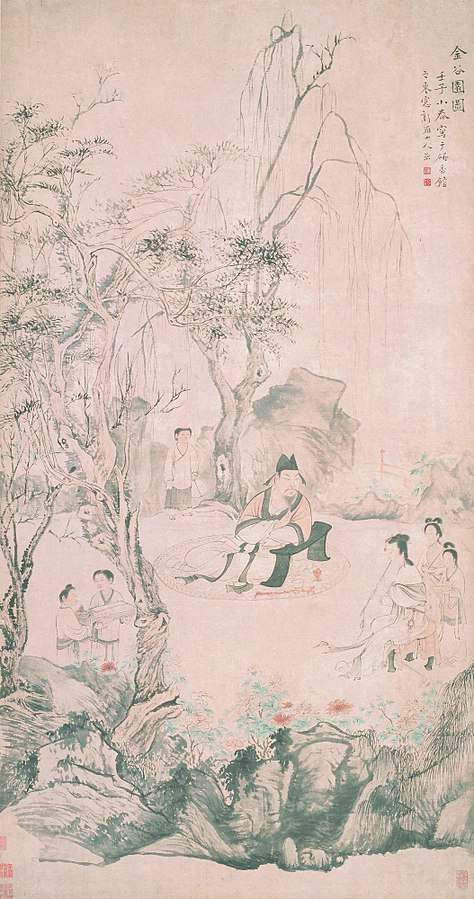
During the turbulent Six Dynasties period (220-589AD) after the fall of the Han, ministers and officials came and went as power at court changed hands. Having lost their positions, disappointed scholars retired to the country to live in seclusion and build gardens. This became a recurring theme in Chinese garden history. One of these, a wealthy aristocrat and former provincial governor called Shi Chong, built a garden northeast of the capital Luoyang in 296AD, called Jingu Yuan, the Garden of the Golden Valley. This was no simple rural retreat, however, but an extravagant and elaborate garden which inspired emulation through the centuries.

Hua Yan (1682–1756) Golden Valley Garden
金谷園圖

He invited thirty poets to a banquet at which they were required to compose a poem each – those who failed were ‘punished’ by being required to drink an immoderate quantity of wine. The resulting collection Poems from the Golden Valley began a long association between poems and gardens in Chinese culture, in which gardens became both a location for composing poetry and the subject thereof. In turn, gardens were inspired by poems and literary works.

Wen Zhengming (1470–1559) A Graceful Gathering at the Orchid Pavilion
兰亭修禊图

Another famous early example of this association was the Liubei Tang, the Garden of the Floating Cup. In 353AD, the poet, calligrapher, and general Wang Xizhi held a gathering of poets at a garden called the Orchid Pavilion, where King Guojian of Yue is supposed to have planted an orchid in the 5th century BC. Seating them beside a winding stream, he floated cups of wine. If a poem came to rest beside a guest, he had to drink the wine and compose a poem on the spot. This was much imitated and became a feature of many later gardens. The poems themselves are much less well regarded than Wang’s Preface to them. The pavilion and garden still exist, as well as a stele bearing what is said to be Wang Xizhi’s calligraphy.

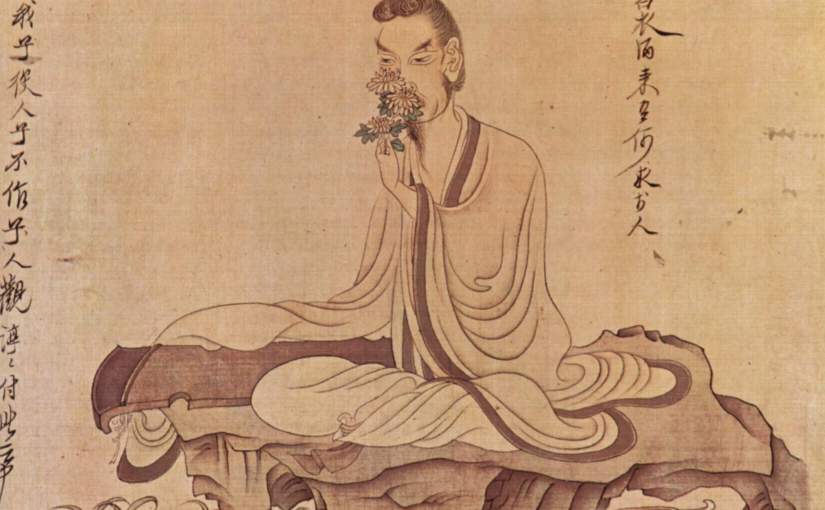
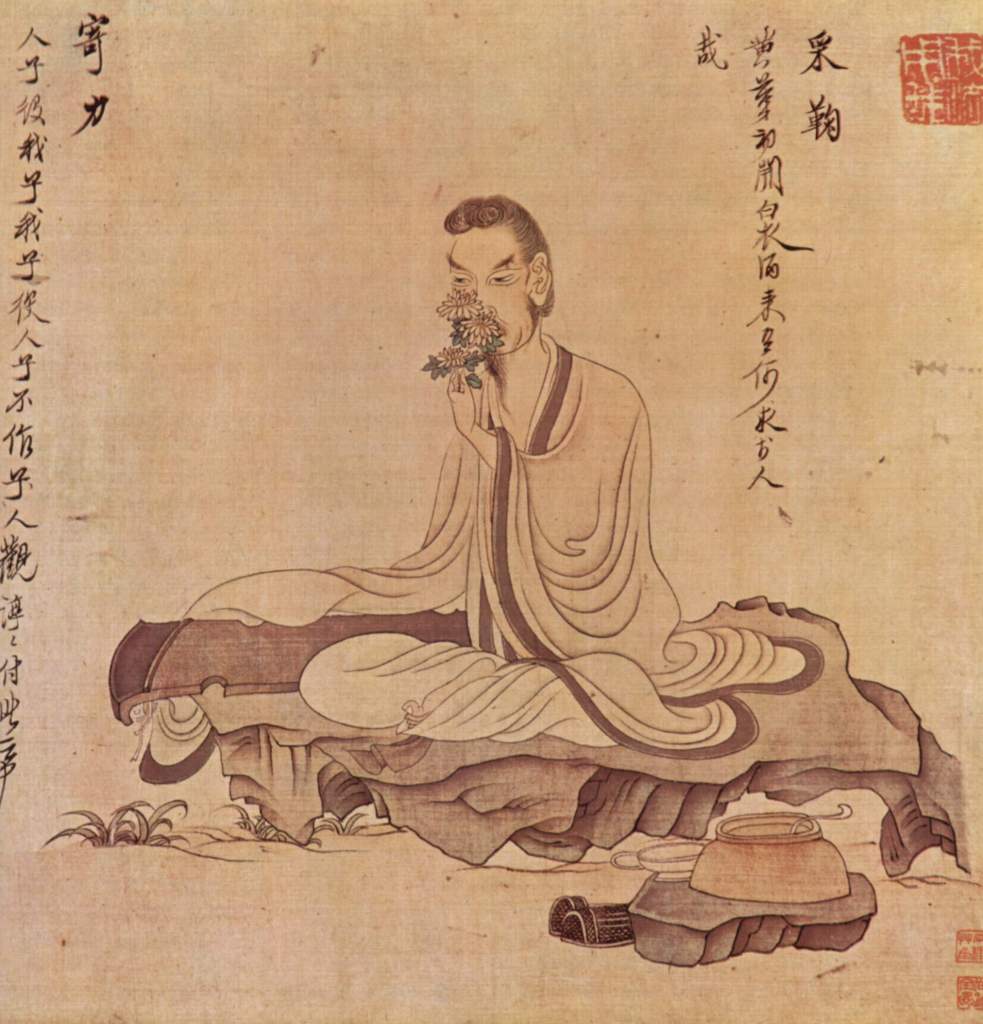
Chen Hongshou (1598-1652) Painting of Tao Yuanming

Tao Yuanming (365-427AD), author of The Peach Blossom Spring, was another scholar who withdrew from the world. Always reluctant to participate in public life, he endured poverty to live in seclusion and cultivate himself in the Daoist tradition. He wrote poetry and gardened, as well as farming to feed himself and his family.

Drinking Wine (#5)
I’ve built my house where others dwell
And yet there is no clamour of carriages and horses
You ask me how this is possible– (And so I say):
When the heart is far, one is transported
I pluck chrysanthemums under the eastern fence
And serenely I gaze at the southern mountains
At dusk, the mountain air is good
Flocks of flying birds are returning home
In this, there is a great truth
But wanting to explain it, I forget the words

Tao Yuanming

To this day he is the archetype of the refined gentleman hermit, and chrysanthemums have been closely associated with him throughout history. He was one of the originators of the ‘Field and Garden’ genre of poetry.

Wang Wei, Wangchuan Villa

The Tang dynasty, which followed the turbulent Six Dynasties period, was a golden age of Chinese culture, including gardens. One famous Tang garden was the Wangchuan garden of the poet, painter, and administrator Wang Wei (701-761AD). The garden included 20 landscape scenes to be viewed from set viewpoints. Wang wrote poems to go with each scene and also painted them. The gardens, poems, and paintings were hugely influential in later years.

The Garden of the Golden Valley

Scattered pomp has turned to scented dust
Streaming waters know no care, grass spreads and claims spring as its own
At sunset, an East Wind carries the sound of crying birds
Petals on the ground are her likeness still, beneath the tower where she fell

Du Mu (803–852)

In the late Tang the poet Du Mu wrote this poem (translation from here) about Shi Chong’s Garden of the Golden Valley, built 500 years earlier. Shi Chong ultimately came to a sad end. A rival, jealous of Shi Chong’s beautiful concubine Lüzhu, framed him for treachery. Shi Chong was executed and Lüzhu threw herself to her death from a tower in the garden.

Love, Immortality and Utopia – The Symbolism of Peaches

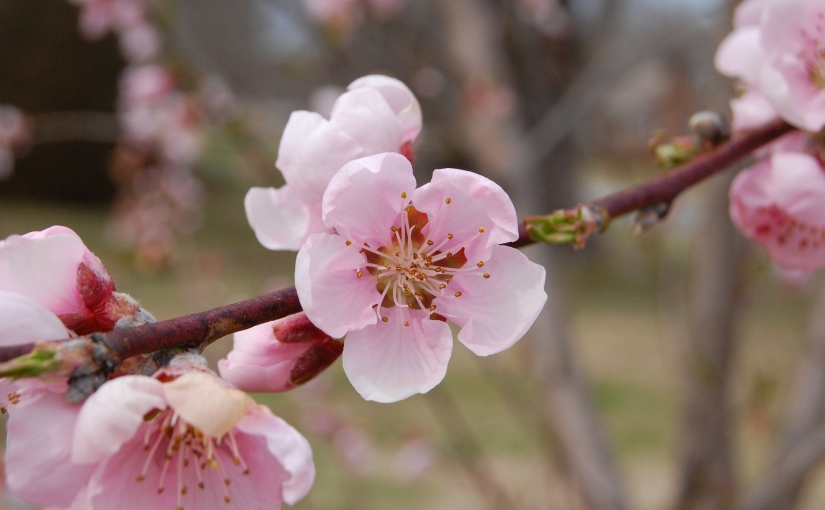
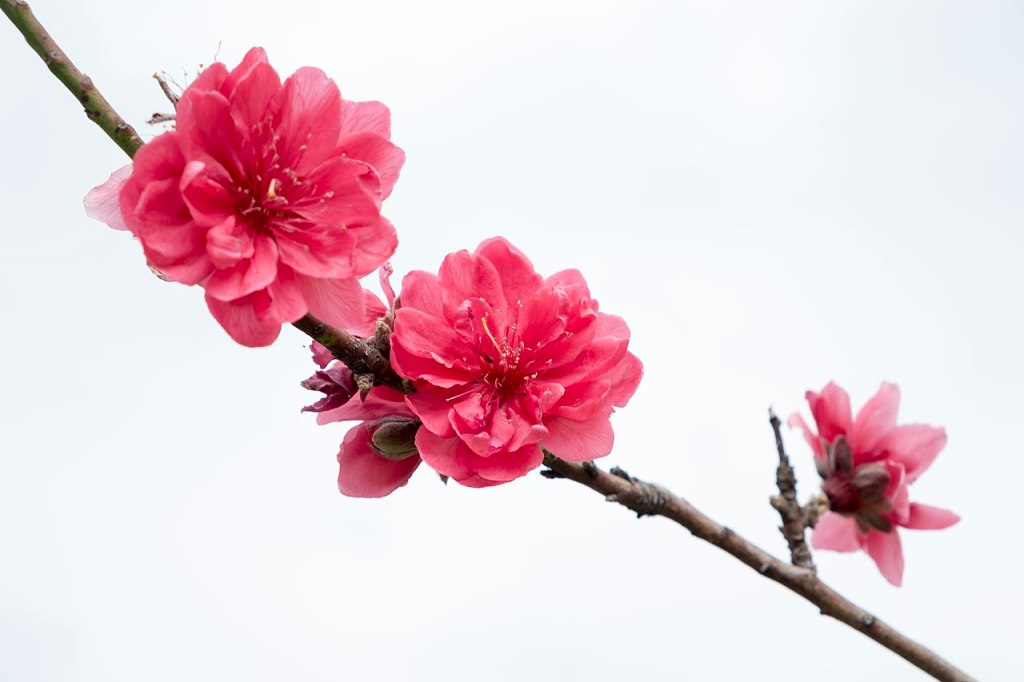
Peaches have been cultivated in China for about 3000 years, originally for food and medicinal purposes, and poems about the beauty of peach blossom date to 600BC, showing their early use as an ornamental. By the Song dynasty (960-1279AD), several varieties had been bred with double flowers in reds and whites as well as pinks.

Each part of the tree has its own symbolism. Peach blossom opens in spring, the season of romance, and is strongly associated with love, and with feminine beauty.

Within this gate on this same day last year,  
Cheeks and peach flowers out bloomed each other here.  
Her very cheeks can now be found no more.  
The peach flowers smile in spring wind as before 

Cui Hu (translated by Ma Hongjun).

This very well known poem from the Tang dynasty has formed the basis for many romantic stories and operas and given rise to a chengyu (Chinese idiom) 人面桃花 rén miàn táo huā, her face is like a peach blossom, to describe a woman’s beauty.

Today, peach blossom is one of the flowers used to decorate at Chinese New Year, and is especially popular with single people hoping for ‘peach blossom luck’ – luck in love.

The peach itself has long been a Taoist symbol of immortality. Xiwangmu, the Queen Mother of the West, lives on the mythical Mount Kunlun and grows peaches in her orchard. They produce fruit every three thousand years and confer immortality on anyone who eats them.

The wood of the peach tree is said to ward off demons. Swords carved from peach wood were used in Taoist exorcisms, and feature as magical weapons in martial arts legends.

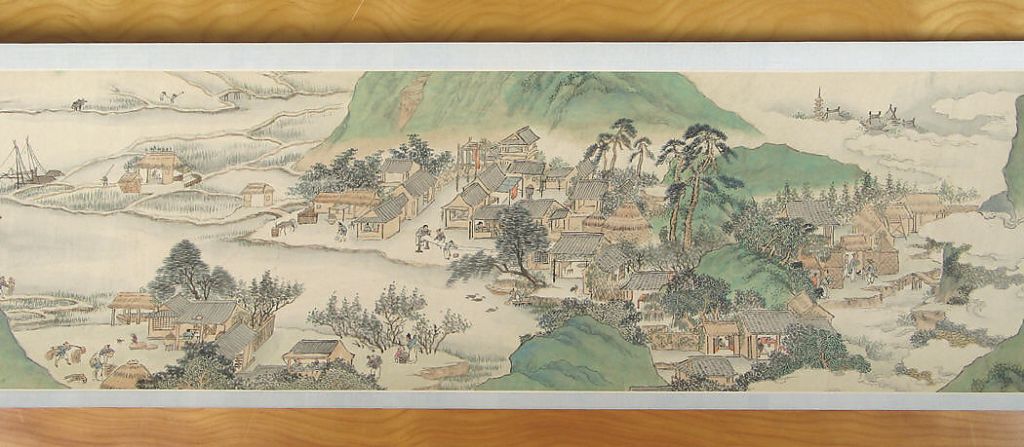
Peach Blossom Spring by Zhang Hong, Ming dynasty

One further literary association which was highly influential in the development of the Chinese garden was the story of ‘The Peach Blossom Spring’. Written in 421 AD by Tao Yuanming, it told of a fisherman who followed a stream through a forest of blossoming peach trees to a cave at its source. Squeezing through this cave he found a hidden village, surrounded by beautiful scenery and fertile fields, where people lived happy and tranquil lives, cut off from the world for many generations. He met with a warm welcome and stayed for a while, but then wanted to return home. He was warned that it was pointless to tell anyone else or to try to find his way back to the village later, and so it proved. The story inspired many paintings and poems, as well as influencing gardens, and gave rise to a chengyu – 世外桃源 shìwaì taóyuán, the Peach Spring beyond this world, which means a utopia.

National Beauty and Heavenly Fragrance: the Chinese Peony

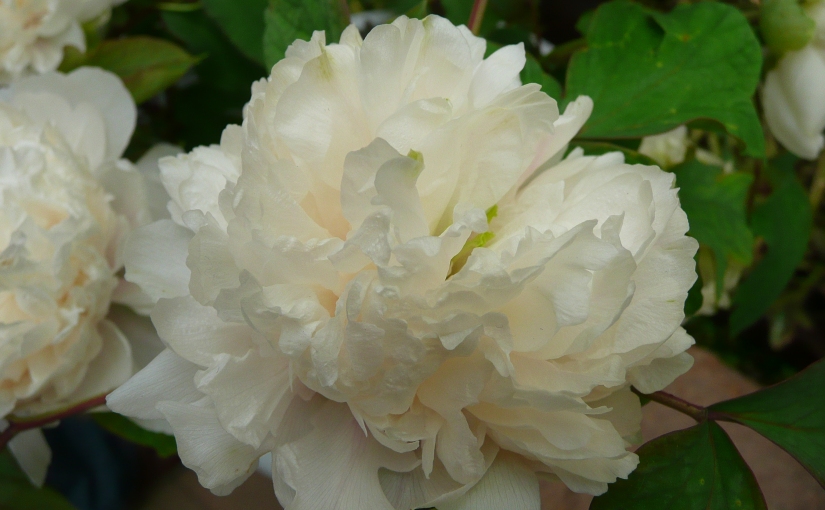
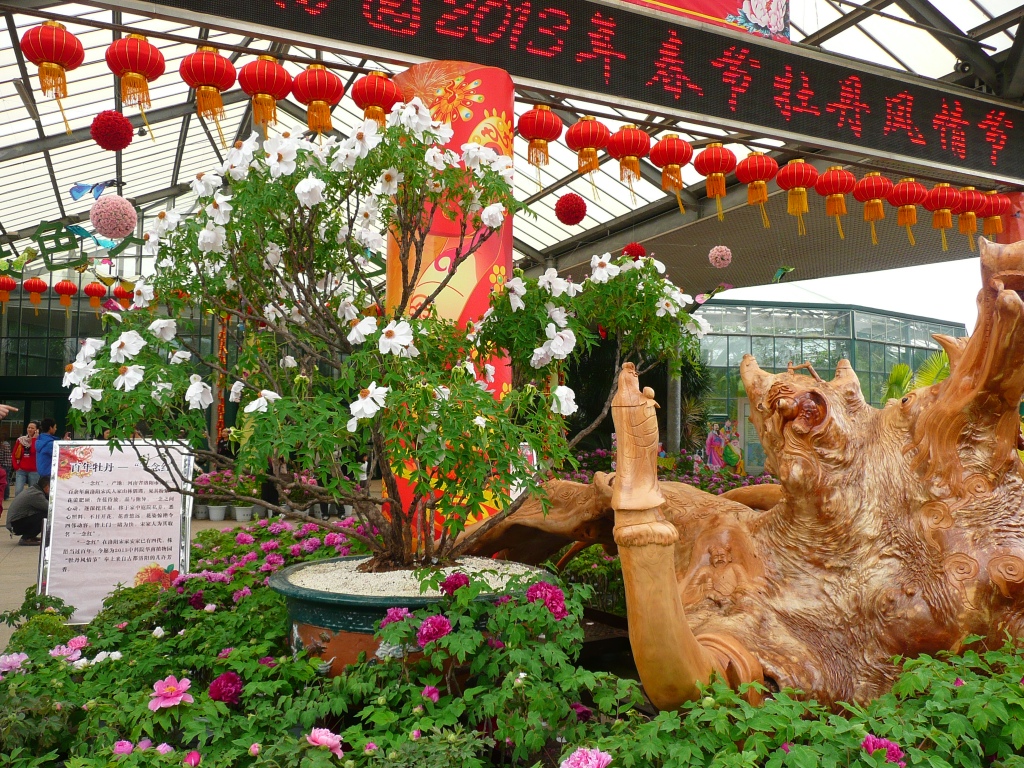
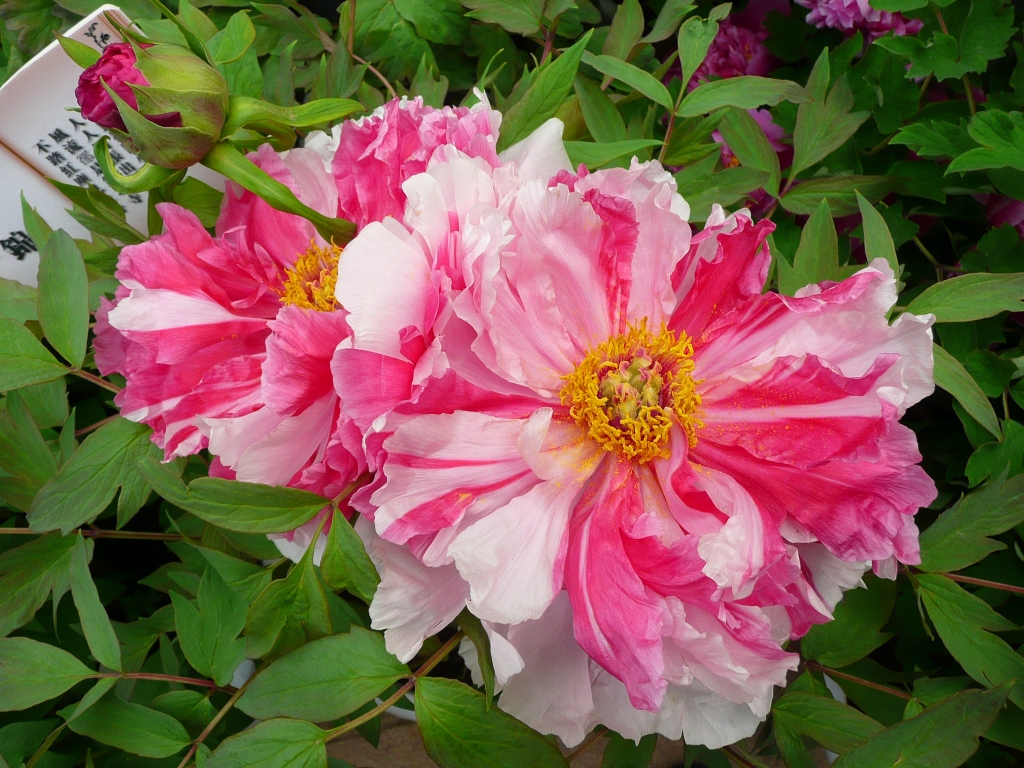
A symbol of wealth and honour, peonies are known as the King of Flowers and have been cultivated in China for millennia. Like many traditional plants of the Chinese garden, they were originally cultivated for medicinal purposes and are mentioned in the Shennong Bencao Jing, an ancient materia medica written circa 200-250 AD, recording oral traditions dating back much further. Some records indicate they were cultivated as far back as the Xia (the possibly mythical first dynasty, 2000-1766 BC).

New Year peony festival at the South China Botanical Garden, Guangzhou

Before the Qin dynasty (221-206 BC) not much distinction was made between herbaceous peonies, shaoyao, and tree peonies, mudan, which were simply called tree shaoyao. Paintings from around 400 AD depict peonies in the background, showing that they have been cultivated as ornamentals for at least 1600 years. By the Sui dynasty, 581-618 AD, individual varieties were being recorded, and twenty boxes of peonies were sent as tribute to the Emperor from Hubei. In the early Tang dynasty, peonies were an imperial flower, only permitted to be grown in imperial gardens. They soon spread, however, and were planted in temple and monastery gardens. In the 8th century they were introduced to Japan by a Buddhist monk.

Peonies, by Yun Shouping, 17th century

There is a legend that the Tang Empress Wu Zetian visited a garden in the winter. Nothing was in flower, so she ordered all the plants to bloom. The next day, despite the snow, all the plants had obeyed the Empress and flowered, except the peony. Enraged, she banished it from the capital to Luoyang, where it bloomed profusely. Subject to the vicissitudes of war and changing dynasties, Luoyang has been the capital of China’s peony industry ever since.

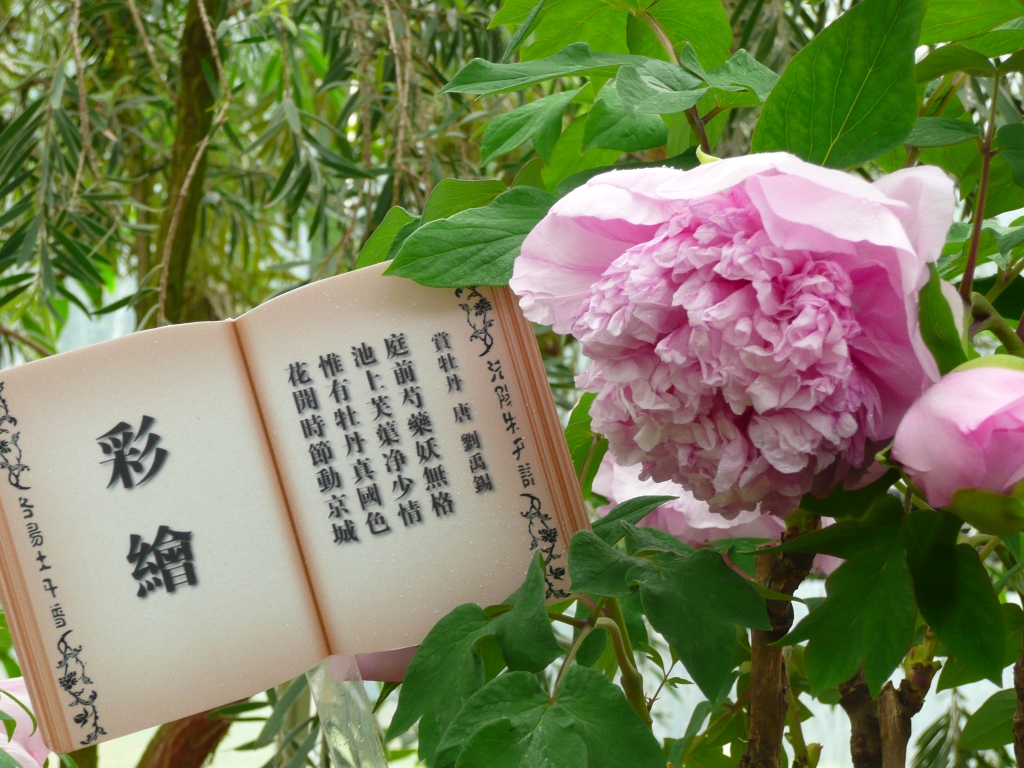
Paeonia x suffructicosa ‘Cai Hui’, Brightly Coloured Painting

The first monograph on peonies, written in 1034 AD, described 24 double and semi-double varieties. The large double ‘Thousand-Petalled’ varieties were the most popular, new varieties costing as much as a hundred bushels of rice. At least two of the varieties, Yao’s Yellow and Wei Purple, are still in cultivation. By the 1800s, a single plant could cost 1000 coins.

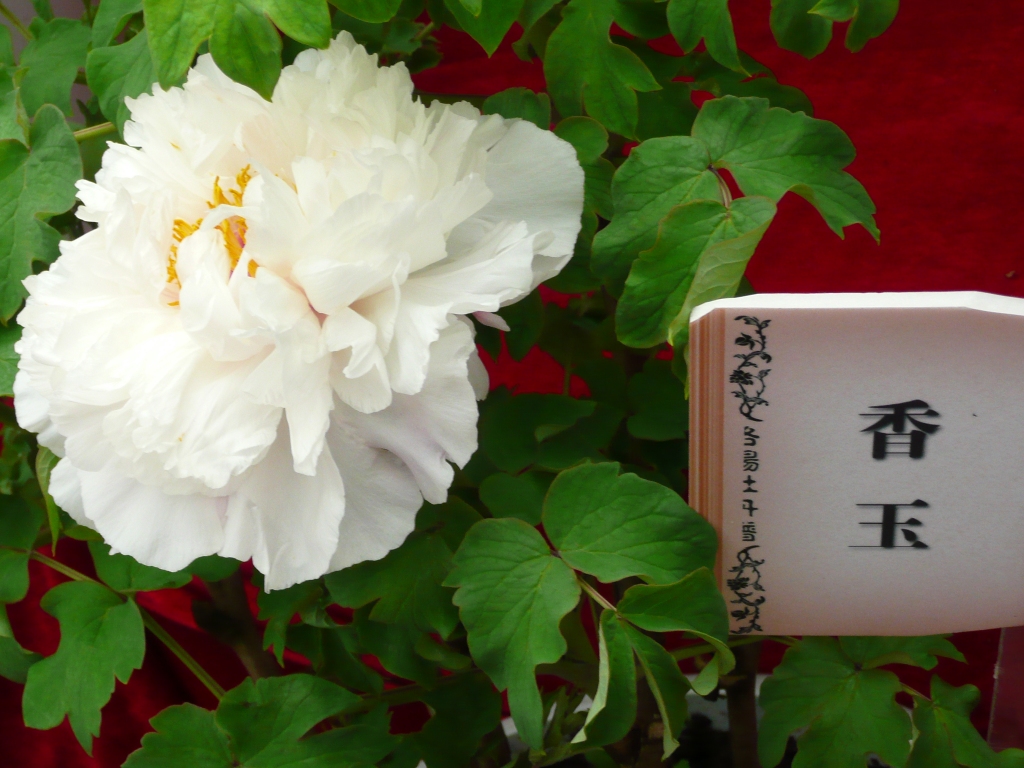
Paeonia x suffructicosa ‘Xiang Yu’, Fragrant Jade

In 1655, English visitors from the East India Company saw peonies in Beijing and sent accounts home. More than a hundred years later, in 1787, Joseph Banks asked the Company’s representative in China, Alexander Duncan, to send plants to Kew. The Kew plants have not survived but a plant from that first introduction was moved from Duncan’s own garden to the Edinburgh Botanical Gardens and can still be seen there.

Further introductions through the late 18th and early 19th century culminated in Robert Fortune’s third expedition, 1848-1851, when he obtained 30 of the best tree peonies available in Shanghai, as well as herbaceous peonies for grafting. The latter half of the 19th century saw hundreds of peony varieties offered for sale by nurseries across Europe. Kelways nursery in the U.K., famous for peonies, dates from this period.

The peony was the national flower of China until 1928, when the government of the Republic of China replaced it with the plum blossom instead, which was a symbol of resilience in hard times, and not as closely associated with China’s imperial past. The People’s Republic of China has no official national flower, though the peony consistently tops polls held to choose one, by a huge margin.

Willows in the Chinese garden

Willows by West Lake, Hangzhou

Willows are one of the plants most closely associated with Chinese gardens. In the West, they are inextricably linked with China through ‘Willow Pattern’ plates – though in fact the pattern originated in England, part of the 18th century craze for Chinoiserie.

Though the ‘Willow Pattern’ itself is inauthentic, willows are truly an essential plant in the Chinese garden.

The weeping willow, Salix babylonica, is native to northern China and probably made its way to Europe along the Silk Road. It was named by Linnaeus, and the specific epithet is due to the fact that, through a mistranslation, it was incorrectly believed to be the tree mentioned in the Bible as growing ‘by the rivers of Babylon’. Many of the weeping willows seen in the U.K. nowadays are hybrids between Salix babylonica and forms of our native willow, Salix alba, which are better suited to our climate.

Willows in Tongli water town, Jiangsu

In Chinese culture, willow has a number of symbolic meanings. It is associated with spring and rebirth. Its pliability suggests meekness and humility. It is associated with friendship, because of its intertwining branches, and also with parting from friends. Traditionally a willow branch was given as a parting gift, because its name in Chinese – 柳 liǔ – sounds like a word for ‘stay’. It was believed to have the power to repel evil spirits, and was used to sweep tombs on the Qingming festival. A branch might be fixed to the front door of a house to ward off harm.

Leifeng pagoda, West Lake, Hangzhou

Willow was also a symbol of female beauty, sometimes compared to the waist of a beautiful woman in poems. Its pliability also suggested frailty, however, and its combined associations with spring, the season of sexual desire, and femininity, meant it was also used as a symbol for prostitution. So the innocent sounding chengyu (Chinese idiom) 花街柳巷 Flower Street and Willow Lane actually means a red light district.

Willows by the pond in the Lingering garden, Suzhou

In the Chinese garden, willows are planted beside water. They are one of the few plants mentioned by name in Ji Chang’s The Craft of Gardens, where he always mentions planting them by water. The rectangular lattice work windows were known as willow leaf pattern.

What is a Chinese garden?

Cloud Capped Peak in the Lingering Garden, Suzhou

It is sometimes said that a Chinese garden is built rather than planted. The essential physical elements are rocks, water, plants, and buildings. Ji Cheng, in the Ming classic The Craft of Gardens (1631) recommended starting a garden with water. In the Chinese garden, as in the landscape, water is yin, the opposite of mountains which are yang. The two opposites in balance embody the harmony of nature.

“For every ten parts of land, three should be made into a pond, of irregular shape so that it is interesting, and preferably made by dredging out an existing stream. Of the remaining seven-tenths, four should be built up with earth – how high or low is of no importance – and be planted with bamboo in a harmonious way.”

(Ji Cheng, The Craft of Gardens)
Artificial mountain with grotto beneath overlooking a pond. Pearl Pagoda Garden, Tongli

Rocks in the garden are often piled up to make an artificial mountain, with a path leading to a pavilion on top. The views from the top are carefully planned. There may be a grotto beneath. Both mountain and grotto echo the abodes of the Daoist Immortals.

‘Bamboo Shoot’ rocks in the Couple’s Retreat Garden, Suzhou

Individual rocks are admired for their aesthetic qualities, and have been for centuries. The most famous of these ‘Scholars’ Rocks’ are called Taihu rocks, limestone features formed by erosion deep in Lake Tai. From the Tang dynasty onwards it became fashionable to use these in gardens. The ‘Cloud Capped Peak’ in the first photo is a famous Taihu rock, said to be a relic from the collection of rocks ordered by Emperor Huizong (reigned 1100-1126 AD) of the Song dynasty.

Rocks may also represent imaginary landscapes, as in this penjing in the Lion Grove Garden, Suzhou:

Buildings are a vital part of the Chinese garden. A large part of The Craft of Gardens enumerates the many types of different structures that can be constructed, as well as discussing in detail elements such as walls, doorways, lattice windows, paving, and bridges.

Doorway in the Couple’s Retreat Garden, Suzhou. This is a visual pun – ‘ping’, the word for vase, sounds like the word for peace.

Many traditional Chinese houses are built around one or more courtyards. With the addition of various pavilions, halls, and of course a library (no scholar’s garden could be without one) the division between inside and outside is often not clearly marked, especially in the warm sub-tropical south of the country. Buildings in the garden are released from the formal Confucian regularity of the main house, and indeed symmetry is to be avoided.

“…buildings in gardens are different from ordinary dwelling-houses, for they must have order in variety and yet their orderliness should not be too rigid: even this orderliness should have a pleasing unpredictability, and yet at their most diverse there should be an underlying consistency.”

(Ji Cheng, The Craft of Gardens)
Building in the Lion Grove Garden, Suzhou

The last element in the Chinese garden is the plants. Although China – described by E.H. Wilson as ‘The Mother of Gardens’ – has huge botanical diversity, Chinese gardens use a fairly restrained palette of plants.

Lotus pond in the Humble Administrator’s Garden, Suzhou

They are mostly chosen for their symbolic value, with meanings acquired over many centuries. Many of these will be dealt with in more detail in later posts. Key Chinese garden plants include bamboo; pines; willows; chrysanthemums; orchids; peonies; plum (Prunus mume, more commonly known in the West as Japanese Apricot); lotus; wisteria; and peach.

Bamboo and rock, framed through a window and against a white wall to create a living painting in the Lingering Garden, Suzhou

A Westerner reading The Craft of Gardens may be surprised by how little mention is made of plants, with very few mentioned by name, and only one snippet of what we might consider gardening advice (on training roses).

Subtropical planting in the Qinghui Garden, Shunde, Guangdong. This southern garden in the Lingnan style boasts over 100 species of plants.

Ji Cheng considered the placing of garden buildings and features, perhaps especially rocks, as more difficult and requiring of a refined taste and a sensitivity to the nature of the site.

“The hidden significance of mountains and forests needs deep study, whereas the temperament of flowers and trees is easy to grasp.”

(Ji Cheng, The Craft of Gardens)

Indeed it is the atmosphere of a Chinese garden, its indefinable essence, that is the most important element of all. A Chinese garden is a microcosm of the world, and a retreat from it. Inspired by nature, it is a work of careful artifice. It is a search for immortality which at the same time reminds us of the passing of the seasons and the transience of life.

It is hard to appreciate all the beauty of the Chinese garden without some understanding of its history and place in an ancient horticultural tradition, its religious and philosophical roots, its inspiration in the Chinese landscape and its links to Chinese artistic culture, especially painting and poetry. These elements will be addressed in later posts.