One of the greatest plant-hunters of the early twentieth century, Ernest Henry ‘Chinese’ Wilson was born in 1876 and began his horticultural career as an apprentice at a local nursery before going on to study at Birmingham Botanical Gardens. In 1899 he was working at Kew when he was chosen to go on a plant-hunting expedition to China for Veitch’s nursery.

The aim of this first expedition was to find specimens of Davidia involucrata, the handkerchief tree, an almost legendary rarity discovered in 1866 by Pere David Armand. A lone tree in a single location had been seen twelve years previously by Augustine Henry. Harry Veitch, employing a number of plant-hunters at the time, advised Wilson to stick to the one thing he was searching for and not waste time and money wandering about as probably every worthwhile plant in China had already been introduced. Wilson was to prove him spectacularly wrong.
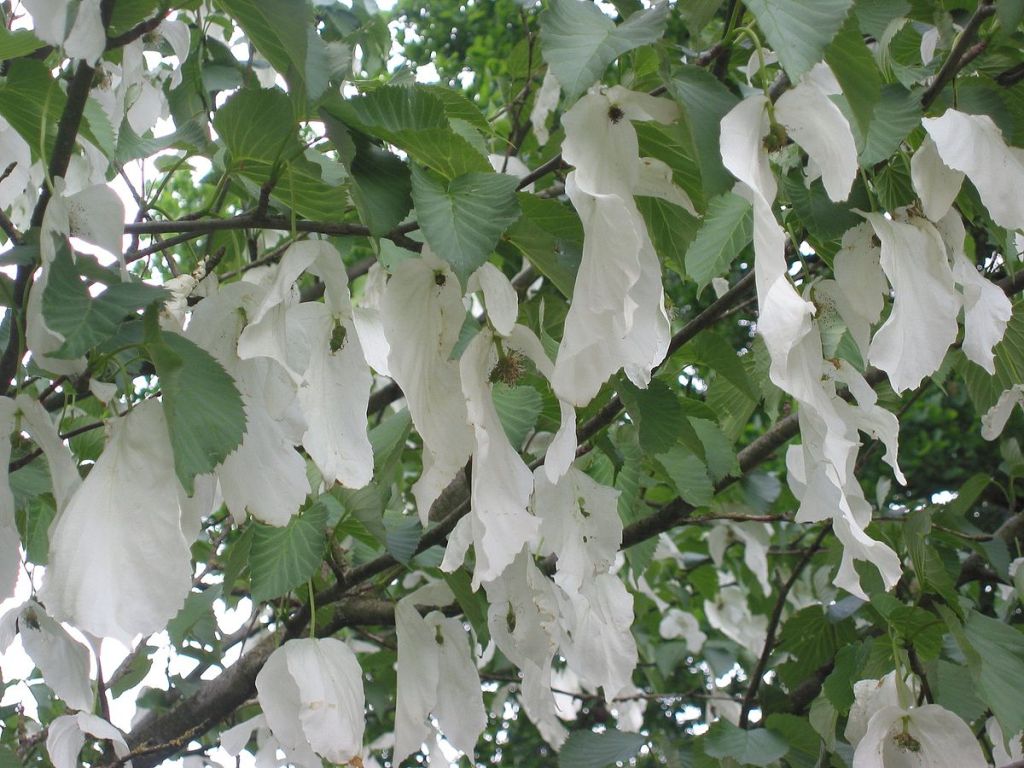
Wilson’s first objective was to reach Henry, then stationed in a remote town in Yunnan. The journey, by river and mule, was arduous and dangerous, complicated by the unstable political situation, plague epidemics, and recent anti-foreign riots. Having met and consulted with Henry, Wilson set out armed with a sketch map marked with a cross representing the single tree Henry had found in the course of a six month trip. Wilson eventually reached the location of the previous sighting after a journey he described euphemistically as “exciting”, only to find that the tree had recently been felled to make way for a new house. Undaunted, he eventually managed to locate a grove of flowering trees in Hubei. In the same month, he made a discovery less celebrated but now probably better known – ‘Wilson’s Chinese Gooseberry’, now known as the kiwi fruit. Making his base at the town of Yichang on the Yangtze river, he spent the next two years exploring and collecting seeds. Despite the danger of plague and outbreaks of rebellion, he collected seed of 305 different species and 35 Wardian cases full of plant material, as well as dried herbarium specimens, representing over 900 species in total.
Wilson’s second trip to China in 1903 was in search of the yellow poppy Meconopsis integrifolia. He was able to hire many of the of the men who had worked with him on his previous expedition. In contrast to some other Western plant-hunters of the time, Wilson respected and got on well with the Chinese people he met and employed. Travelling from Sichuan into Tibet, he secured seed of both Meconopsis integrifolia and the red Meconopsis punicea. He suffered from altitude sickness and other illnesses, cured with “large doses of opium” and had lost almost three stone by the time he reached Songpan in Sichuan. He returned to England in 1905, with the seed of over 500 species and 2400 herbarium specimens, including Lilium regale, the species he was most proud of introducing in his remarkable career.
Wilson’s third expedition to China was undertaken on behalf of the Arnold Arboretum of Harvard University. Their interest was primarily in woody plants, but the expedition was partially funded by subscribers, for whom Wilson was to look for orchids and lilies amongst other things. The Arnold Arboretum also asked Wilson to photograph as much as he could. His photographs, taken on a plate camera, were quite remarkable for the time and are now in the Arboretum’s archive. Some can be seen here:
Surviving famine and a bad bout of malaria, Wilson shipped huge amounts of plant material to the United States in 1908, including thousands of lily bulbs. Unfortunately, almost all of the bulbs rotted in transit.

It was to collect more lily bulbs in particular that Wilson was reluctantly persuaded to make one last expedition to China, with serious consequences. He always travelled with a sedan chair, though he rarely used it, as it was a kind of badge of respectability that allowed the traveller to pass freely. Wilson considered it better than a passport. For once he was being carried in the chair, on a narrow mountain road, when the expedition was hit by an avalanche. Wilson managed to get out of the chair just before it was carried over the edge, but was hit by falling rock and broke his leg in two places. Fortunately only one of the porters was injured and no one was killed. While the leg was being immobilised with splints improvised from the camera tripod, a mule train came up. Wilson could not be moved and the mule train could neither pass on the narrow track, nor wait in case of further rockfalls, so he lay across the road and the mules stepped over him. After that it was a three days’ forced march back to the nearest medical attention in Chengdu. Infection set in and he came close to losing his leg. After three months he was well enough for the journey back to the States, but the leg never healed properly and he walked with what he called his ‘lily limp’ for the rest of his life.
This was the end of his travels in China. Between 1911 and 1915, he collected specimens in Japan for the Arboretum, including 63 named flowering Cherry forms, and in 1917 he made an expedition to Korea and Taiwan. His wife and daughter joined him on these trips. Wilson named Rosa helenae and the bamboo Fargesia murielae after them.
Ironically, given the dangers and privations he had survived on his collecting trips, Wilson died in a car accident in the States in 1930, three years after becoming Keeper of the Arnold Arboretum.
In total, Wilson introduced about 2000 Asian plant species to the West. Sixty species of Chinese plants are named after him.
Some plants named after Wilson:
Chrysanthemum ‘E H Wilson’, Corydalis wilsonii, Cymbidium wilsonii, Ensete wilsonii, Exochorda giraldii var. wilsonii, Gentiana wilsonii, Hypericum wilsonii, Magnolia wilsonii, Meconopsis wilsonii, Phalaenopsis wilsonii, Picea wilsonii, Primula wilsonii, Styrax wilsonii, Trachelospermum jasminoides ‘Wilsonii’. Sinowilsonia is a monotypic genus which commemorates the nickname ‘Chinese’ Wilson.
 Japonica Plants Nursery