The Asian Garden U.K. Blog

Plant profile: Zingiber mioga, Japanese Ginger

Zingiber mioga, commonly known as Japanese Ginger, is a hardy rhizomatous perennial originating from Japan, China, and Korea. It’s an excellent ornamental plant and can add quite a tropical feel in a shady spot where other exotics might not thrive.

The species has green leafy stems to about 1m, 3ft, and pale yellow orchid-like flowers at the base of the plant in September. It’s very hardy and likes woodland conditions in at least partial shade. It doesn’t like to be too wet in the winter. There is a slightly more vigorous form, Z. mioga ‘Crug’s Zing’, collected by the Wynn-Joneses in Korea, which has delicate pink flowers.

Zingiber mioga ‘Dancing Crane’

There are also three variegated cultivars, ‘Dancing Crane’, ‘Silver Arrow’ and ‘White Feather’. These are still hardy, though not as bone hardy as the species, so a protective winter mulch might be wise in colder areas. Of the three, ‘Dancing Crane’ is the most strongly variegated, with broad white streaks on a slightly shorter growing plant. ‘Silver Arrow’ is also quite distinctive, with marked creamy veining radiating from the leaf base. ‘White Feather’ has a more subtle variegation, with a narrow white edge to the leaves.

Zingiber mioga ‘Silver Arrow’

The flower buds and young spring shoots are eaten in Japanese and Korean cuisine., and the plant is used medicinally in China. Although related to true ginger, Zingiber officinale, the roots of Zingiber mioga are not edible, and neither are the leaves or stems.

The Japanese name of the plant, Myoga, has a number of stories attached to it. In one, a forgetful disciple of the Buddha struggled to remember his own name. When told to wear a name tag, he would forget that he was wearing it. When he died and was buried, an unfamiliar plant was found growing beside his grave and named ‘Myoga’ (the kanji of which literally mean ‘to carry a name’) in memory of his efforts.

Much later, in the 16th century, Myoga stalks were apparently woven into sandals for horses called umagutsu, which helped traction in wet conditions and also disguised the sound of horses’ hooves. To discourage people from eating the shoots and ensure a plentiful supply of the useful stems, the above story was turned around to associate Myoga with forgetfulness, and claim eating it made you stupid.

Myoga buds are one of the 10 most common family crests in Japan. During the Sengoku period, many samurai chose Myoga as their symbol on the battlefield as the name is a homophone for ‘luck’.
Koten Engei, the Japanese tradition of classical plants

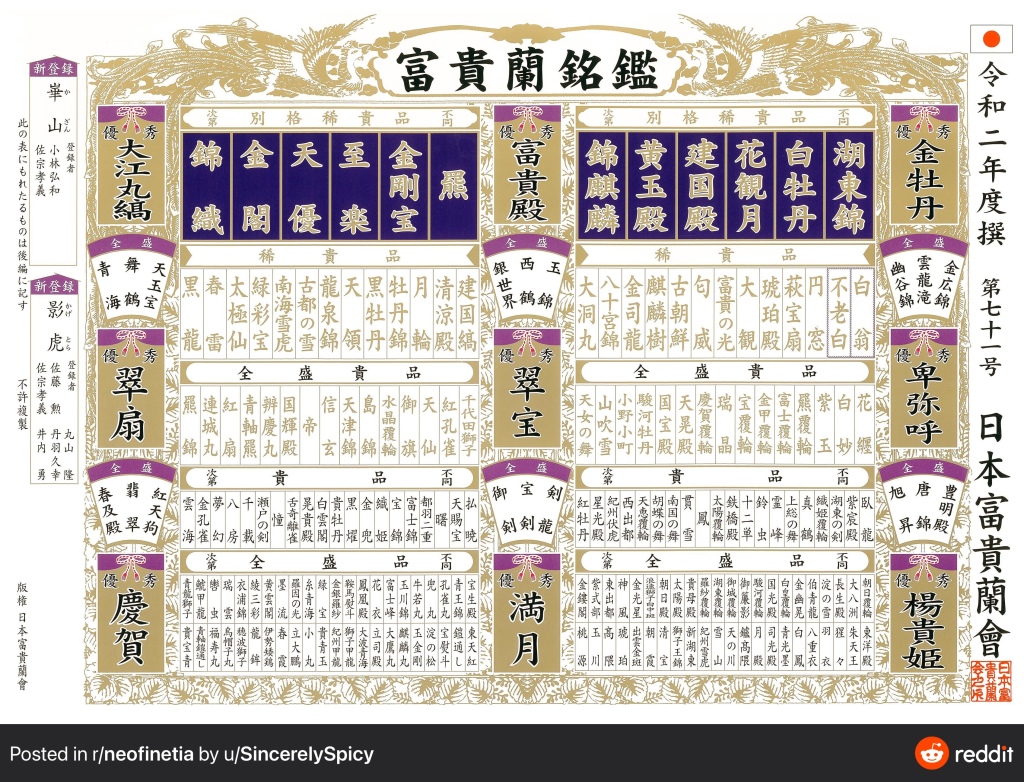
Koten engei (literally ‘classical horticulture’) is the Japanese tradition of (somewhat obsessively) growing and displaying select groups of Japanese native plants with a focus on natural variations and mutations. Plant societies hold shows and the plants are displayed in special hand-made pots, which themselves are often very beautiful. The emphasis is almost always on foliage, with flowers a bonus rather than the main attraction. The societies classify and rank varieties in a document called a meikan, published once a year and based on the ranking system for sumo wrestlers.

2020 Meikan for Neofinetia falcata orchids, issued by the Japan Fukiran Association

Variegated plants are highly valued in Japanese horticulture, and koten engei plants are no exception, with the various patterns of variegation classified and named. Often, the more highly variegated (and therefore weaker and more difficult to grow) plants are the most prized. Unusual leaf shapes and dwarf forms are also valued. In some plants, such as Neofinetia orchids, shapes of leaf joints and the colours of root tips are assessed and ranked.

Small Rohdea japonica collection by Untei Sekine, 1832

The popularity of various koten engei plants waxes and wanes in a cyclical fashion over the years, with particular plants creating mini-booms rather like the Dutch tulip mania of the seventeenth century. There are around 30 koten engei shokobutsu – plants of the koten engei tradition- mostly native to Japan with a few introduced long ago from China and Korea. These include Rohdea japonica (Omoto, the Japanese Sacred Lily), Ardisia japonica, Nandina, Asarums (Wild Gingers), Neofinetia falcata orchids (now Vanda falcata), dwarf Rhapis excelsa (Lady Palms), Chrysanthemums, and Morning Glories (Ipomoea nil) amongst others.

Plant Profile: Deinanthe

Deinanthe is a small genus, of only two species, closely related to hydrangeas and rarely grown in U.K. gardens. Commonly known as false Hydrangeas, the botanical name comes from the Greek Deinos meaning extraordinary, and anthos meaning flower. They are herbaceous perennials, very hardy, slowly forming a clump about 15-18″, 40-50cm tall and wide. They are woodland plants and need partial to full shade and a humus rich soil. Summer moisture is essential – they will not tolerate drying out. Watering should be reduced as the growing season comes to an end.

Deinanthe bifida ‘Pink-Shi’

Deinanthe bifida is a Japanese endemic, introduced to the West by the Russian botanist C. J. Maximowicz in 1860. The flowers are white. A few varieties are available, such as ‘Pink Shi’ and ‘Pink-Kii’, which have pink buds opening to slightly pink-tinged flowers, and may occasionally produce a few sterile florets. It is slightly larger and easier to grow than Deinanthe caerulea. The hydrangea-like leaves are split at the end rather attractively.

Deinanthe caerulea

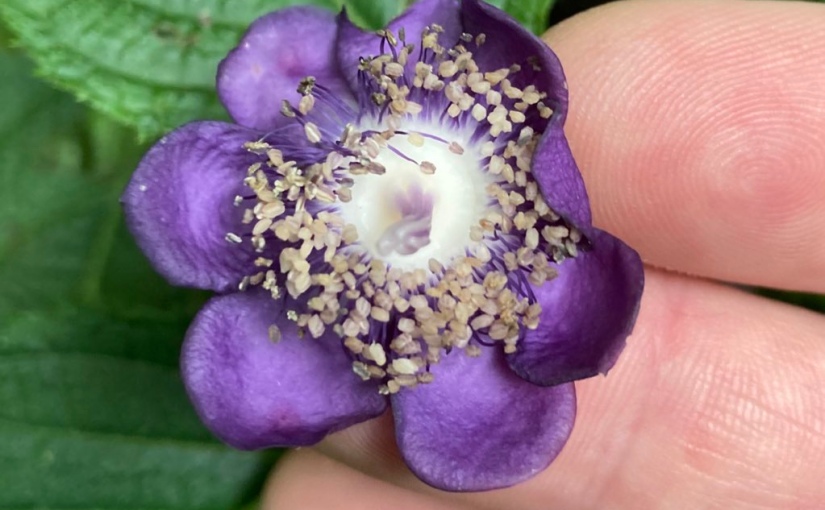
Deinanthe caerulea is a Chinese species, native to Hubei, introduced by E.H. Wilson in about 1911. Smaller and slower-growing than D. bifida, it is even less tolerant of summer drought. The flowers are a remarkable waxy purplish blue. It is sometimes sold under the trade name ‘Blue Wonder’. There is also a hybrid between the two species, sometimes known incorrectly as D. caerulea European Form, which has pale blue flowers.

Propagation is by seed, when produced, or more reliably by division in spring.

The Mother Of Gardens

In 1899, the plant hunter Ernest Wilson set out on his first plant hunting expedition to China for James Veitch and Sons nursery. He was looking for Davidia involucrata, the fabled Dove Tree, discovered by Père Armand David in 1869. “Stick to the one thing you are after and don’t spend time and money wandering about. Probably every worthwhile plant in China has now been introduced to Europe,” he was advised by his employers. They could hardly have been more wrong. In his 1929 book “China, Mother of Gardens”, Wilson wrote about collecting some 3500 species in China alone, of which about 1800 were new introductions to the West.

China is second only to Brazil in the number of native plant species and its botanical diversity is unparalleled amongst temperate countries. With a similar land area to the USA, China has about twice as many plant species – 31000. About half of these are endemic. Where does this biodiversity come from? One important factor was the relative lack of glaciation in China during the last major ice age. Some species which would once have been found across the northern hemisphere were wiped out elsewhere, surviving only in China. This accounts for the ‘living fossils’ such as Metasequioa glyptostroboides, the Dawn Redwood, described as a species from fossils of the Mesozoic Era in 1941 and discovered as a living plant in China in the same year (although the connection was not made until 1946).

Metasequioa glyptostroboides

Similarly, Ginkgo biloba, the Maidenhair tree, is the last remaining species of a genus found in the fossil record around the world. By the end of the Pliocene, Ginkgo species were restricted to central China. Introduced to the West from Japan in the 17th century, having made its way there from China in the 14th century, Ginkgo biloba was long believed to be extinct in the wild. Some specimens planted by temples are said to be 1500 years old or more, with one perhaps 4000 years old. Such a long history of cultivation in China makes it hard to determine whether plant populations are wild or cultivated – small existing populations of Ginkgo in Zhejiang province have very little genetic diversity, suggesting they may have been planted, probably by monks, about 1000 years ago. Small populations recently studied in the Dalou mountains show much greater genetic diversity, suggesting they may be of wild origin.

This long history of cultivation may be another, though lesser, factor in China’s remarkable diversity of plant species. Many ornamental species were first cultivated in China for food and/or medicinal purposes, and a number of trees were grown for symbolic and religious reasons as far back as 5000 years ago. This may have preserved species now extinct in the wild. For example Trachycarpus fortunei, the Chusan or Windmill palm, though widely grown, may have no truly wild specimens in existence.

Trachycarpus fortunei

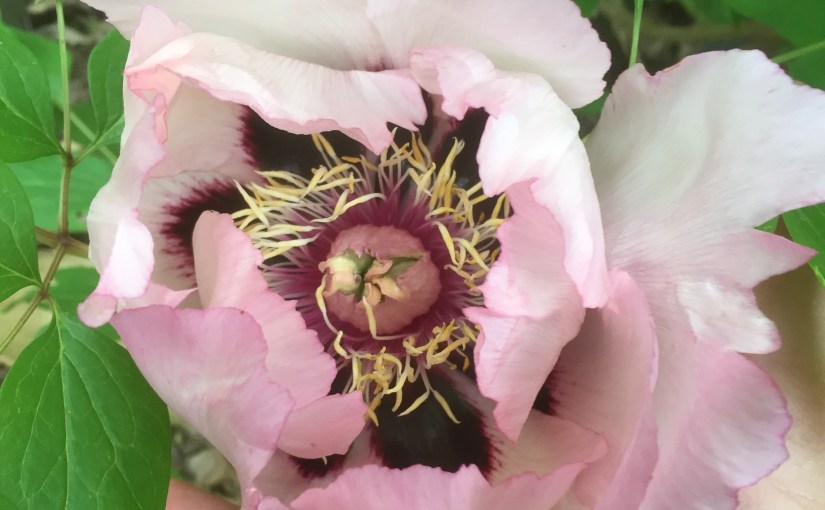
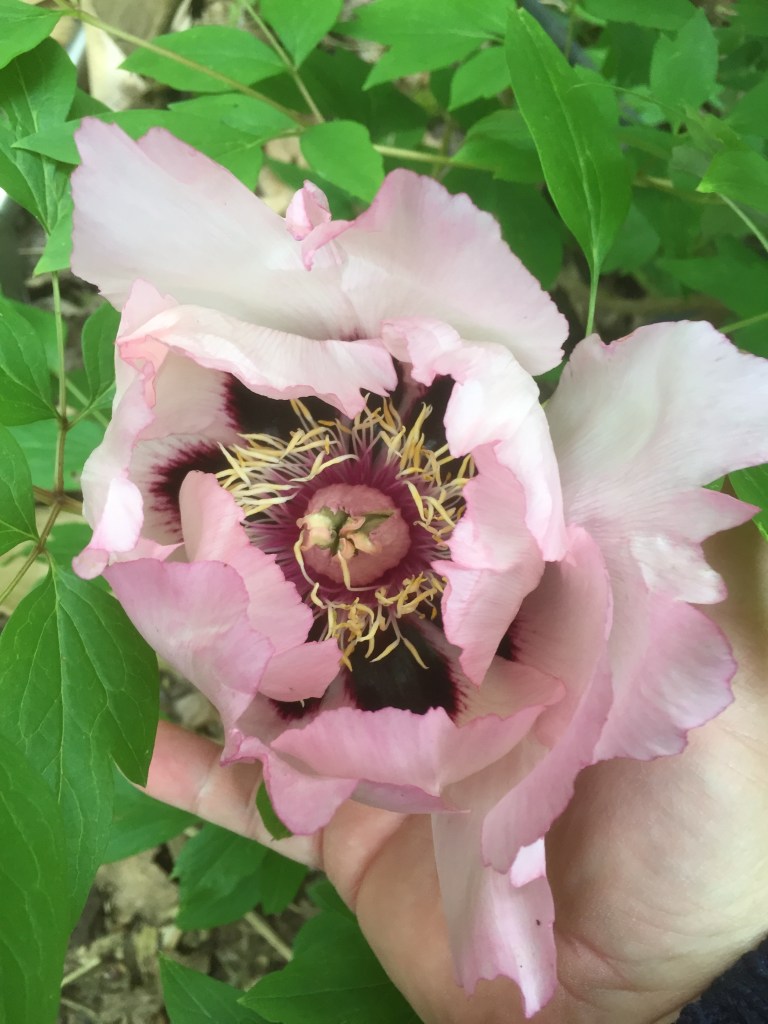
China is the centre of distribution for roses (93 out of 150 species); camellias (the number of species varies depending on the authority – the Flora of China counts about 120 species, 97 native to China with 76 endemic); maples (half of the 110 species are found in China); peonies (about 30 species, half native to China, 10 endemic), and many other plants, without which our gardens would be very much the poorer.

Paeonia rockii

Chinese Sayings about Plants

‘Orchid and Rock’, 1572, attributed to Ma Shouzhen. The central poem, by Xue Mingyi, refers to secluded orchids in an empty valley.

Four character sayings, called chengyu, are an interesting feature of the Chinese language, if rather a challenge for the learner. Some of them are quite easy to understand – like 好久不見 hao jiu bu jian, long time no see. Others require knowledge of the often ancient story they refer to. 塞翁失馬 Sai Weng shi ma, the old man from the border lost his horse, can mean either a blessing in disguise or bad luck disguised as good, and refers to a Daoist story from the second century BC.

Many chengyu refer to plants, particularly those with strong symbolic meanings in Chinese culture, such as orchids, willows, pines, and bamboo. Here are a selection.

柳暗花明 liǔ àn huā míng, willows make shade, flowers give light – hope at the darkest hour

柳烟花雾 liǔ yān huā wù, willow scent and flower mist – a scene full of the delights of spring

残花败柳 cán huā bài liǔ, broken flower, withered willow – a fallen woman (willow is often used to symbolise female frailty)

华而不实 huá ér bù shí, flower but no fruit – all show and no substance

红杏出墙 hóng xìng chū qiáng, the red apricot blossom leans over the garden wall – a wife having an affair

破竹之势 pò zhú zhī shì, a force to smash bamboo – an irresistible force

雨后春笋 yǔ hòu chūn sǔn, after rain, the spring bamboo – rapid new growth, or many new things in rapid succession

胸有成竹 xiōng yǒu chéng zhú, to have a finished bamboo in mind – to plan and prepare in advance

势如破竹 shì rú pò zhú, like splitting bamboo – when things are going your way, don’t stop.

出水芙蓉 chū shuǐ fú róng, a lotus flower breaking the surface – surpassingly beautiful (apparently this can refer to a young woman’s face or an old man’s calligraphy – offered without comment)

秋菊傲霜 qiū jú ào shuāng, the autumn chrysanthemum braves the frost – resilience in adversity

明日黄花 míng rì huáng huā, chrysanthemums after the Double Ninth festival – an out-dated or antiquated thing

春兰秋菊chūn lán qiū jú, spring orchids and autumn chrysanthemums – everyone/ thing has their own unique charm

采兰赠芍 cǎi lán zèng sháo, pick orchids and present peonies – presents between lovers

芝兰之室 zhī lán zhī shì, a room with irises and orchids – in wealthy and pleasant company

芝兰玉树 zhī lán yù shù, irises, orchids and jade trees – a child with splendid future prospects (irises and orchids symbolise a noble character and the jade tree is also called the scholar tree, a term which might be used to describe a fine son who would do well in the Imperial examinations)

兰艾同焚 lán ài tóng fén, burn orchids and stinking weeds together – to destroy noble and common indiscriminately, or the rain falls on the just and unjust alike

空谷幽兰 kōng gǔ yōu lán, secluded orchids in an empty valley – a noble character (Confucius often used the orchid as a symbol of virtue. Orchids still give out their perfume when there is no one to appreciate it, just as people of good character maintain their standards in poverty)

松柏后凋 sōng bǎi hòu diāo, the pine and the cypress are the last to wither – honesty and virtue will stand the test of time (again, this refers to the Analects of Confucius)

苍松翠柏 cāng sōng cuì bǎi, evergreen pine and cypress – steadfast nobility, similar to the previous phrase

瓜田李下 guā tián lǐ xià, in a melon patch or under a plum tree – suspicious circumstances (this is an abbreviated form of the saying “Don’t put on your shoes in a melon patch, don’t adjust your hat in a plum field,” as reaching up or down in those circumstances could be misconstrued as stealing fruit.)

Plant profile: Eomecon chionantha

Eomecon chionantha, the snow poppy or dawn poppy, is an uncommon perennial plant from China, and the only species in the genus. It has delicate white poppy-like flowers with yellow stamens sporadically through the summer and into autumn. The fleshy leaves, an attractive feature in their own right, are glaucous green, and kidney-shaped with scalloped edges. In a mild winter it is evergreen. It forms spreading clumps on long rhizomes when happy.

Eomecon chionantha

In its native habitat it grows on riverbanks and in moist woodlands in eastern China. In the garden it appreciates moist, humus rich soils in partial shade. It will take full sun but not drought. It is not prone to pests or diseases in general but may need protection from slugs.

The generic name derives from the Greek eos meaning dawn or the east and mekon meaning poppy (as in Meconopsis). The specific name chion meaning snow and anthos meaning flower give the plant its common name. It is also sometimes known as Chinese Bloodroot or Asian Bloodroot. It is related to Sanguinaria, the Bloodroot of North America, and like its relatives bleeds a reddish sap from cut rhizomes.

Plant Profile: Ypsilandra thibetica

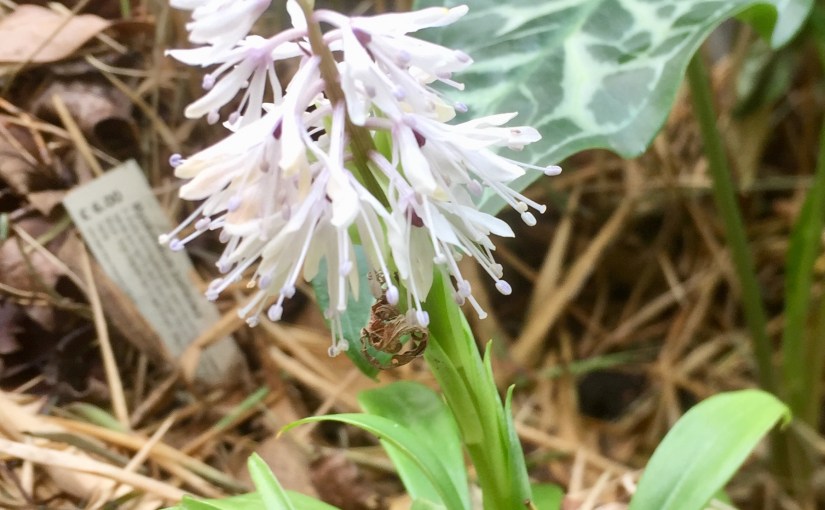
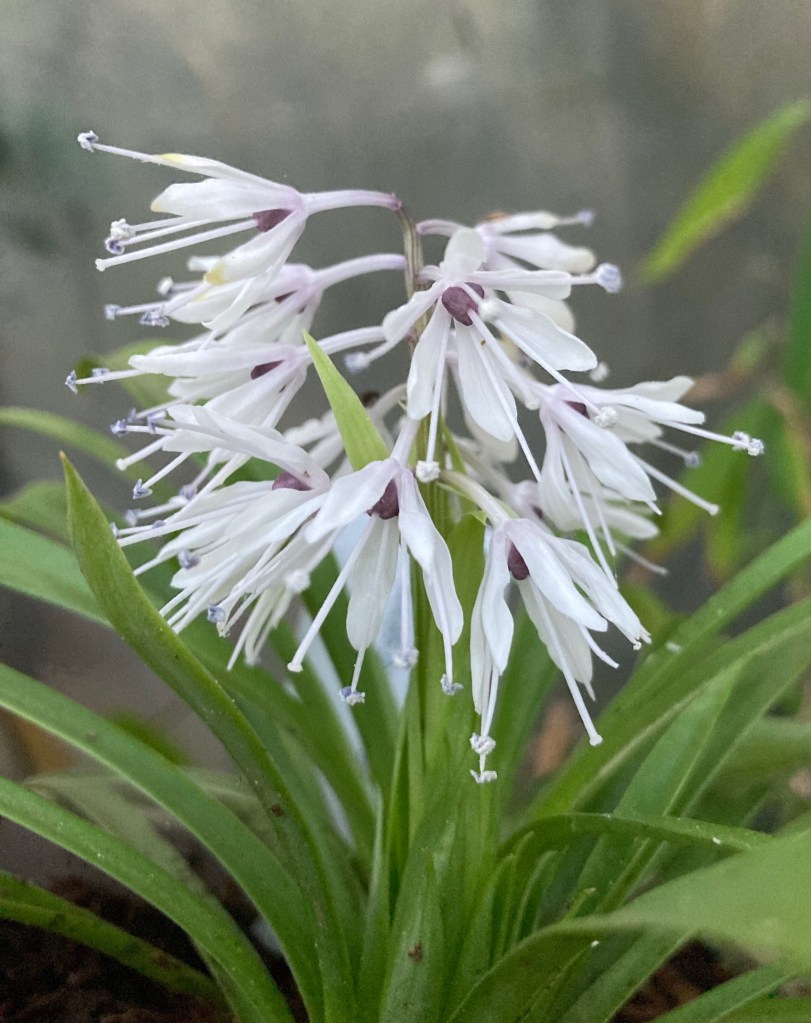
Ypsilandra thibetica is an attractive and unusual evergreen perennial, not common in the U.K., native to southwestern China and Taiwan. There are five other species in the genus, all from East Asia. It usually has white scented flowers which become slightly coppery or pink as they age, with pale blue anthers. Some forms have pink or pale lilac flowers, and the flowering stems reach about 30 centimetres tall. The leaves are strap-like and form rosettes, bulking up slowly to form a clump of multiple rosettes.

Ypsilandra needs at least partial shade, not too dry and not too hot in the summer. It likes a humus rich soil. In its natural habitat it grows on wooded slopes, and it is best to plant it with the rosette of foliage at a slight angle to allow water to run off and avoid the risk of rotting.

The generic name comes from the Greek ‘ypsilo’ (y-shaped) and andros (anthers). It is used in Traditional Chinese Medicine to stop bleeding amongst other things.

Disporopsis, Disporum, and Prosartes – a new National Collection for Suffolk

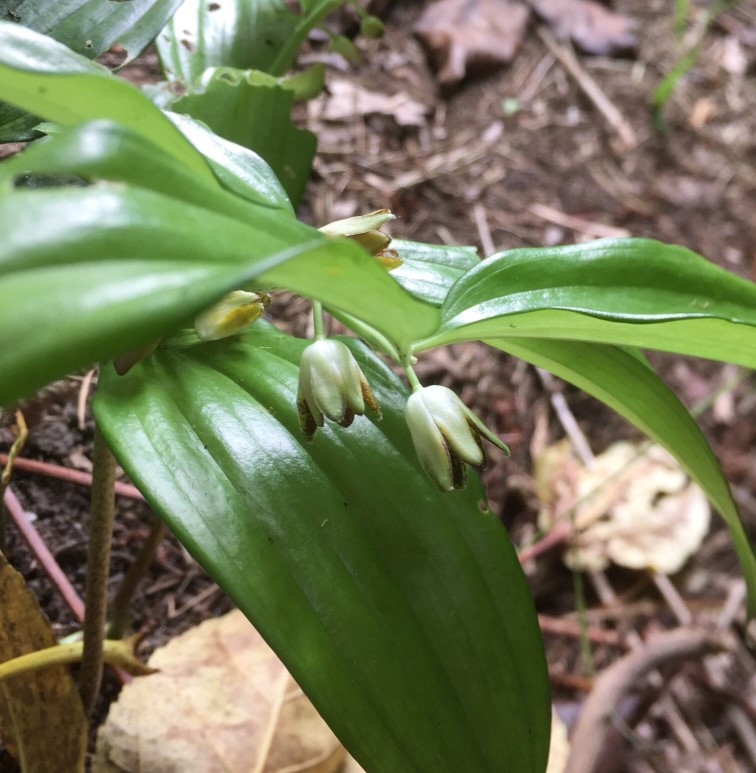
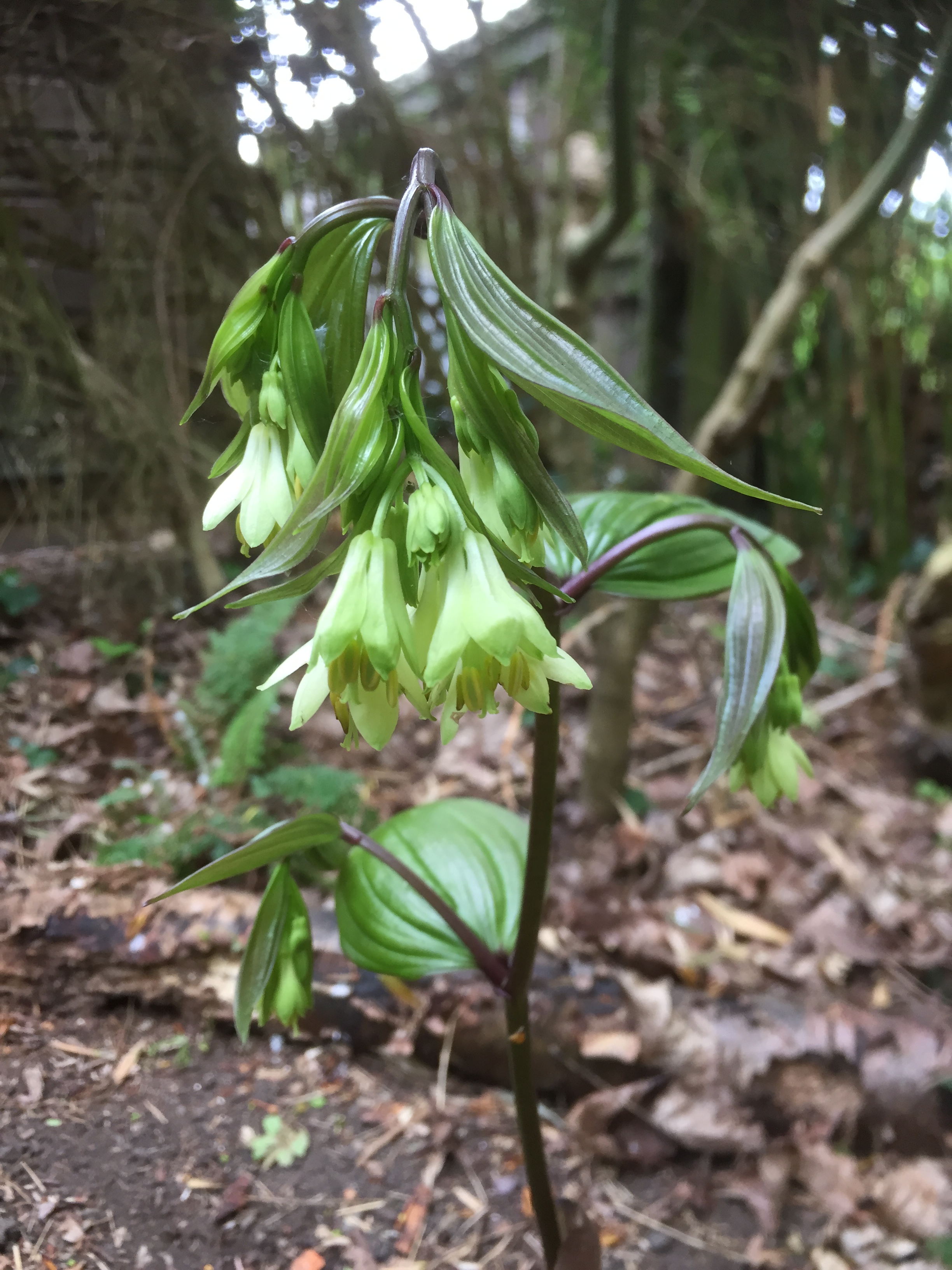
These three related genera contain some excellent perennials for shade and deserve to be more widely grown. The genus Disporopsis is closely related to Polygonatum and its common name is Evergreen Solomon’s Seal. The genus Disporum has had rather a convoluted taxonomic history, having at various times been included in the Convallariaceae (with Disporopsis), Liliaceae, Asparagaceae, and Uvulariaceae. More recent genetic research places it in the family Colchicaceae. Disporum and Disporopsis are native to temperate parts of Asia, especially China, Japan, Korea and Taiwan. The genus Prosartes contains the North American species which were previously included in Disporum.

Disporopsis aspersa

Disporopsis are quite tough little plants, with small white or cream, sometimes purple spotted, bell shaped flowers in spring. The flowers are usually lemon scented, and followed by purple berries. They form clumps from slowly spreading rhizomes, and although they prefer moist woodland conditions, will tolerate dry shade. Disporopsis pernyi, from China, is the most widely available of the eleven or so species. Besides being evergreen, Disporopsis species have the significant advantage over their herbaceous relatives of being untroubled by Solomon’s Seal Sawfly.

Disporum bodinieri

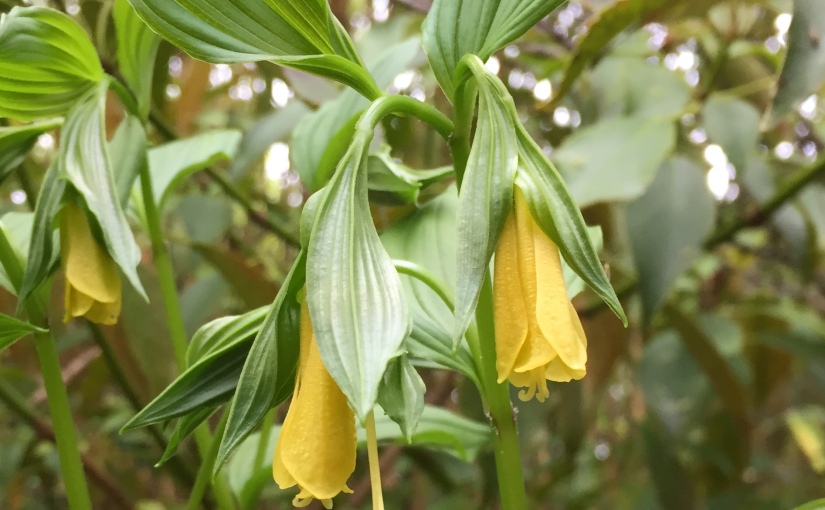
Disporum is a larger and more varied genus, with approximately twenty five species, and includes some striking architectural plants. It is probably the most ornamental of the three genera, but unfortunately a little fussier as to cultivation than Disporopsis. Disporum longistylum ‘Green Giant’ is a Dan Hinkley introduction from Sichuan, China, with bamboo like stems up to 8 feet tall, and delicate greenish white flowers. Disporum longistylum ‘Night Heron’ is a slightly shorter plant with amazing dark, chocolatey new foliage in spring. One of my personal favourites, Disporum bodinieri, is a more delicate plant at 2-3 feet tall, with pretty cream bell shaped flowers in May. Some forms of Disporum cantoniense have attractive purple flowers, whilst Disporum uniflorum has comparatively large yellow flowers. Disporum sessile is a shorter Japanese species, one foot to eighteen inches tall, of which there are many different variegated forms, showing the Japanese horticultural love of both variegation and finding infinite varieties of their native species. Disporum smilacinum is another species with many variegated forms cultivated in Japan, and also a pink flowered form. They all require at least partial shade, humus rich soil, and adequate moisture, being less tolerant of dry conditions than Disporopsis. Some species are evergreen or semi-evergreen, and most have black berries.

Disporum uniflorum

Finally, Prosartes, the North American genus, shares its common name of Fairy Bells with Disporum. There are currently six species. Most are shorter, to about 2 feet tall. The most commonly encountered are Prosartes hookeri, known as ‘Drops of Gold’ because of its protruding yellow anthers, and Prosartes smithii, also known as ‘Fairy Lanterns’. The flowers are generally followed by red berries, which are reputedly edible though not especially flavoursome. Unlike Disporum and Disporopsis, which are clearly quite tasty, the leaves of Prosartes species contain a compound which deters slugs and snails.  

Plant profile: Borinda papyrifera CS1046

There are well over 200 species and varieties of temperate bamboo, and more being introduced all the time, but if I could only have one, this would be it.

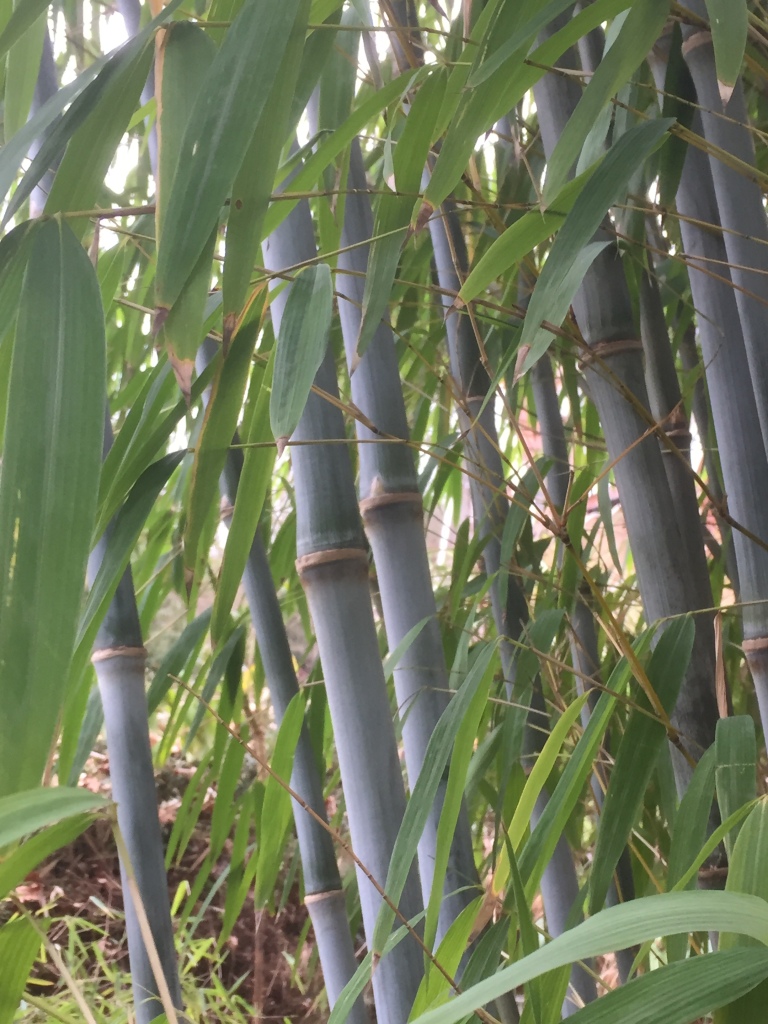
Borinda papyrifera CS1046

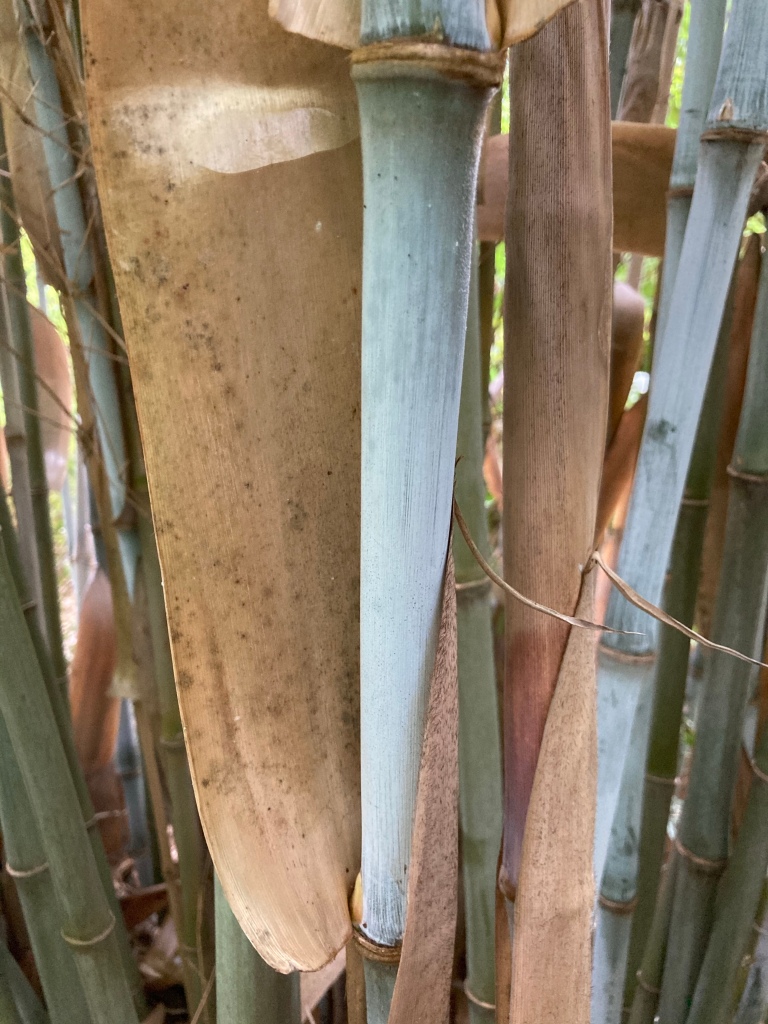
Borinda papyrifera CS1046 is a clump-forming bamboo collected from Yunnan in southwest China by Chris Stapleton (hence ‘CS’). The specific epithet ‘papyrifera’ refers to the large, papery sheaths which protect the emerging culms.

This year’s culm showing the pale colouration and the papery sheath that gives the plant its name.

Its most striking and ornamental feature is the icy blue colour of its new culms. This colour is quite persistent, lasting a couple of years before fading to a more greenish shade. The culms are thick – about 2 inches in diameter on my 10 year old plant – and the leaves are quite large.

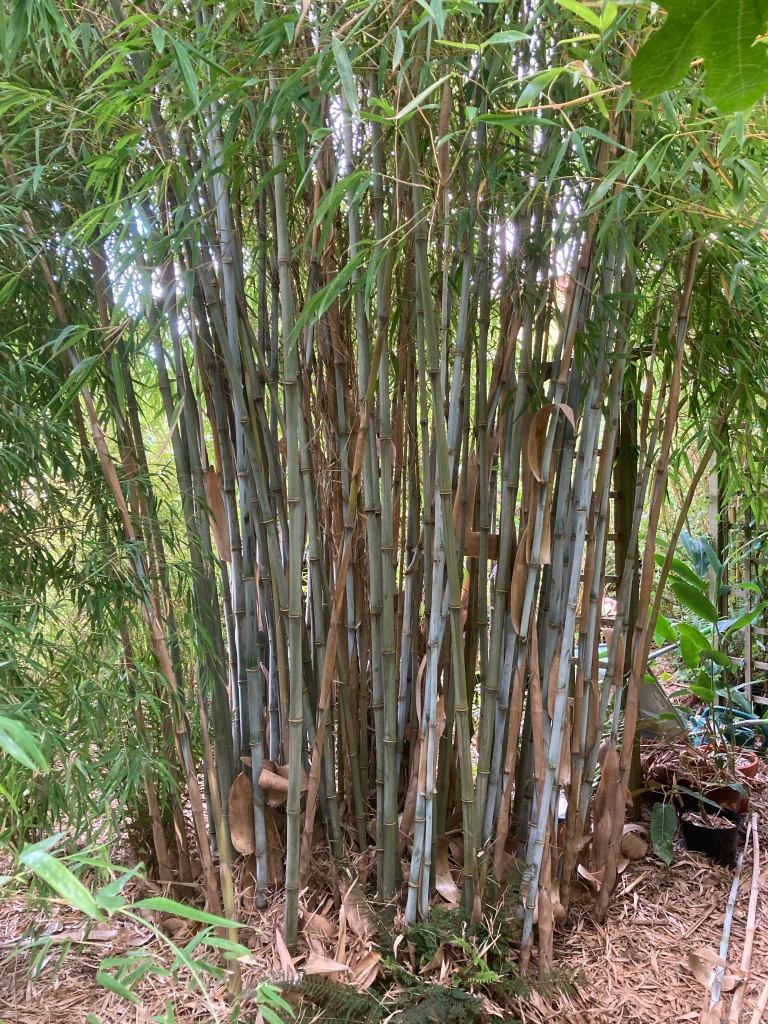
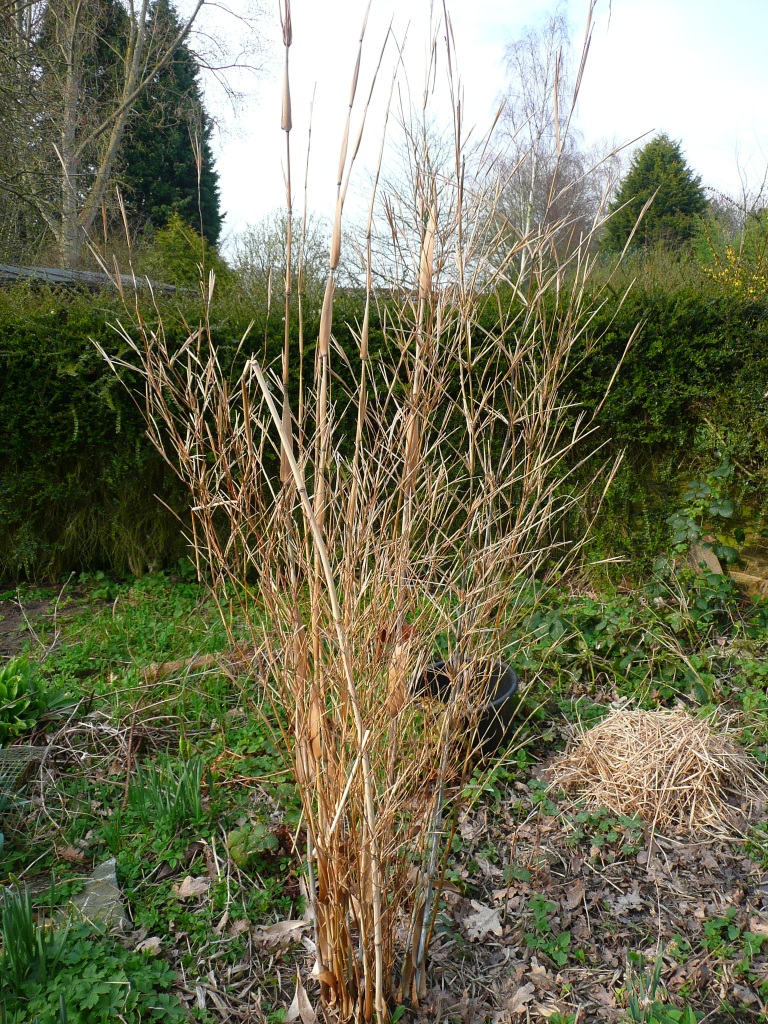
The 10 year old plant in my garden is now some 2.5m (8ft) across.

Though clump-forming it is by no means small. At 6m (20ft) plus with culms more widely spaced than many clumpers it is perhaps best described as statuesque. It would make an ideal specimen plant.

Borinda papyrifera CS1046 is not tremendously hardy as a young plant, but once established is much tougher. Mine was cut almost to the ground as a youngster in the hard winter of 2010, though it came back quite strongly, but didn’t lose a leaf in the ‘Beast from the East’ in 2018. Other clones of Borinda papyrifera are available, some of which were collected at higher altitudes and may prove hardier.

The same plant as above, after the winter of 2010.

It is reasonably tolerant of drought once established, but will tend to abort some culms in dry summers. My plant has attained its current size without extra watering until this year when I gave in to the realities of the changing climate and bought a hose. I also haven’t fed it, but always leave the shed leaves and sheaths in the base of the clump, which break down slowly and return their nutrients to the plant.

Unfortunately this very desirable bamboo is tricky to propagate, partly because it is quick to mature, which makes it hard to find and somewhat expensive. A variety called Fargesia ‘Blue Panda’ is being sold, which is apparently a micro-propagated form of Borinda papyrifera CS1046. If anything it seems to be more expensive than the original and, given what poor plants micro-propped Phyllostachys make, it would be wise to wait until more is known about its performance before buying it. Personally I would only buy a hand-propagated Borinda.

Growing bamboos in containers

Most bamboos are suitable for growing in containers, and in a small garden it may be the best way to include these lovely plants.

The first thing is to choose your bamboo. All Fargesia species do well in containers. Many Phyllostachys species are also happy in containers, and as they are running bamboos, it is a good way to grow them without having to worry about them spreading. These two genera make up the majority of widely available bamboo species, so there’s plenty of choice. Less commonly encountered, Chusquea species hate being grown in pots and very invasive species of Sasa and Chimonobambusa will also not do well.

The next thing is to choose your container. It’s important to choose one which either has straight sides or slopes outwards, so that the bamboo can be removed for repotting when necessary. Containers which belly outwards or narrow towards the top are not suitable. People often buy tall and narrow pots for bamboo, but actually the best shape is shorter and wide. Bamboos are comparatively shallow rooted, and a wider base both gives them room to grow and helps with stability in windy conditions.

You can either pot a bamboo up every couple of years into progressively larger containers or pop it straight into the largest one. Bamboos are not generally bothered about being over potted. Once it has filled the pot, it should be taken out every two or three years, the rootball sawn in half, and each half repotted. It’s best not to cut it into more than two pieces. Bamboos aren’t keen on being divided and if you try to make too many you risk losing them.

The logical choice of growing medium would be half multipurpose compost and half John Innes no 3. I have only used peatfree compost for many years and my bamboos are perfectly happy in it, even in the old New Horizon which wasn’t a patch on the Sylvagrow I use now.

As far as feeding and watering go, remember bamboos are woody grasses, so essentially you have a 7ft lawn in a pot. A high nitrogen feed is ideal, but not too late in the year when it encourages vulnerable soft growth. Always keep the bamboo’s shed leaves in the top of the pot. As they break down they return essential nutrients, including the silica that makes bamboos flexible, to the plant.

Watering is really important. Bamboos in the ground are pretty drought resistant when established, but a bamboo in a pot will go brown and crispy like your lawn if it dries out, and it may well die. If you do have one that dries out (and it’s happened to me more than once) plunge it in a big bucket of water as soon as you notice. Lift it out when thoroughly soaked, and keep it well watered. If you’re lucky it will sprout new leaves, though it will take a while. It’s almost impossible to overwater a bamboo, so you won’t ever go wrong by being generous with water. I stand most of my potted bamboos in shallow trays of water all summer.