The Asian Garden U.K. Blog

Using bamboo for screening

Bamboo is an extremely effective and decorative screen in the garden. Being evergreen, it blocks unsightly views all year round. The gentle sound of the foliage and its thickness means it is quite effective at filtering unwanted noise as well. Bamboo can also be used as a windbreak, although in exposed positions only the tougher species such as Pseudosasa japonica should be used. Pseudosasa japonica is also the best choice for screening salt winds, though measures must be taken to manage its spread. As always with bamboo, the most important thing is to choose the right variety in the first place.
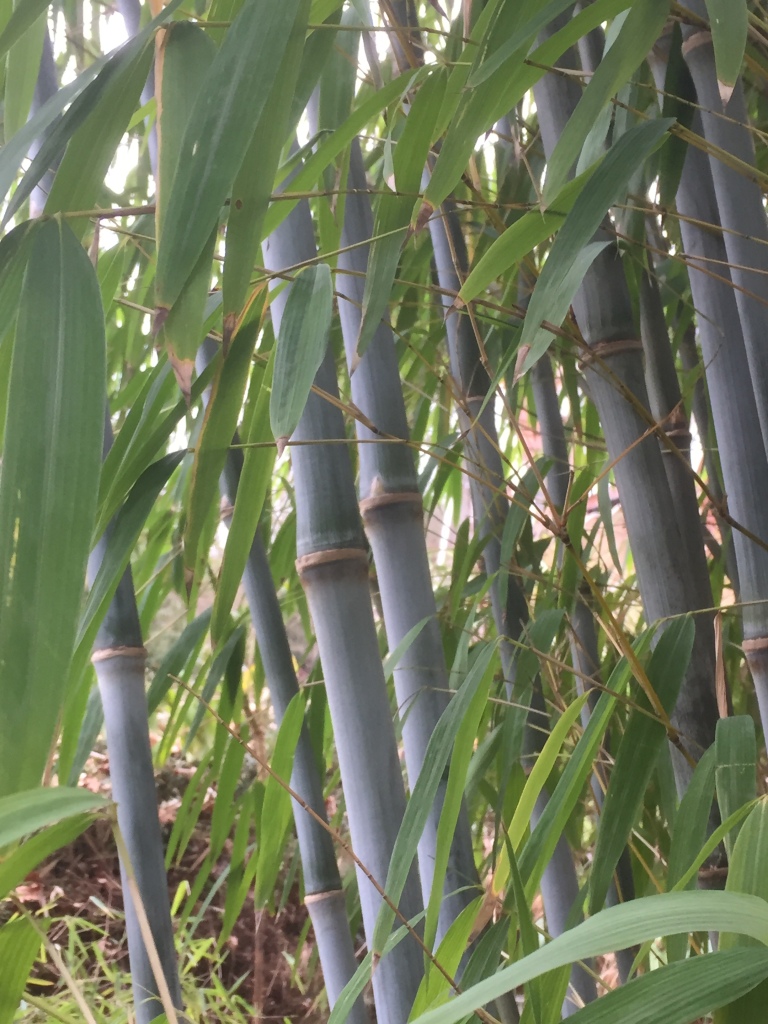
Borinda papyrifera CS1046

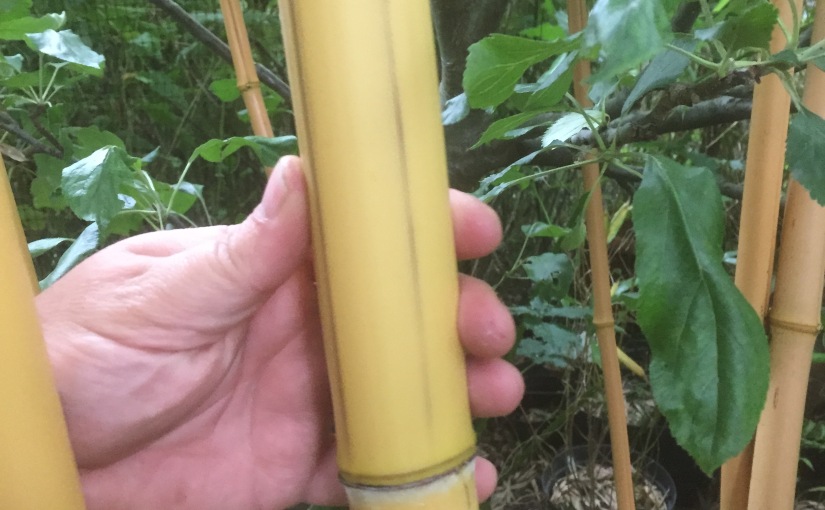
The first thing to consider is height. If you want a really tall screen, over about 4m (16ft), you will need to go for a running bamboo. Clumpers don’t generally get above this height, and some are quite a bit shorter. Most Borinda species (clumpers) are exceptions to this, but are both expensive and hard to find. So if you wanted a tall but narrowish screen, where one plant would do, a Borinda would be a very attractive possibility. If you are looking at screening a longer length, a Phyllostachys species would be more economical. Phyllostachys aurea is widely available, tough, very hardy, and grows 5-8m (16-26ft) depending on conditions. It is a running bamboo, but generally quite well-behaved. (For more on clumping and running bamboos see here). For a taller screen still, Phyllostachys vivax or one of its forms would be a good choice. It can get over 8m (26ft) in the right conditions. It’s also quick to mature, with lovely thick culms, and several of the forms are very decorative, such as P. vivax f. aureocaulis which is a beautiful sunshine yellow with occasional fine green stripes. On the downside it doesn’t have much foliage low down on the culms, and is more vigorously spreading than P. aurea.
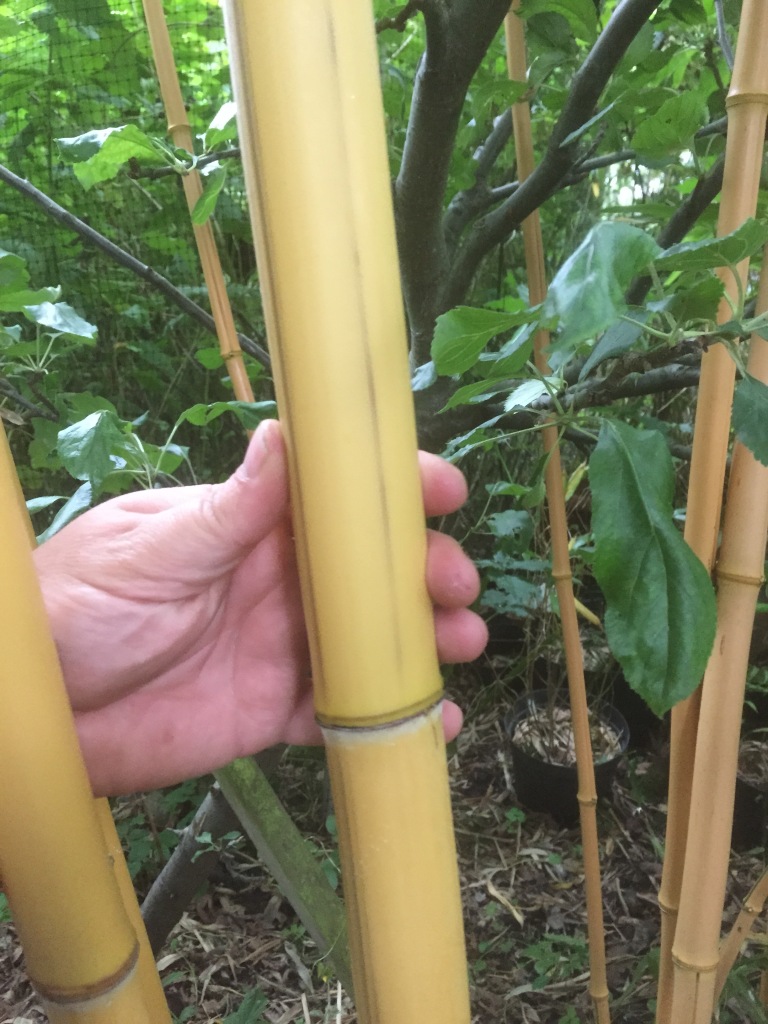

Phyllostachys vivax f. aureocaulis

The next thing to consider is the width of the planting. Generalising somewhat, running bamboos tend to be more upright, while clumpers tend to have a wide mushroom cloud of foliage over a narrower clump of culms. You should also consider the width of the planting area available. The taller you want your bamboo to be, the more growing space for the rhizomes you will need. So, for example, if you had a bed 30cm (1ft) wide, you couldn’t grow a bamboo to 8m (26ft) tall in that space. In fact only the smallest bamboos, such as Pleioblastus auricomus at 1-2m (3-6.5ft), could be grown in such a narrow space, and as it is quite invasive would need work to control it. The best option for such a small space would be to grow bamboos in containers.
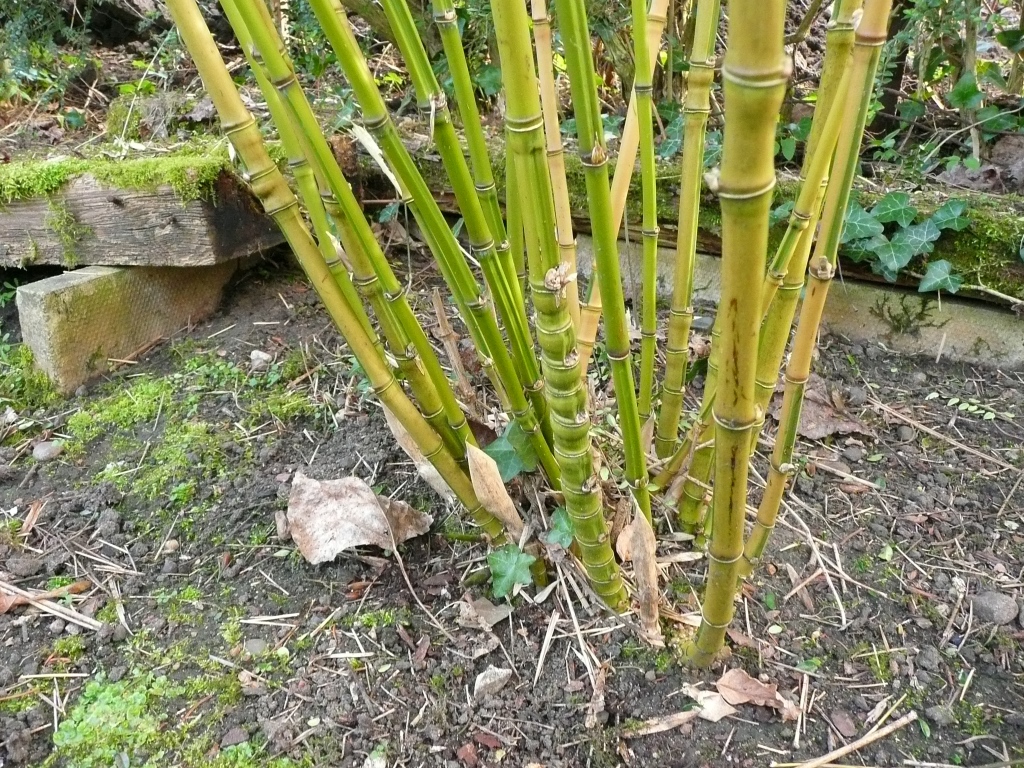
Phyllostachys aurea ‘Koi’, with three sided concrete paver barrier visible behind it. This was one of the first bamboos I planted in my current garden about 12 years ago and it is still nowhere near needing that barrier though technically a runner!

The third factor to consider is how you will control the spread of your bamboo screen. If you are planting along a boundary I would always recommend using a barrier of some kind, even if you are planting clumpers. Though they will never send out runners, the clumps do expand in width every year and will eventually come up just the other side of the fence. There are a number of options you can use. I use a line of recycled concrete pavers on edge in the ground, overlapping an inch or so and also sticking up an inch or so above soil level. They are angled very slightly away from the bamboo, so that a runner meeting them is encouraged upwards. When it pokes over the barrier it is easy to see and trim. Bamboo rhizome barrier is available, but not cheap, and I know of one grower who swears by damp proof membrane! For a running bamboo you can encircle the entire planting area with a barrier, giving it the most space allowable, but after many years it will effectively become ‘potbound’ and will try to break through. I put a barrier along no more than three sides of a plant, so it can only spread out of bounds in one direction and I can cut and dig out rhizomes should it eventually become necessary.

Fourthly, and related to all the above factors, is whether to plant your screen of bamboos in the ground or grow them in pots. The advantage of growing in containers is that the spread is controlled and you can grow almost any species you like regardless of how invasive it would be in the ground. The disadvantages are that the plants will stay shorter than they would in the ground, and that you will have to water them. Bamboos established in the ground are pretty drought tolerant, but in pots will die if allowed to dry out completely. If you need height, P. vivax will still get to a decent height in pots, and the larger the container you can give it the taller it will get.
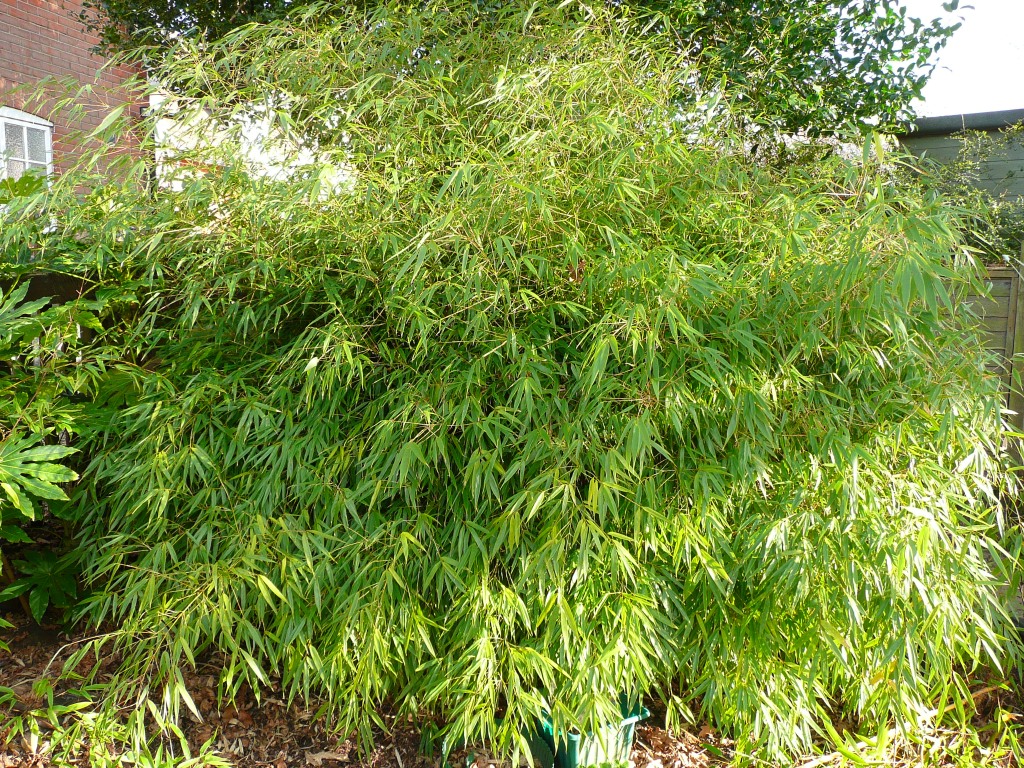
Fargesia rufa, a clumping bamboo which forms a mushroom of foliage.

The final thing to consider is the likelihood of flowering. Bamboos flower very infrequently, with gaps for many species upwards of thirty years. However, there is always a small chance, and clumpers in particular are likely to die if they flower completely (more on bamboo flowering here). If planting a long row of clumping bamboos it is a very good idea to choose a mix of species and varieties, so that if you are unlucky you only lose one or two plants and not the whole row. Fargesia nitida and its numerous forms have flowered since the 2000s so are unlikely to flower again soon. A number of hybrids between F. nitida and F. murielae have recently become available, show promising vigour (F. murielae itself is very slow to get going) and also should not flower for many years. F. robusta and its forms are among the taller clump formers at 4-5m (14-16ft). F. rufa is one of the shortest, topping out at 3m (10ft), but has a particularly wide cloud of foliage, is quick growing, and tough as old boots.
Genyue, the Garden that Brought Down a Dynasty

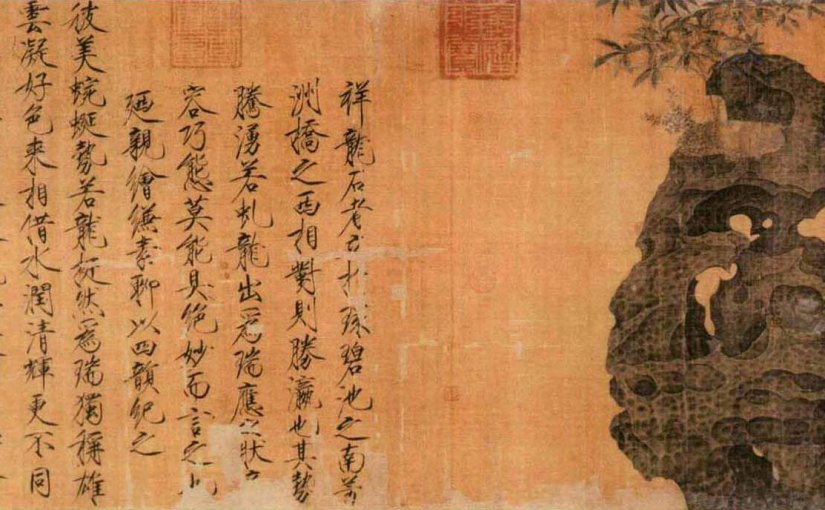
Auspicious Dragon Rock, painting and poem by Zhao Ji (the personal name of Emperor Huizong)

The Song dynasty was founded in 960AD following 60 years of turmoil after the fall of the Tang, China’s golden age. Like the Tang, it was a great era of garden building. It was a time of commercial prosperity, scientific and technological advancement, agricultural development and, as a consequence, population expansion. However, with powerful rivals to the north and west, contested borders, factionalism at court and the long shadow of the An Lushan Rebellion (which broke the power of the Tang) behind it, Song prosperity was tinged with hedonism and excess.

Portrait of Emperor Huizong, artist unknown

The eighth Emperor of the Northern Song was Huizong (1082-1135AD). He was a great painter – arguably one of China’s greatest – a calligrapher, a musician and poet. He wrote treatises on medicine and on tea. He was a patron of the arts, a fervent Daoist, an avid collector of paintings and antiques, and passionate about gardens. In particular, he loved rocks.

Five-coloured Parakeet on Blossoming Apricot Tree, attributed to Zhao Ji (the personal name of Emperor Huizong)

There were five Imperial parks in the Song capital Bianjing (now Kaifeng), four of which were situated at the gates on the four sides of the city. These parks were opened to courtiers and officials on set occasions, and one was opened to the general public for a short while each year. The fifth park, Genyue, the Northeast Marchmount, was for the private use of the Emperor and his guests. It was built beside the imperial residence on a site selected by a geomancer in the northeast of the city. He recommended that the earth be heaped up and artificial mountains constructed, to ensure the Emperor plenty of heirs. (The character ‘Gen’ 艮 of Genyue is from the I Ching and represents mountains, the northeast, and sons).

The construction of Genyue was, after long preparation, begun in 1118, but Huizong had been collecting plants, rocks, animals, and birds from much earlier in his reign. In 1105 a ‘Provision Bureau’ was set up in Suzhou. This was the base of the merchant Zhu Mian, who was especially talented at finding scarce and valuable Lake Tai stones, often in other people’s gardens. Some of these ended up in Zhu Mian’s own garden. To find materials for Genyue a ‘Flower and Rock Network’ was set up to transport huge quantities of rarities from all corners of the empire. The scale of this undertaking is hard to comprehend. Collectors sourced rare plants from as far as 900 miles to the south of the capital. The military were drafted in to help with transportation, and commoners were sent out to search in swamps and mountains for rare plants. A dedicated fleet of boats transported huge rocks along the Grand Canal to the capital, day and night, interrupting the normal transport of food and raw materials. In some places bridges were knocked down and irrigation systems destroyed to allow their passage. As well as the physical damage and disruption, the Flower and Rock Network spawned largescale corruption and waste, drained the imperial treasury, and was greatly resented by the common people.

The Cloud-Capped Peak, Lingering Garden, Suzhou, said to be one of a handful of ‘relic stones’ from those collected by Huizong. 6.5 metres tall, it weighs about 5 tons.

Completed in 1122, Genyue was a representation of the empire in miniature, a tradition dating back to earlier Emperors, most notably Qin Shi Huangdi himself. Depleting an empire to build a garden seems supremely frivolous now, but at the time such gardens had a ritual and religious aspect, giving the project a deeper meaning. As well as ensuring more sons, Huizong hoped to gain the favour of the Immortals for himself, his dynasty, and for Song China. Zhang Hao, an official writing soon after the events, during the Southern Song, recounted the story of the site’s geomantic significance:

…as predicted, there was a response [in the form] of numerous sons. From this time forward, there was regular security within the seas and lack of incident at the imperial court, and His Highness devoted quite a bit of attention to parks and preserves.

Record of the Northern Marchmount, Zhang Hao, translated by James M. Hargett p. 185 in The Dunbarton Oaks Anthology Of Chinese Garden Literature, A. Hardie and D.M. Campbell (Eds,)

The garden was not particularly large, when compared to other imperial parks. What was most remarkable about it was the size of the artificial mountain landscape,

…an artificial pile more than ten li in circumference, of ‘ten thousand layered peaks’, with ranges, cliffs, deep gullies, escarpments and chasms. In some places the structure rose two hundred and twenty-five feet above the surrounding countryside, and in others it fell away, through foothills of excavated earth and rubble, to ponds and streams and thickly planted orchards of plum and apricot.

The Chinese Garden, Maggie Keswick, p.53. ‘Li‘ is a historical measurement which has varied over time. In the Song dynasty, ten li was about 2.5 miles.

There were dozens of buildings dotted about this landscape, enumerated and named by the Emperor in his own account of the garden. There was an artificial cascade, operated by workers who rushed to open the sluice gate when the Emperor arrived. More prosaically, there was a farm with fields, orchards, and a herb garden. Besides entire transplanted forests of bamboo there were plants of all kinds. Huizong himself records some of the plants that were sent from around the empire.

…loquat (Eriobotrya japonica), orange (Citrus sinensis),
pomelo (Citrus grandis), sourpeel tangerine (Citrus deliciosa),
sweetpeel tangerine (Citrus reticulata), betel-nut palm (Areca catechu),
Chinese juniper (Juniperus chinensis), and lichee (Litchi chinensis)
trees, as well as gold moth (unidentified), jade bashfulness
(unidentified), tiger ear (Saxifraga stolonifera), phoenix tail
(Pteris multifida), jasmine (Jasminum grandiflorum), oleander
(Nerium oleander), Indian jasmine (Jasminum sambac), and magnolia
(Michelia figo) plants. Ignoring variations in geography and differences
in climate, all the trees and plants generated and grew…

Record of the Northern Marchmount, Emperor Huizong, translated by James M. Hargett ibid p.186

Above all, of course, there were rocks. Scholars’ rocks had become popular in gardens in the Tang dynasty, but Huizong took petromania to new extremes. Fantastically shaped rocks were arranged all over the garden. Names were bestowed upon them, and engraved, with the most important inscribed in gold.

Rock landscape in the Lion Grove Garden, Suzhou. Dating from the following Yuan dynasty, these contorted rocks are said to resemble lions and to this day are immensely popular.

Unfortunately, the use of the vast amounts of money and manpower expended on the garden weakened an empire surrounded by warlike rivals. Focusing on his garden and the arts, Huizong neglected economic policy and, most crucially, the military. In 1126 – just four years after Genyue was completed – the Jurchen, of the Jin empire to the north, laid siege to Bianjing. The garden was destroyed, its precious rocks flung from catapults, its trees cut for firewood, its rare animals killed and eaten by the army. Huizong was persuaded to abdicate in favour of his son. A temporary peace was cobbled together, but within a year, the Jurchen returned in greater force. They took Bianjing, sacked the city, destroyed or looted its treasures, and massacred many of the inhabitants. Huizong was taken north as a captive, given the mocking title Duke Hunde ‘Besotted Duke’. One of his sons, who avoided capture, withdrew south of the Yangtze and founded the Southern Song. Huizong died in Heilongjiang in 1135, a prisoner of the Jin dynasty to whom he had lost the heartlands of his country.

Poetry and the Chinese Garden

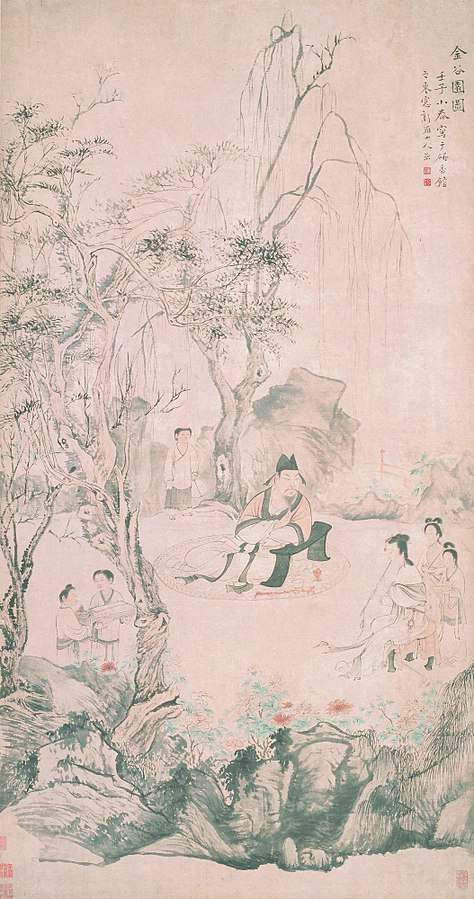
During the turbulent Six Dynasties period (220-589AD) after the fall of the Han, ministers and officials came and went as power at court changed hands. Having lost their positions, disappointed scholars retired to the country to live in seclusion and build gardens. This became a recurring theme in Chinese garden history. One of these, a wealthy aristocrat and former provincial governor called Shi Chong, built a garden northeast of the capital Luoyang in 296AD, called Jingu Yuan, the Garden of the Golden Valley. This was no simple rural retreat, however, but an extravagant and elaborate garden which inspired emulation through the centuries.

Hua Yan (1682–1756) Golden Valley Garden
金谷園圖

He invited thirty poets to a banquet at which they were required to compose a poem each – those who failed were ‘punished’ by being required to drink an immoderate quantity of wine. The resulting collection Poems from the Golden Valley began a long association between poems and gardens in Chinese culture, in which gardens became both a location for composing poetry and the subject thereof. In turn, gardens were inspired by poems and literary works.

Wen Zhengming (1470–1559) A Graceful Gathering at the Orchid Pavilion
兰亭修禊图

Another famous early example of this association was the Liubei Tang, the Garden of the Floating Cup. In 353AD, the poet, calligrapher, and general Wang Xizhi held a gathering of poets at a garden called the Orchid Pavilion, where King Guojian of Yue is supposed to have planted an orchid in the 5th century BC. Seating them beside a winding stream, he floated cups of wine. If a poem came to rest beside a guest, he had to drink the wine and compose a poem on the spot. This was much imitated and became a feature of many later gardens. The poems themselves are much less well regarded than Wang’s Preface to them. The pavilion and garden still exist, as well as a stele bearing what is said to be Wang Xizhi’s calligraphy.

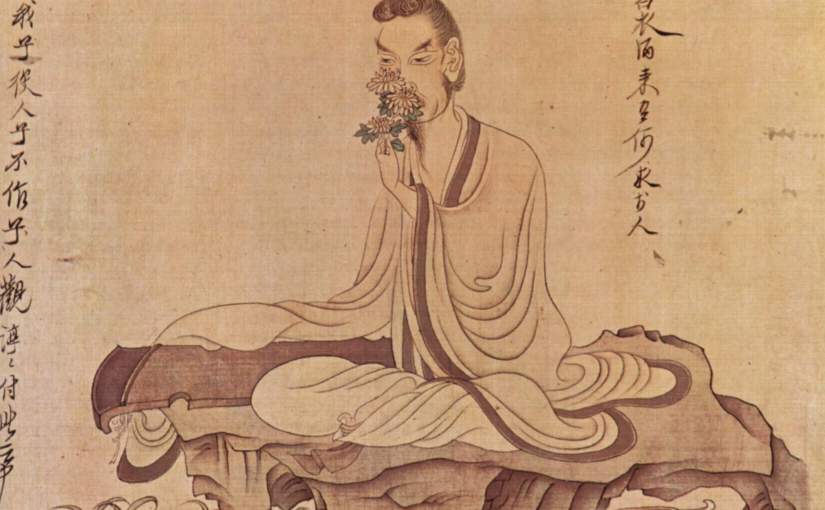
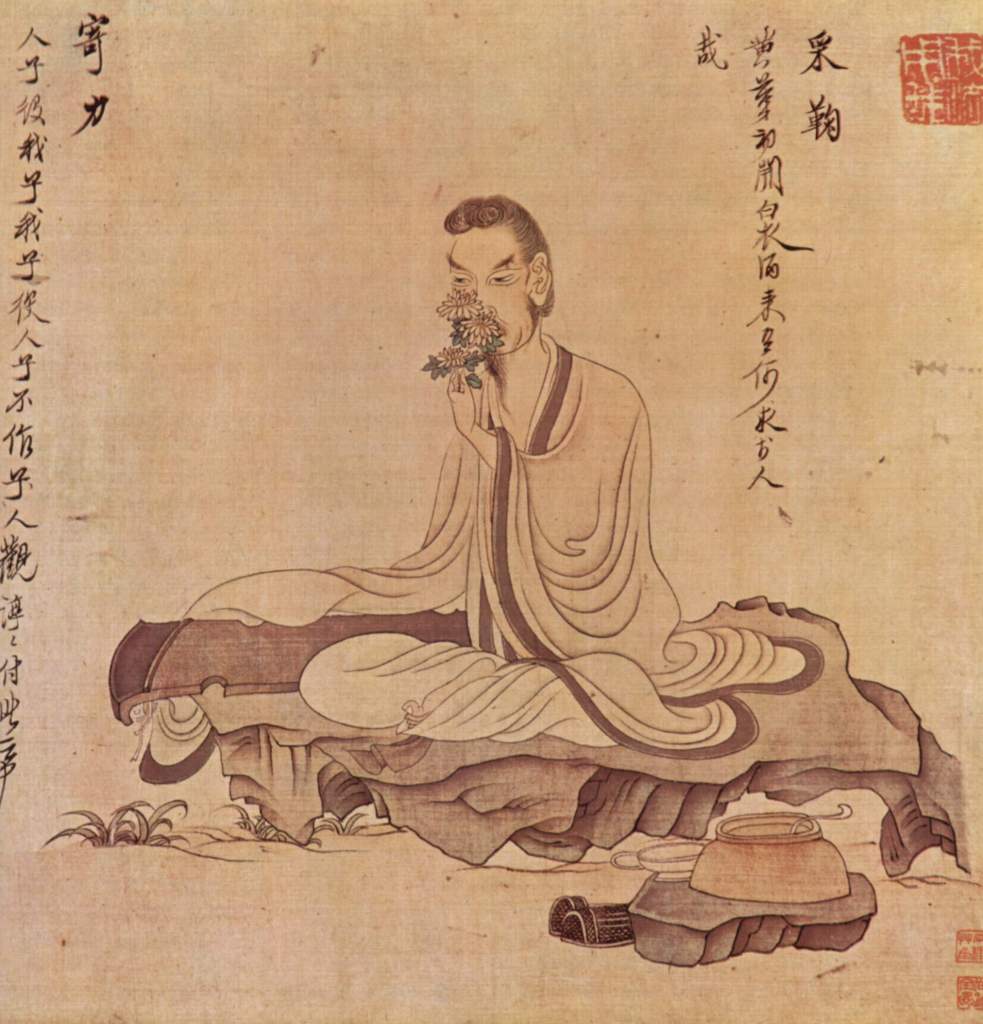
Chen Hongshou (1598-1652) Painting of Tao Yuanming

Tao Yuanming (365-427AD), author of The Peach Blossom Spring, was another scholar who withdrew from the world. Always reluctant to participate in public life, he endured poverty to live in seclusion and cultivate himself in the Daoist tradition. He wrote poetry and gardened, as well as farming to feed himself and his family.

Drinking Wine (#5)
I’ve built my house where others dwell
And yet there is no clamour of carriages and horses
You ask me how this is possible– (And so I say):
When the heart is far, one is transported
I pluck chrysanthemums under the eastern fence
And serenely I gaze at the southern mountains
At dusk, the mountain air is good
Flocks of flying birds are returning home
In this, there is a great truth
But wanting to explain it, I forget the words

Tao Yuanming

To this day he is the archetype of the refined gentleman hermit, and chrysanthemums have been closely associated with him throughout history. He was one of the originators of the ‘Field and Garden’ genre of poetry.

Wang Wei, Wangchuan Villa

The Tang dynasty, which followed the turbulent Six Dynasties period, was a golden age of Chinese culture, including gardens. One famous Tang garden was the Wangchuan garden of the poet, painter, and administrator Wang Wei (701-761AD). The garden included 20 landscape scenes to be viewed from set viewpoints. Wang wrote poems to go with each scene and also painted them. The gardens, poems, and paintings were hugely influential in later years.

The Garden of the Golden Valley

Scattered pomp has turned to scented dust
Streaming waters know no care, grass spreads and claims spring as its own
At sunset, an East Wind carries the sound of crying birds
Petals on the ground are her likeness still, beneath the tower where she fell

Du Mu (803–852)

In the late Tang the poet Du Mu wrote this poem (translation from here) about Shi Chong’s Garden of the Golden Valley, built 500 years earlier. Shi Chong ultimately came to a sad end. A rival, jealous of Shi Chong’s beautiful concubine Lüzhu, framed him for treachery. Shi Chong was executed and Lüzhu threw herself to her death from a tower in the garden.

How to grow Japanese Maples

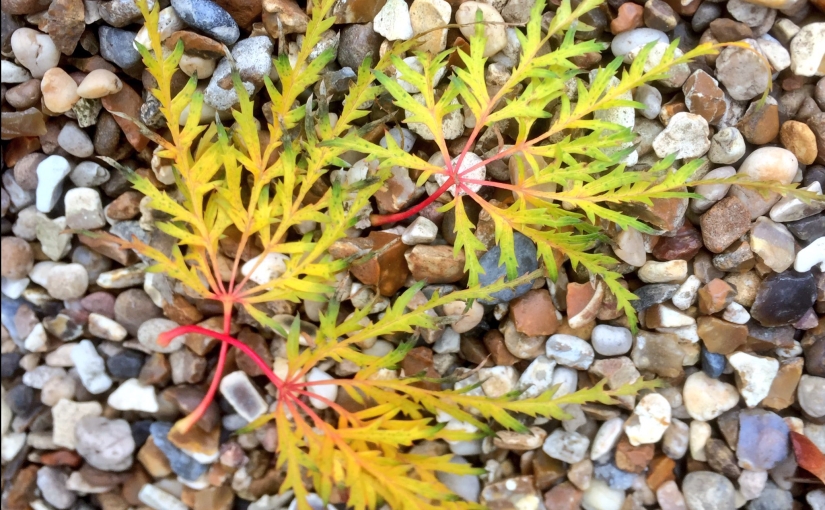
One of the most evocative of Japanese plants, Acer palmatum cultivars are easy to grow as long as they are sited correctly. Whether in the ground or in containers they need shelter from cold or drying winds. Cool dappled shade is the ideal position. Green cultivars, and some purples, tolerate sun best. Red leaved cultivars need some sun, or the colour will not develop properly, but don’t like full sun all day. Variegated or more delicate dissectum and linearilobum cultivars will need shade at least during the hottest part of the day to prevent scorching and some, like ‘Ukigumo’, can only be grown successfully in shade.

Acer palmatum ‘Katsura’

They do best in a moist but well-drained soil with plenty of organic matter, ideally slightly acidic. In a container, the standard advice is to use John Innes 2 or 3, mixed with an ericaceous compost, but it is better for the environment to use a good quality peat free ericaceous, such as those available from Sylvagrow or Dalefoot. Top pots with gravel to suppress weeds, or mulch well with compost or leafmould in the ground, but make sure the mulch doesn’t touch the trunk. Feed with a balanced fertiliser in spring before the leaves emerge.

Acer palmatum ‘Omureyama’ starting to colour in autumn

Correct watering is important. They need a good supply of moisture, and won’t tolerate either drought or water-logging well. They are quite shallow rooted, so make sure they are not crowded by other plants competing with them. Besides, they are best given space to show off their beautiful form.

Emerging foliage of Acer palmatum ‘Katsura’

Acers are perfectly hardy, but in pots their roots are more vulnerable to frost, so in colder area the pots should be wrapped in fleece or moved to a protected spot in winter. Acers come into leaf very early in the year and the new foliage can be caught by late frosts. This won’t kill them but will set them back, so protect with fleece when frosts are expected.

Acers don’t need much pruning – simply removed dead, damaged or diseased branches, and any that are crossing and rubbing. Prune when the tree is dormant, between November and February, and be sure to cut back to just above a bud. A long stub left above a cut can be an entry point for disease or dieback.

Love, Immortality and Utopia – The Symbolism of Peaches

Peaches have been cultivated in China for about 3000 years, originally for food and medicinal purposes, and poems about the beauty of peach blossom date to 600BC, showing their early use as an ornamental. By the Song dynasty (960-1279AD), several varieties had been bred with double flowers in reds and whites as well as pinks.

Each part of the tree has its own symbolism. Peach blossom opens in spring, the season of romance, and is strongly associated with love, and with feminine beauty.

Within this gate on this same day last year,  
Cheeks and peach flowers out bloomed each other here.  
Her very cheeks can now be found no more.  
The peach flowers smile in spring wind as before 

Cui Hu (translated by Ma Hongjun).

This very well known poem from the Tang dynasty has formed the basis for many romantic stories and operas and given rise to a chengyu (Chinese idiom) 人面桃花 rén miàn táo huā, her face is like a peach blossom, to describe a woman’s beauty.

Today, peach blossom is one of the flowers used to decorate at Chinese New Year, and is especially popular with single people hoping for ‘peach blossom luck’ – luck in love.

The peach itself has long been a Taoist symbol of immortality. Xiwangmu, the Queen Mother of the West, lives on the mythical Mount Kunlun and grows peaches in her orchard. They produce fruit every three thousand years and confer immortality on anyone who eats them.

The wood of the peach tree is said to ward off demons. Swords carved from peach wood were used in Taoist exorcisms, and feature as magical weapons in martial arts legends.

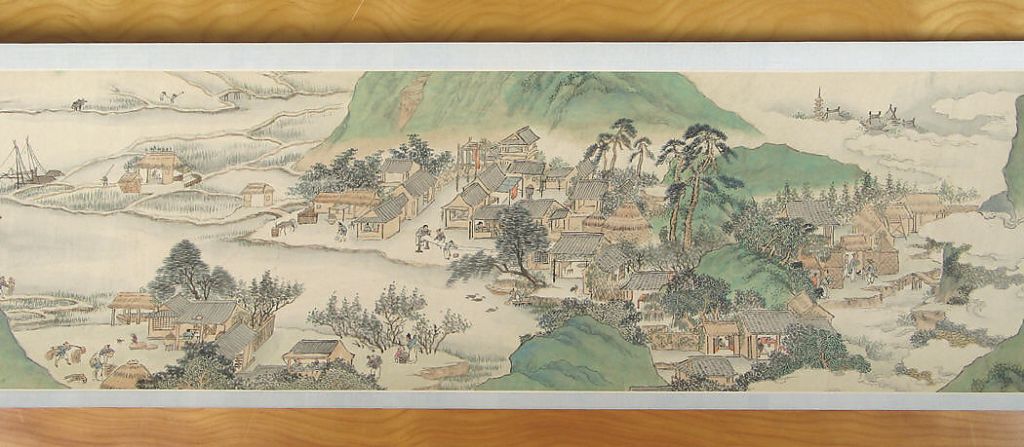
Peach Blossom Spring by Zhang Hong, Ming dynasty

One further literary association which was highly influential in the development of the Chinese garden was the story of ‘The Peach Blossom Spring’. Written in 421 AD by Tao Yuanming, it told of a fisherman who followed a stream through a forest of blossoming peach trees to a cave at its source. Squeezing through this cave he found a hidden village, surrounded by beautiful scenery and fertile fields, where people lived happy and tranquil lives, cut off from the world for many generations. He met with a warm welcome and stayed for a while, but then wanted to return home. He was warned that it was pointless to tell anyone else or to try to find his way back to the village later, and so it proved. The story inspired many paintings and poems, as well as influencing gardens, and gave rise to a chengyu – 世外桃源 shìwaì taóyuán, the Peach Spring beyond this world, which means a utopia.

How to grow Japanese Irises

Iris ensata (syn. Iris kaempferi) is one of the archetypal plants of the Japanese garden. They are rhizomatous, beardless irises, native to East Asia. They have fans of strap shaped leaves and flowering stems 2-4ft tall. They flower in early summer, with two or three large, exotic-looking flowers on a stem, in shades of purple, blue, white, and pink.

They are extremely hardy, down to -20ºC, zone 4 in the US. They will grow in full sun to partial shade, as long as they get at least 6 hours of sun, and like a loose, slightly acidic damp soil with plenty of organic matter. It is especially important in the spring, in the run up to their early summer flowering, that they have plentiful moisture.

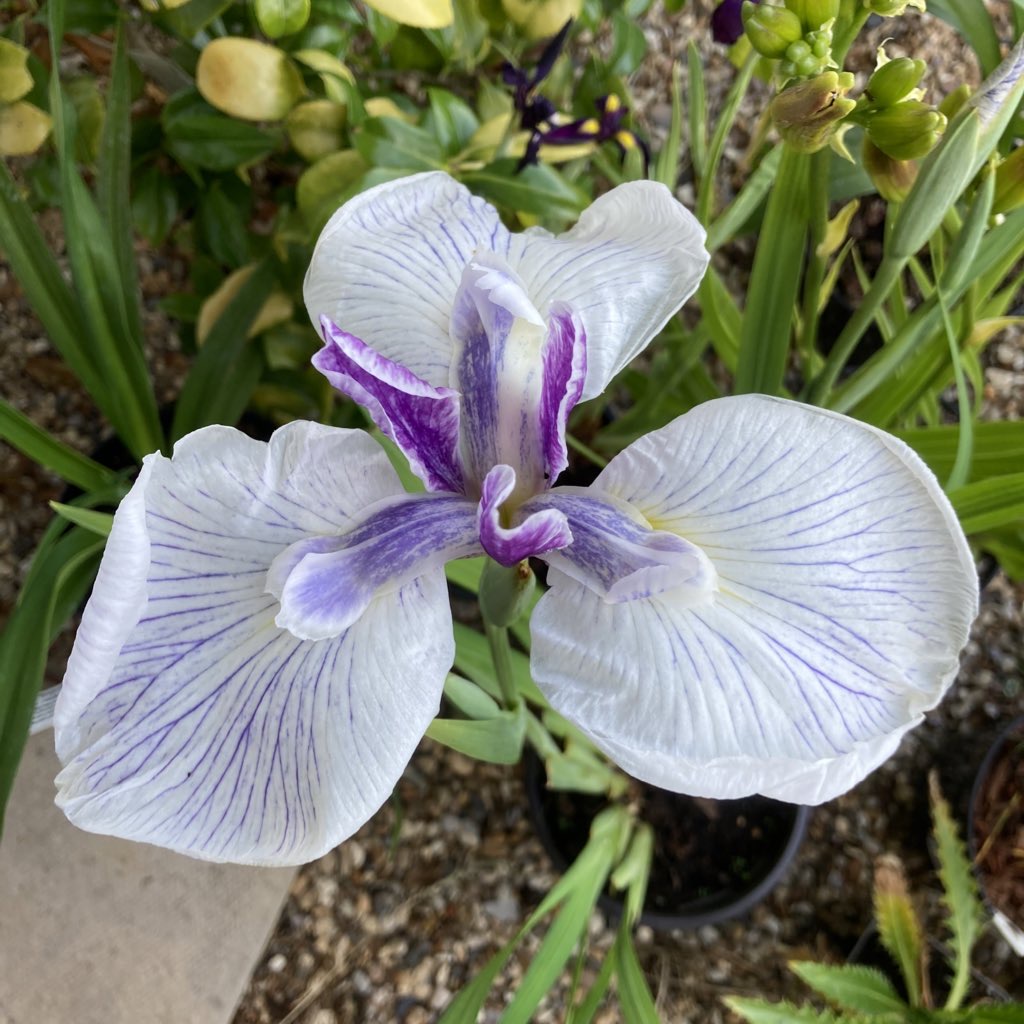
Iris ensata ‘Moonlight Waves’

They are sometimes sold as marginal plants, and are happy to be grown in shallow water, as long as the crown of the plant is not covered, during spring and summer. However, they need to be lifted out of the water over winter or they are likely to rot. The old foliage should be cut back to the ground in the winter, after it has been knocked back by the first frost.

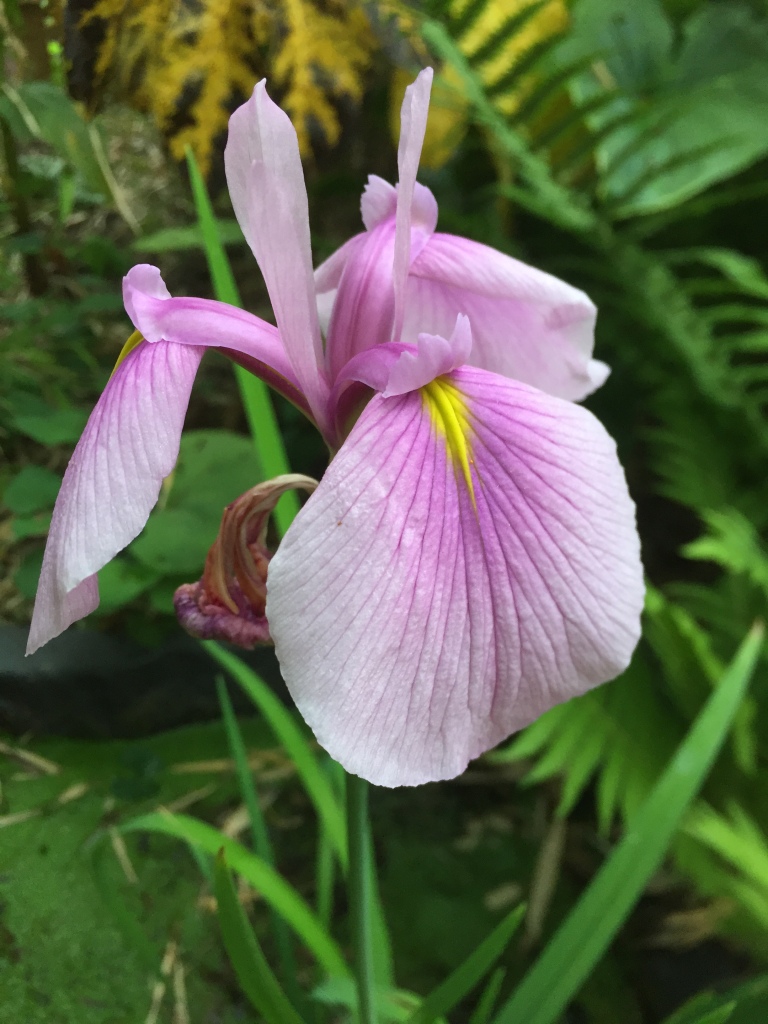
Iris ensata ‘Rose Queen’

Iris ensata are heavy feeders and will benefit from a generous feed of a balanced fertiliser for acid-loving plants in the early spring and again after flowering, and a good mulch to help retain moisture. It’s good to add plenty of organic matter to the soil when they are planted or divided, but don’t add fertiliser at this point. Bone meal should be avoided as it is actively harmful to Japanese irises.

Iris ensata ‘Grayswood Catrina’

It’s very important to divide and transplant Japanese Irises every three to four years to maintain vigour. New roots form above the old each year, so over time the crown of the plant rises above the soil, potentially causing it to fail. To divide, dig up the plant and divide it into individual sections or fans, or slightly larger sections of 2-4 fans each. The oldest roots and rhizomes – the lowest – should be removed, and the foliage cut back to about 1/3 of its length. The divisions should be planted 2-3 inches deep. in fresh soil where Iris ensata has not been grown for the previous three years, and kept well watered. It is best to divide Japanese Irises in spring or autumn, avoiding the heat of mid-summer, though in cooler areas they can be divided immediately after flowering.

Iris ensata ‘Oku Banri’

Iris ensata have been cultivated in Japan for at least five hundred years, and possibly much longer. Extensive Iris breeding began in the late Edo period, around the 1800s. Japanese Irises were introduced to the West by Carl Thunberg in 1794, and again by von Siebold in the 1850s (as Iris kaempferi). Many varieties have been bred in the United States as well. Some 2000 varieties are now available.

National Beauty and Heavenly Fragrance: the Chinese Peony

A symbol of wealth and honour, peonies are known as the King of Flowers and have been cultivated in China for millennia. Like many traditional plants of the Chinese garden, they were originally cultivated for medicinal purposes and are mentioned in the Shennong Bencao Jing, an ancient materia medica written circa 200-250 AD, recording oral traditions dating back much further. Some records indicate they were cultivated as far back as the Xia (the possibly mythical first dynasty, 2000-1766 BC).

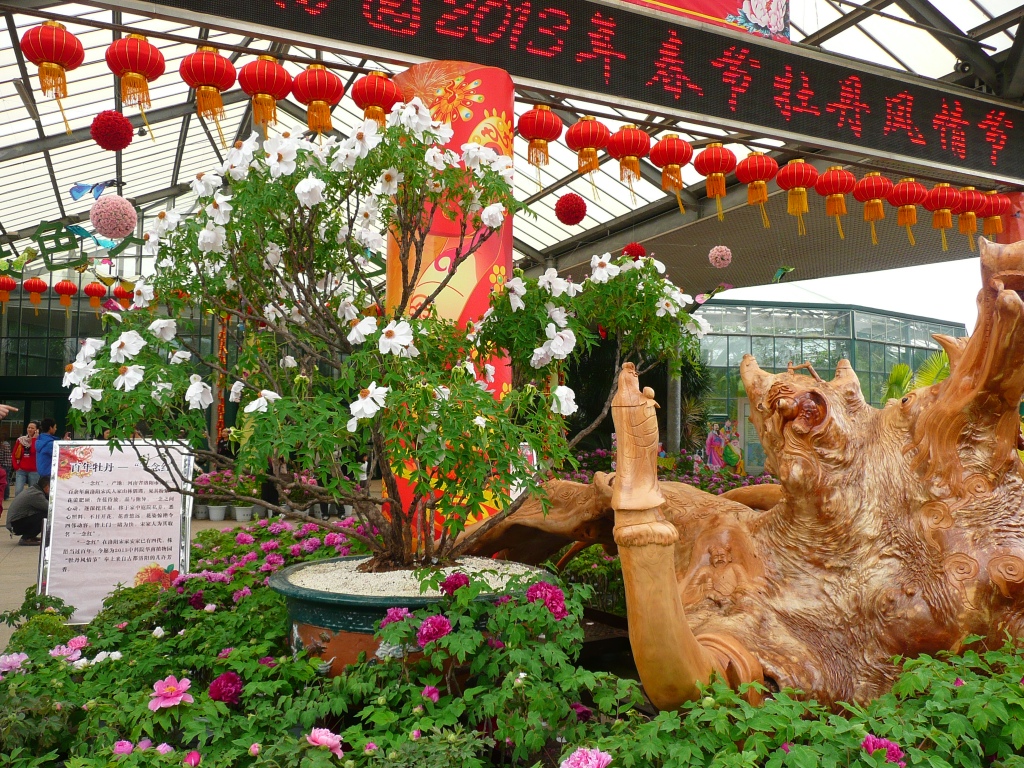
New Year peony festival at the South China Botanical Garden, Guangzhou

Before the Qin dynasty (221-206 BC) not much distinction was made between herbaceous peonies, shaoyao, and tree peonies, mudan, which were simply called tree shaoyao. Paintings from around 400 AD depict peonies in the background, showing that they have been cultivated as ornamentals for at least 1600 years. By the Sui dynasty, 581-618 AD, individual varieties were being recorded, and twenty boxes of peonies were sent as tribute to the Emperor from Hubei. In the early Tang dynasty, peonies were an imperial flower, only permitted to be grown in imperial gardens. They soon spread, however, and were planted in temple and monastery gardens. In the 8th century they were introduced to Japan by a Buddhist monk.

Peonies, by Yun Shouping, 17th century

There is a legend that the Tang Empress Wu Zetian visited a garden in the winter. Nothing was in flower, so she ordered all the plants to bloom. The next day, despite the snow, all the plants had obeyed the Empress and flowered, except the peony. Enraged, she banished it from the capital to Luoyang, where it bloomed profusely. Subject to the vicissitudes of war and changing dynasties, Luoyang has been the capital of China’s peony industry ever since.

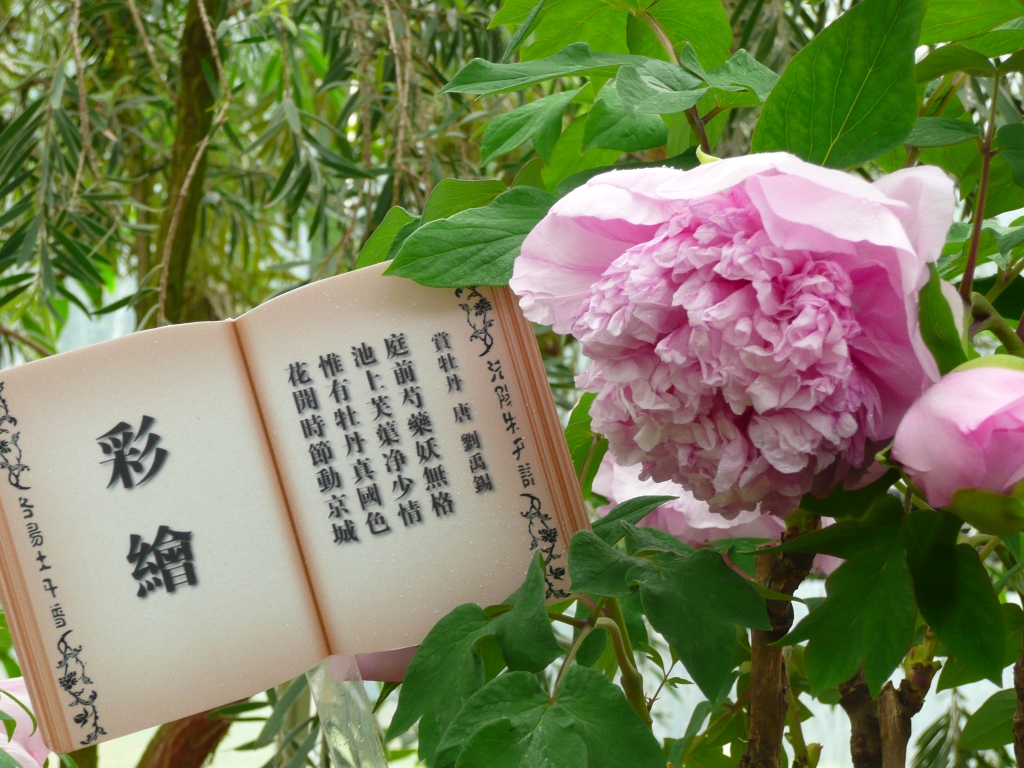
Paeonia x suffructicosa ‘Cai Hui’, Brightly Coloured Painting

The first monograph on peonies, written in 1034 AD, described 24 double and semi-double varieties. The large double ‘Thousand-Petalled’ varieties were the most popular, new varieties costing as much as a hundred bushels of rice. At least two of the varieties, Yao’s Yellow and Wei Purple, are still in cultivation. By the 1800s, a single plant could cost 1000 coins.

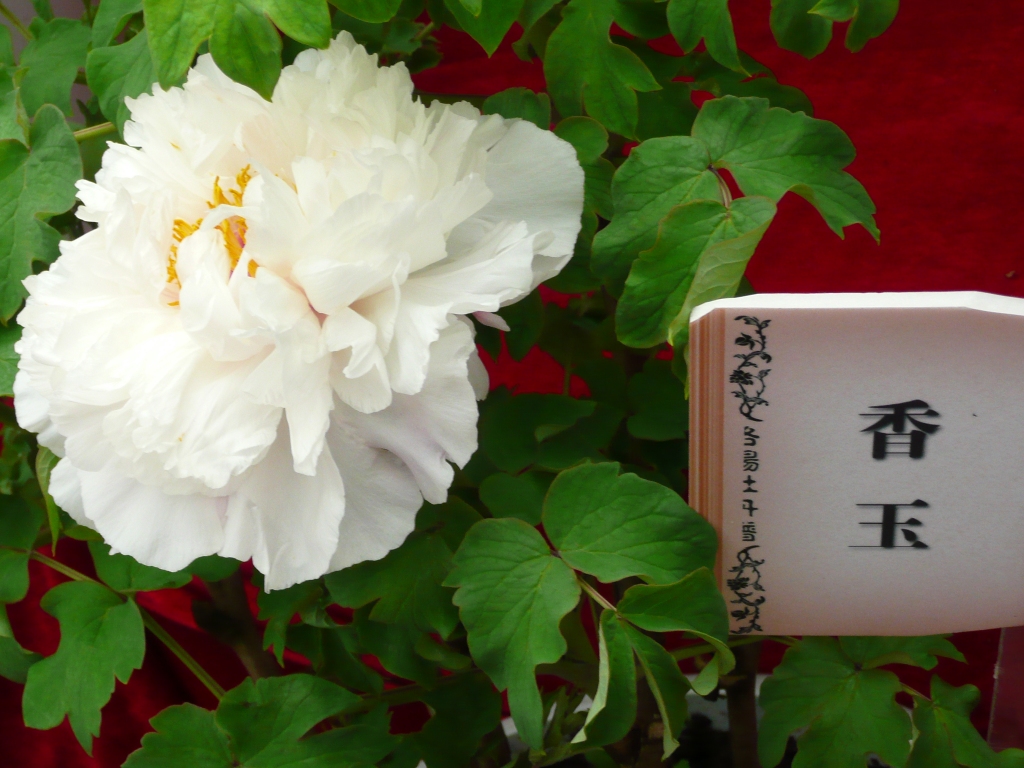
Paeonia x suffructicosa ‘Xiang Yu’, Fragrant Jade

In 1655, English visitors from the East India Company saw peonies in Beijing and sent accounts home. More than a hundred years later, in 1787, Joseph Banks asked the Company’s representative in China, Alexander Duncan, to send plants to Kew. The Kew plants have not survived but a plant from that first introduction was moved from Duncan’s own garden to the Edinburgh Botanical Gardens and can still be seen there.

Further introductions through the late 18th and early 19th century culminated in Robert Fortune’s third expedition, 1848-1851, when he obtained 30 of the best tree peonies available in Shanghai, as well as herbaceous peonies for grafting. The latter half of the 19th century saw hundreds of peony varieties offered for sale by nurseries across Europe. Kelways nursery in the U.K., famous for peonies, dates from this period.

The peony was the national flower of China until 1928, when the government of the Republic of China replaced it with the plum blossom instead, which was a symbol of resilience in hard times, and not as closely associated with China’s imperial past. The People’s Republic of China has no official national flower, though the peony consistently tops polls held to choose one, by a huge margin.

Willows in the Chinese garden

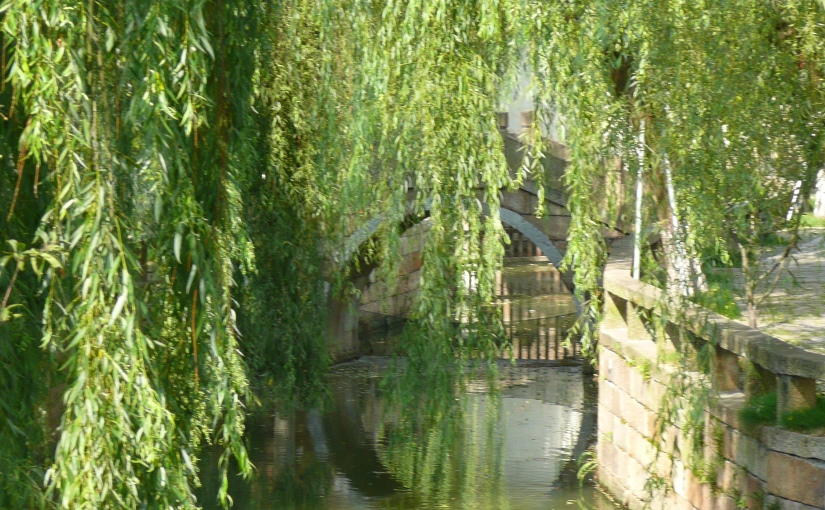
Willows by West Lake, Hangzhou

Willows are one of the plants most closely associated with Chinese gardens. In the West, they are inextricably linked with China through ‘Willow Pattern’ plates – though in fact the pattern originated in England, part of the 18th century craze for Chinoiserie.

Though the ‘Willow Pattern’ itself is inauthentic, willows are truly an essential plant in the Chinese garden.

The weeping willow, Salix babylonica, is native to northern China and probably made its way to Europe along the Silk Road. It was named by Linnaeus, and the specific epithet is due to the fact that, through a mistranslation, it was incorrectly believed to be the tree mentioned in the Bible as growing ‘by the rivers of Babylon’. Many of the weeping willows seen in the U.K. nowadays are hybrids between Salix babylonica and forms of our native willow, Salix alba, which are better suited to our climate.

Willows in Tongli water town, Jiangsu

In Chinese culture, willow has a number of symbolic meanings. It is associated with spring and rebirth. Its pliability suggests meekness and humility. It is associated with friendship, because of its intertwining branches, and also with parting from friends. Traditionally a willow branch was given as a parting gift, because its name in Chinese – 柳 liǔ – sounds like a word for ‘stay’. It was believed to have the power to repel evil spirits, and was used to sweep tombs on the Qingming festival. A branch might be fixed to the front door of a house to ward off harm.

Leifeng pagoda, West Lake, Hangzhou

Willow was also a symbol of female beauty, sometimes compared to the waist of a beautiful woman in poems. Its pliability also suggested frailty, however, and its combined associations with spring, the season of sexual desire, and femininity, meant it was also used as a symbol for prostitution. So the innocent sounding chengyu (Chinese idiom) 花街柳巷 Flower Street and Willow Lane actually means a red light district.

Willows by the pond in the Lingering garden, Suzhou

In the Chinese garden, willows are planted beside water. They are one of the few plants mentioned by name in Ji Chang’s The Craft of Gardens, where he always mentions planting them by water. The rectangular lattice work windows were known as willow leaf pattern.

What is a Chinese garden?

Cloud Capped Peak in the Lingering Garden, Suzhou

It is sometimes said that a Chinese garden is built rather than planted. The essential physical elements are rocks, water, plants, and buildings. Ji Cheng, in the Ming classic The Craft of Gardens (1631) recommended starting a garden with water. In the Chinese garden, as in the landscape, water is yin, the opposite of mountains which are yang. The two opposites in balance embody the harmony of nature.

“For every ten parts of land, three should be made into a pond, of irregular shape so that it is interesting, and preferably made by dredging out an existing stream. Of the remaining seven-tenths, four should be built up with earth – how high or low is of no importance – and be planted with bamboo in a harmonious way.”

(Ji Cheng, The Craft of Gardens)
Artificial mountain with grotto beneath overlooking a pond. Pearl Pagoda Garden, Tongli

Rocks in the garden are often piled up to make an artificial mountain, with a path leading to a pavilion on top. The views from the top are carefully planned. There may be a grotto beneath. Both mountain and grotto echo the abodes of the Daoist Immortals.

‘Bamboo Shoot’ rocks in the Couple’s Retreat Garden, Suzhou

Individual rocks are admired for their aesthetic qualities, and have been for centuries. The most famous of these ‘Scholars’ Rocks’ are called Taihu rocks, limestone features formed by erosion deep in Lake Tai. From the Tang dynasty onwards it became fashionable to use these in gardens. The ‘Cloud Capped Peak’ in the first photo is a famous Taihu rock, said to be a relic from the collection of rocks ordered by Emperor Huizong (reigned 1100-1126 AD) of the Song dynasty.

Rocks may also represent imaginary landscapes, as in this penjing in the Lion Grove Garden, Suzhou:

Buildings are a vital part of the Chinese garden. A large part of The Craft of Gardens enumerates the many types of different structures that can be constructed, as well as discussing in detail elements such as walls, doorways, lattice windows, paving, and bridges.

Doorway in the Couple’s Retreat Garden, Suzhou. This is a visual pun – ‘ping’, the word for vase, sounds like the word for peace.

Many traditional Chinese houses are built around one or more courtyards. With the addition of various pavilions, halls, and of course a library (no scholar’s garden could be without one) the division between inside and outside is often not clearly marked, especially in the warm sub-tropical south of the country. Buildings in the garden are released from the formal Confucian regularity of the main house, and indeed symmetry is to be avoided.

“…buildings in gardens are different from ordinary dwelling-houses, for they must have order in variety and yet their orderliness should not be too rigid: even this orderliness should have a pleasing unpredictability, and yet at their most diverse there should be an underlying consistency.”

(Ji Cheng, The Craft of Gardens)
Building in the Lion Grove Garden, Suzhou

The last element in the Chinese garden is the plants. Although China – described by E.H. Wilson as ‘The Mother of Gardens’ – has huge botanical diversity, Chinese gardens use a fairly restrained palette of plants.

Lotus pond in the Humble Administrator’s Garden, Suzhou

They are mostly chosen for their symbolic value, with meanings acquired over many centuries. Many of these will be dealt with in more detail in later posts. Key Chinese garden plants include bamboo; pines; willows; chrysanthemums; orchids; peonies; plum (Prunus mume, more commonly known in the West as Japanese Apricot); lotus; wisteria; and peach.

Bamboo and rock, framed through a window and against a white wall to create a living painting in the Lingering Garden, Suzhou

A Westerner reading The Craft of Gardens may be surprised by how little mention is made of plants, with very few mentioned by name, and only one snippet of what we might consider gardening advice (on training roses).

Subtropical planting in the Qinghui Garden, Shunde, Guangdong. This southern garden in the Lingnan style boasts over 100 species of plants.

Ji Cheng considered the placing of garden buildings and features, perhaps especially rocks, as more difficult and requiring of a refined taste and a sensitivity to the nature of the site.

“The hidden significance of mountains and forests needs deep study, whereas the temperament of flowers and trees is easy to grasp.”

(Ji Cheng, The Craft of Gardens)

Indeed it is the atmosphere of a Chinese garden, its indefinable essence, that is the most important element of all. A Chinese garden is a microcosm of the world, and a retreat from it. Inspired by nature, it is a work of careful artifice. It is a search for immortality which at the same time reminds us of the passing of the seasons and the transience of life.

It is hard to appreciate all the beauty of the Chinese garden without some understanding of its history and place in an ancient horticultural tradition, its religious and philosophical roots, its inspiration in the Chinese landscape and its links to Chinese artistic culture, especially painting and poetry. These elements will be addressed in later posts.

Ernest ‘Chinese’ Wilson

One of the greatest plant-hunters of the early twentieth century, Ernest Henry ‘Chinese’ Wilson was born in 1876 and began his horticultural career as an apprentice at a local nursery before going on to study at Birmingham Botanical Gardens. In 1899 he was working at Kew when he was chosen to go on a plant-hunting expedition to China for Veitch’s nursery.

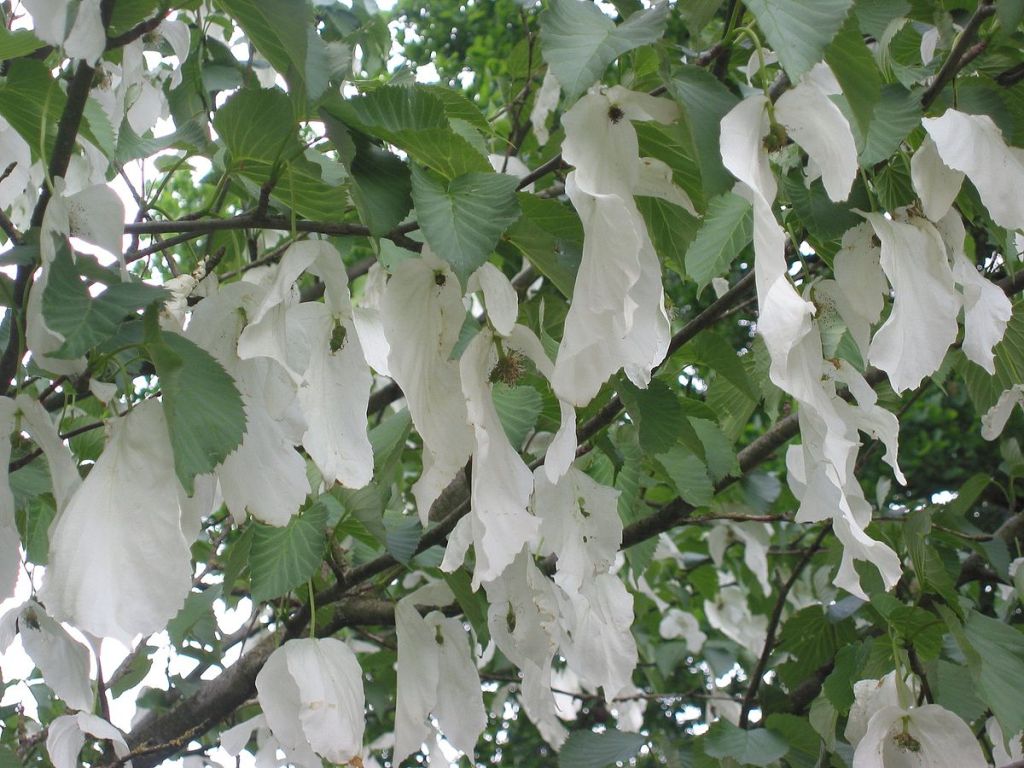
The aim of this first expedition was to find specimens of Davidia involucrata, the handkerchief tree, an almost legendary rarity discovered in 1866 by Pere David Armand. A lone tree in a single location had been seen twelve years previously by Augustine Henry. Harry Veitch, employing a number of plant-hunters at the time, advised Wilson to stick to the one thing he was searching for and not waste time and money wandering about as probably every worthwhile plant in China had already been introduced. Wilson was to prove him spectacularly wrong.

Davidia involucrata

Wilson’s first objective was to reach Henry, then stationed in a remote town in Yunnan. The journey, by river and mule, was arduous and dangerous, complicated by the unstable political situation, plague epidemics, and recent anti-foreign riots. Having met and consulted with Henry, Wilson set out armed with a sketch map marked with a cross representing the single tree Henry had found in the course of a six month trip. Wilson eventually reached the location of the previous sighting after a journey he described euphemistically as “exciting”, only to find that the tree had recently been felled to make way for a new house. Undaunted, he eventually managed to locate a grove of flowering trees in Hubei. In the same month, he made a discovery less celebrated but now probably better known – ‘Wilson’s Chinese Gooseberry’, now known as the kiwi fruit. Making his base at the town of Yichang on the Yangtze river, he spent the next two years exploring and collecting seeds. Despite the danger of plague and outbreaks of rebellion, he collected seed of 305 different species and 35 Wardian cases full of plant material, as well as dried herbarium specimens, representing over 900 species in total.

Wilson’s second trip to China in 1903 was in search of the yellow poppy Meconopsis integrifolia. He was able to hire many of the of the men who had worked with him on his previous expedition. In contrast to some other Western plant-hunters of the time, Wilson respected and got on well with the Chinese people he met and employed. Travelling from Sichuan into Tibet, he secured seed of both Meconopsis integrifolia and the red Meconopsis punicea. He suffered from altitude sickness and other illnesses, cured with “large doses of opium” and had lost almost three stone by the time he reached Songpan in Sichuan. He returned to England in 1905, with the seed of over 500 species and 2400 herbarium specimens, including Lilium regale, the species he was most proud of introducing in his remarkable career.

Wilson’s third expedition to China was undertaken on behalf of the Arnold Arboretum of Harvard University. Their interest was primarily in woody plants, but the expedition was partially funded by subscribers, for whom Wilson was to look for orchids and lilies amongst other things. The Arnold Arboretum also asked Wilson to photograph as much as he could. His photographs, taken on a plate camera, were quite remarkable for the time and are now in the Arboretum’s archive. Some can be seen here:

Surviving famine and a bad bout of malaria, Wilson shipped huge amounts of plant material to the United States in 1908, including thousands of lily bulbs. Unfortunately, almost all of the bulbs rotted in transit.

Lilium regale

It was to collect more lily bulbs in particular that Wilson was reluctantly persuaded to make one last expedition to China, with serious consequences. He always travelled with a sedan chair, though he rarely used it, as it was a kind of badge of respectability that allowed the traveller to pass freely. Wilson considered it better than a passport. For once he was being carried in the chair, on a narrow mountain road, when the expedition was hit by an avalanche. Wilson managed to get out of the chair just before it was carried over the edge, but was hit by falling rock and broke his leg in two places. Fortunately only one of the porters was injured and no one was killed. While the leg was being immobilised with splints improvised from the camera tripod, a mule train came up. Wilson could not be moved and the mule train could neither pass on the narrow track, nor wait in case of further rockfalls, so he lay across the road and the mules stepped over him. After that it was a three days’ forced march back to the nearest medical attention in Chengdu. Infection set in and he came close to losing his leg. After three months he was well enough for the journey back to the States, but the leg never healed properly and he walked with what he called his ‘lily limp’ for the rest of his life.

This was the end of his travels in China. Between 1911 and 1915, he collected specimens in Japan for the Arboretum, including 63 named flowering Cherry forms, and in 1917 he made an expedition to Korea and Taiwan. His wife and daughter joined him on these trips. Wilson named Rosa helenae and the bamboo Fargesia murielae after them.

Ironically, given the dangers and privations he had survived on his collecting trips, Wilson died in a car accident in the States in 1930, three years after becoming Keeper of the Arnold Arboretum.

In total, Wilson introduced about 2000 Asian plant species to the West. Sixty species of Chinese plants are named after him.

Some plants named after Wilson:

Chrysanthemum ‘E H Wilson’, Corydalis wilsonii, Cymbidium wilsonii, Ensete wilsonii, Exochorda giraldii var. wilsonii, Gentiana wilsonii, Hypericum wilsonii, Magnolia wilsonii, Meconopsis wilsonii, Phalaenopsis wilsonii, Picea wilsonii, Primula wilsonii, Styrax wilsonii, Trachelospermum jasminoides ‘Wilsonii’. Sinowilsonia is a monotypic genus which commemorates the nickname ‘Chinese’ Wilson.